
Table of Contents
Context
Amidst the ongoing West Asia conflict in March 2026, global crude oil prices have surged by nearly 30%, directly inflating the cost of LNG and LPG.
What is it?
- Price determination for Liquified Natural Gas (LNG) and Liquified Petroleum Gas (LPG) refers to the global mechanisms and benchmarks used to set the cost of these energy resources.
- Unlike many commodities, these gases do not have a single global price; instead, they are influenced heavily by their relationship with crude oil and specific regional indices.
How Does it work?
- Crude Oil Linkage: Globally, both LNG and LPG prices are generally indexed to or float alongside crude oil prices. When crude oil prices rise, the cost of these gases typically follows.
- Contractual Structures:
- Long-term Contracts: Much of India’s LNG (especially from Qatar) is procured through long-term agreements that provide some price stability.
- Spot Markets: For immediate needs, entities use the spot market, where prices are highly volatile and measured by indices such as the JKM (Japan Korea Marker).
Domestic Production vs. Imports
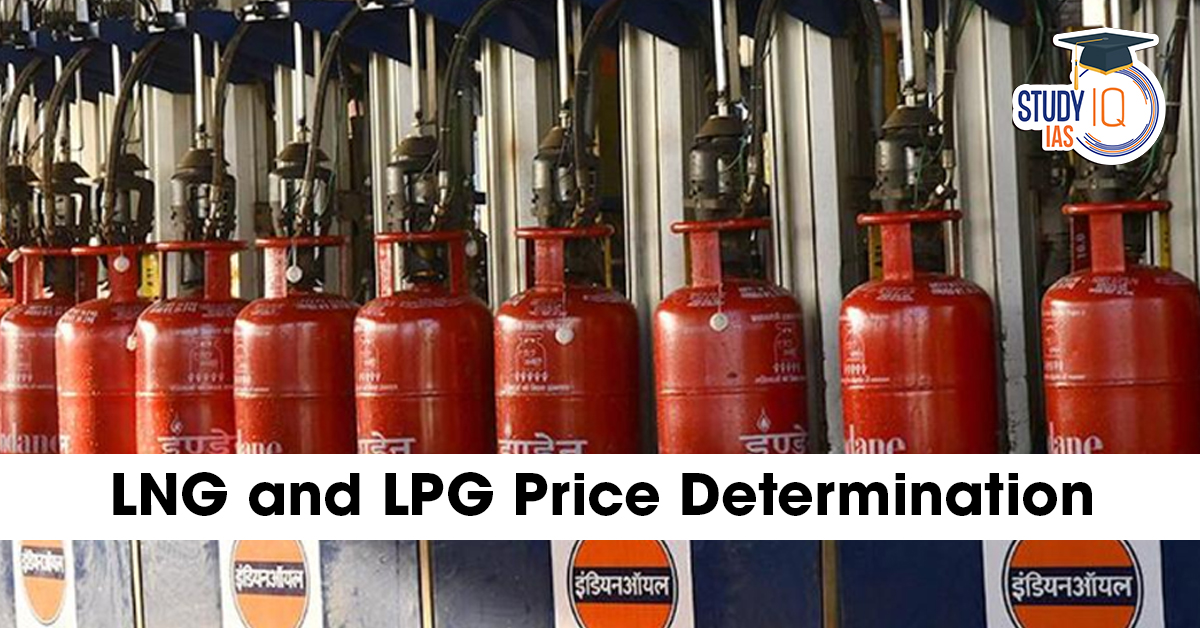
- LPG: 60% of India’s supply is imported, primarily from Saudi Arabia and Qatar. The remaining 40% is produced domestically by Oil Marketing Companies (OMCs) like IOC and BPCL.
- LNG: Half of India’s requirement is produced domestically, while the other half is imported via specialized cryogenic ships.
Factors Affecting Prices
- Geopolitical Stability: Conflicts in West Asia, such as the closure of the Strait of Hormuz, directly hit imports and drive up war premiums on energy.
- Supply Gaps: When major producers like Qatar shut down production, it creates a massive global supply gap, forcing prices higher for all other buyers.
- Transportation and Insurance: Because LNG must be cooled to below –160°C and transported in insulated tanks, rising insurance premiums during wartime significantly increase the final landed cost.
- Storage Capacity: Countries with limited storage, like India, are more vulnerable to immediate price shocks compared to nations with large underground reserves.
Implications for India
- Higher LPG costs threaten the progress of the Pradhan Mantri Ujjwala Yojana, which has expanded coverage to nearly 100% of households.
- A little less than 30% of natural gas is used to make ammonia for fertilizers; price spikes can lead to higher agricultural costs, though current impacts are mitigated by the off-season for farming.
- Natural gas accounts for 13% of power generation and 21% of City Gas Distribution (CGD); high prices force industrial consumers to switch to alternative fuels like naphtha or furnace oil.
|
Read More Notes |
|
| Environment Notes | Art and Culture Notes |
| Science and Tech | History Notes |
| Geography Notes | Indian Polity Notes |
| General Knowledge | International Relation |
|
Explore StudyIQ Courses |
|
 State of the World’s Migratory Species...
 Balancing Innovation with Women’s Digi...
 Essential Commodities Act, 1955 (ECA): O...











 WhatsApp





