
Table of Contents
Context
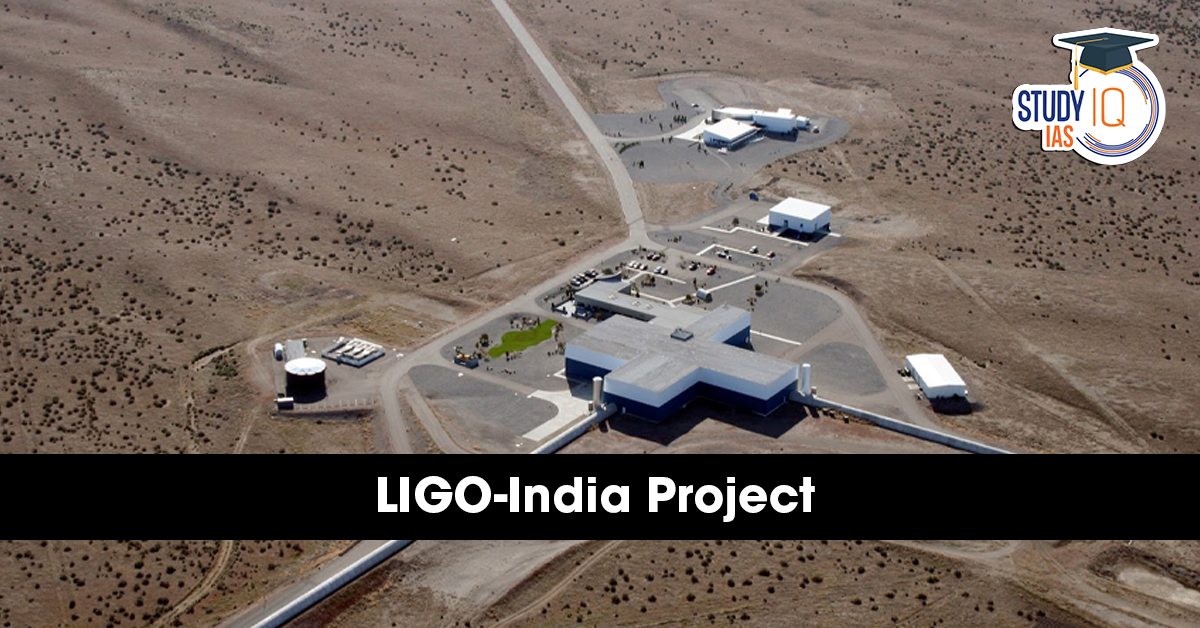
- The LIGO-India project, one of India’s most ambitious scientific initiatives, aims to establish a gravitational-wave observatory in Hingoli district, Maharashtra. Despite receiving government approval in 2023, construction of the ₹1,600-crore Engineering, Procurement and Construction (EPC) contract has not yet begun, as the tender process is still pending nearly a year after it was issued.
|
What is LIGO? |
| ● The Laser Interferometer Gravitational-Wave Observatory (LIGO) is a large-scale scientific instrument designed to detect Gravitational Waves, ripples in spacetime predicted by Albert Einstein in his General Theory of Relativity (1915).
● These waves are produced by extreme cosmic events such as: ○ Black hole mergers ○ Neutron star collisions ○ Supernova explosions ○ The first gravitational waves were detected in 2015 by LIGO detectors in the United States, confirming Einstein’s century-old prediction. How LIGO Detects Gravitational Waves ● Interferometer Design: Each LIGO observatory consists of two 4-kilometre-long arms placed at right angles. These arms form a giant laser interferometer. ● Laser Measurement Technique: Highly stable laser beams travel along both arms and are reflected by mirrors placed at their ends. If a gravitational wave passes through Earth, it slightly stretches one arm while compressing the other. ● Extreme Measurement Precision: The changes measured are extremely tiny—thousands of times smaller than the width of a proton. Advanced sensors and vacuum systems allow the instrument to detect such minute disturbances. Global Network of LIGO Observatories: At present, gravitational-wave detection is carried out by a small network of highly sensitive observatories: ● LIGO Hanford Observatory – Washington, USA ● LIGO Livingston Observatory – Louisiana, USA ● Virgo detector – Italy ● KAGRA – Japan ● Once operational the LIGO-India observatory (expected around 2030), it will become the fifth major gravitational-wave detector in the world and the first in South Asia. Role of LIGO-India ● The Indian observatory will significantly improve the global gravitational-wave detection network by providing better triangulation of signals. With detectors spread across continents, scientists can more accurately determine the location of cosmic events. |
Status of the LIGO-India Project
- Financial Approval and Project Cost: The Indian government approved ₹2,300 crore for the project in 2023, making it one of the country’s largest fundamental science initiatives.
- Tender Delays: The ₹1,600-crore construction tender, issued in April 2025, has experienced multiple deadline extensions and has not yet been awarded.
- Current Progress: According to official responses under the Right to Information (RTI) Act, only the site office has been constructed so far, while the main observatory infrastructure is yet to begin.
- Project Timeline: Despite delays, officials maintain that the facility will be completed by 2030, though timely tender finalisation will be crucial.
|
Read More Notes |
|
| Environment Notes | Art and Culture Notes |
| Science and Tech | History Notes |
| Geography Notes | Indian Polity Notes |
| General Knowledge | International Relation |
|
Explore StudyIQ Courses |
|
 Algorithmic Sovereignty Should Be Indiaâ...
 $100 Oil: Why Supply Security Matters Mo...
 Bridging the Digital Divide: Meaning, Ch...











 WhatsApp





