
Table of Contents
Context
The Department of Atomic Energy (DAE) is prioritising the expedited development of a 900 MWe indigenous LWR, with design work initiated in 2015.
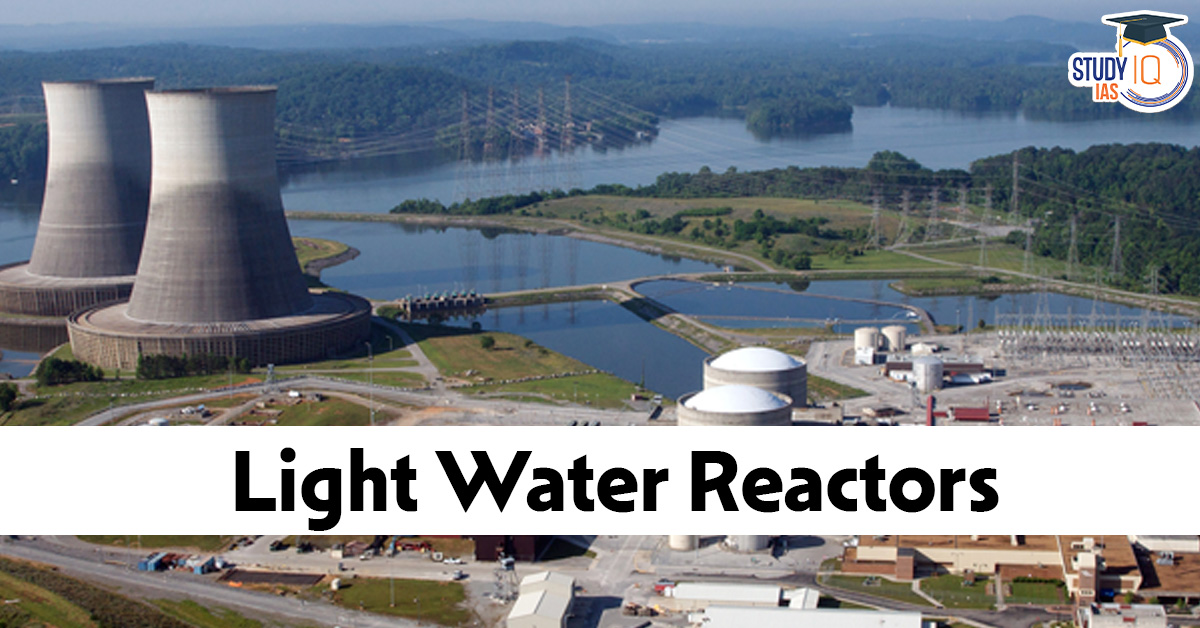
About Light Water Reactors
- The light-water reactor (LWR) is a type of thermal-neutron reactor that uses normal water, as opposed to heavy water, as both its coolant and neutron moderator.
- There are three varieties of light-water reactors: the pressurized water reactor (PWR), the boiling water reactor (BWR), and (most designs of) the supercritical water reactor (SCWR).
Difference Between LWRs and PHWRs
| Aspect | LWRs | PHWRs |
| Moderator | Light water (H₂O) | Heavy water (D₂O) |
| Coolant | Light water | Heavy water |
| Fuel | Enriched uranium | Natural uranium |
| Enrichment Requirement | Required | Not required |
| Global Presence | Dominant worldwide | Limited outside a few countries |
| Construction Cost | Generally lower due to scale | Higher due to heavy water use |
| Fuel Flexibility | Limited | High (thorium, LEU blends possible) |
Why is India pushing for LWRs
-
- Global Dominance: LWRs account for over 85% of global civil nuclear reactor capacity, making them the standard technology in international markets.
- Design and Cost Advantages:
-
- Use normal (light) water as both coolant and moderator.
- Simpler engineering overlaps with conventional thermal power technologies.
- Benefit from economies of scale, resulting in lower construction costs and higher thermal efficiency.
- Export Imperative: An Indian LWR would strengthen India’s bargaining power with foreign vendors and support export ambitions.
Concerns with LWRs
- Cost and Tariffs: Imported LWR projects involve higher capital costs, potentially leading to higher electricity tariffs in the Indian context.
- Indigenous Capability Risk: Excessive reliance on imports could undermine domestic PHWR manufacturing capacity.
- Fuel Access: LWRs require enriched uranium, which is readily available internationally but historically constrained for India.
Significance of India’s Dual-Track Approach
- Integrated Strategic Vision: As India opens its nuclear power sector to private participation and explores reactor exports and small modular reactors (SMRs), it is pursuing a dual-track nuclear strategy that combines LWRs and PHWRs.
- Strengthening India’s Credibility: A diversified reactor portfolio enhances India’s standing as a credible and reliable nuclear supplier, particularly for emerging economies in the Global South seeking affordable and scalable clean energy solutions.
- Advancing Clean Energy Transition and Energy Security: The dual-track approach supports India’s clean energy transition by expanding low-carbon power generation while reducing dependence on fossil fuels and improving long-term energy security.
- Energy diplomacy: Nuclear capabilities increasingly function as a tool of energy diplomacy, complementing India’s outreach through infrastructure development and digital public goods to strengthen strategic partnerships.
| Heavy Water |
|
 Shia Politics in India: History, Influen...
 Future of Chipmaking: Trends, Technologi...
 Nucleic Acid Testing (NAT): Meaning, Wor...











 WhatsApp





