
Table of Contents
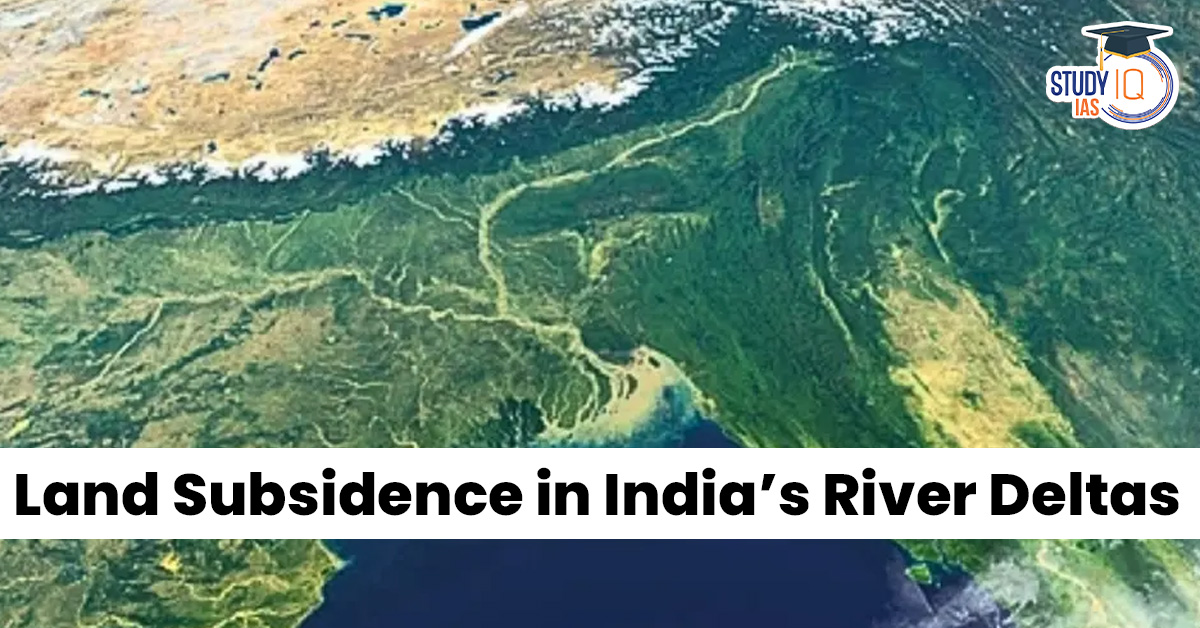
Land subsidence in India’s river deltas has emerged as one of the most serious but under-discussed environmental threats to the country’s coastal and riverine regions. A recent international study published in Nature reveals that major Indian deltas are sinking at alarming rates, in many cases faster than the regional sea-level rise. This dangerous combination is significantly amplifying flood risks, permanent inundation, salinity intrusion, and climate vulnerability for millions of people.
India is home to some of the world’s largest and most densely populated river deltas. These regions support agriculture, fisheries, ports, industries, and megacities like Kolkata. However, the Nature study confirms that human activities have drastically accelerated natural subsidence processes, pushing these fragile ecosystems towards an irreversible crisis.
What is Land Subsidence?
Land subsidence refers to the gradual sinking of the Earth’s surface. In river deltas, some degree of subsidence is natural and occurs due to:
-
Sediment compaction
-
Tectonic movements
-
Isostatic adjustment
However, when human activities disturb groundwater systems, sediment flow, and natural drainage, subsidence accelerates sharply, turning a slow geological process into a fast-moving disaster.
Key Findings of the Nature Study
The study presents a comprehensive assessment of land elevation changes across India’s major river deltas and makes some alarming observations:
-
Active subsidence is confirmed in:
-
Ganges–Brahmaputra
-
Brahmani
-
Mahanadi
-
Godavari
-
Cauvery
-
Kabani
-
-
More than 90% of the area in the:
-
Ganges–Brahmaputra
-
Brahmani
-
Mahanadi deltas
is currently sinking.
-
-
In the Ganges–Brahmaputra, Brahmani, Mahanadi, Godavari, and Kabani deltas, the average subsidence rate exceeds regional sea-level rise, dramatically worsening flood and inundation risks.
-
In the Brahmani and Mahanadi deltas:
-
77% and 69% of their areas respectively are sinking at rates greater than 5 mm per year.
-
-
Kolkata shows subsidence rates equal to or higher than the delta average, driven by:
-
Heavy infrastructure load
-
Intensive groundwater extraction
-
Rapid urban expansion
-
These findings indicate that India’s deltas are not only threatened by rising seas but are also collapsing from within.
Major River Deltas Affected in India
| Delta | Key Concern |
|---|---|
| Ganges–Brahmaputra | Massive groundwater extraction and population pressure |
| Brahmani | Rapid urbanisation |
| Mahanadi | Reduced sediment flow due to upstream dams |
| Godavari | Combined effect of dams and groundwater depletion |
| Cauvery | Severe aquifer stress |
| Kabani | Sediment starvation and hydrological regulation |
Causes of Land Subsidence in India’s River Deltas
1. Unsustainable Groundwater Extraction
This is the most significant driver of accelerated subsidence. Excessive pumping of groundwater creates underground voids, leading to soil compaction and permanent land sinking.
-
Most severe in:
-
Ganges–Brahmaputra delta
-
Cauvery delta
-
2. Rapid Urbanisation
Expanding cities place immense pressure on land and water resources.
-
Construction load compresses underlying soil
-
Paved surfaces prevent groundwater recharge
-
Sewage and drainage alteration destabilise subsurface structures
-
Primary driver in the Brahmani delta
3. Reduced Sediment Supply
River deltas survive by receiving fresh sediment from upstream.
-
Dams and barrages trap sediments
-
River channelisation disrupts natural deposition
-
Particularly impacts:
-
Mahanadi
-
Kabani deltas
-
Without sediment replenishment, deltas sink faster than they can rebuild themselves.
4. Population Pressure
High population density leads to:
-
Greater water demand
-
Increased construction
-
Land reclamation
-
Depletion of natural buffers like wetlands and floodplains
5. Infrastructure Load
Mega infrastructure such as:
-
High-rise buildings
-
Metro systems
-
Industrial complexes
significantly increase downward pressure on soft deltaic soils, especially in cities like Kolkata.
Why Subsidence is More Dangerous Than Sea-Level Rise Alone
When land subsidence combines with sea-level rise, the effect is not additive—it is exponential.
This leads to:
-
More frequent flooding
-
Longer water stagnation
-
Permanent loss of land
-
Salinity intrusion into freshwater aquifers
-
Collapse of agriculture and fisheries
In simple terms:
Rising seas push water upward; sinking land pulls people downward.
Impact on Human Settlements and Economy
-
Increased disaster frequency and intensity
-
Massive displacement and climate refugees
-
Infrastructure damage
-
Food insecurity due to soil salinity
-
Threat to ports, industries, and coastal trade
-
Rising adaptation and rehabilitation costs
Deltas that once acted as economic engines are turning into climate hotspots.
Kolkata: A Case Study of Urban-Induced Subsidence
Kolkata represents how urbanisation magnifies delta vulnerability:
-
Heavy buildings on soft sediments
-
Chronic groundwater withdrawal
-
Limited aquifer recharge
-
High population density
The city’s subsidence rate now rivals or exceeds the delta average, putting millions at risk of chronic flooding and waterlogging.
Human vs Natural Factors
| Natural Processes | Human-Driven Acceleration |
|---|---|
| Sediment compaction | Groundwater over-extraction |
| Tectonic adjustments | Dam construction |
| Geological settling | Urban sprawl |
| Loss of wetlands and floodplains |
Human actions have transformed a slow geological process into an immediate environmental crisis.
| Read More: Links |
|
| Environment Notes | Art and Culture Notes |
| Science and Tech | History Notes |
| Geography Notes | Indian Polity Notes |
| General Knowledge | International Relation |
Way Forward: Sustainable Solutions
-
Groundwater Regulation
-
Strict extraction limits
-
Recharge zones
-
Rainwater harvesting
-
-
Sediment Management
-
Sediment bypass systems in dams
-
Controlled flooding for delta nourishment
-
-
Delta-Sensitive Urban Planning
-
Low-impact construction
-
Restrict high-load infrastructure
-
Preservation of wetlands
-
-
Satellite Monitoring
-
Continuous mapping of subsidence
-
Early warning systems
-
-
Integrated Coastal Zone Management
-
Combine subsidence data with climate models
-
Include delta vulnerability in CRZ regulations
-
Conclusion
The Nature study on land subsidence in India’s river deltas sends a clear warning: India’s coastal future is being reshaped not only by climate change but also by unsustainable development practices. If present trends continue, large parts of the country’s delta regions could become uninhabitable within decades.
India’s deltas are sinking faster than the seas are rising.
This makes land subsidence not just a geological concern, but a national disaster management and development priority.
|
Explore StudyIQ Courses |
|
 The Great Nicobar Island Development Pro...
 Constitutional Tort Explained: Hate Spee...
 National Legislative Index: Measuring Pa...
















 WhatsApp





