
Table of Contents
Context
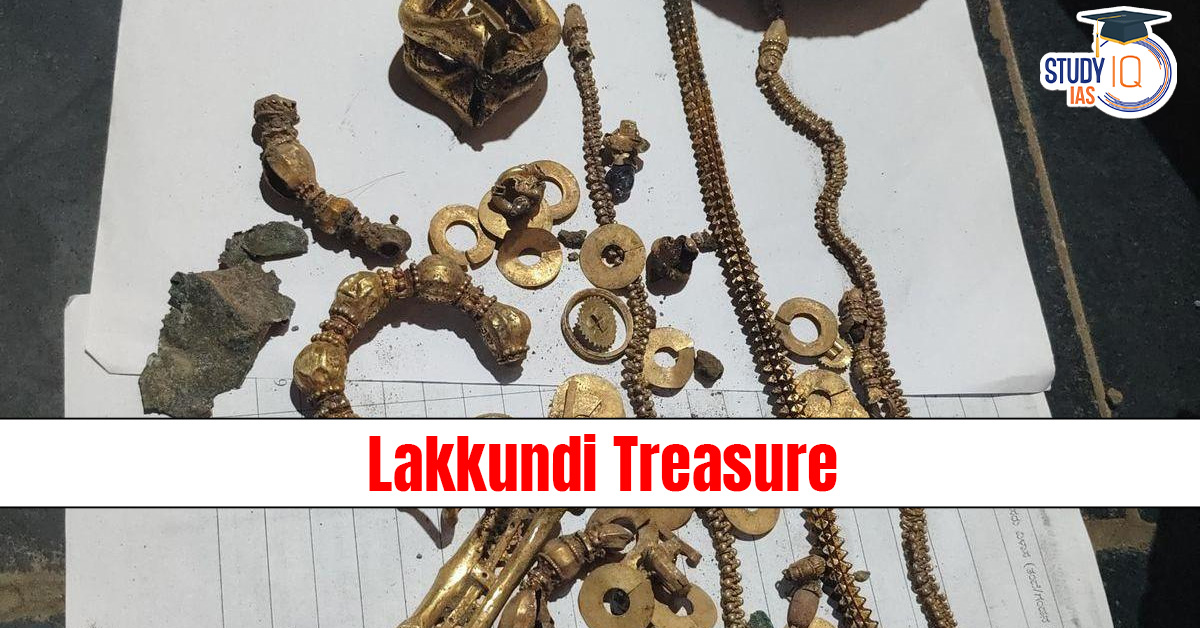
A significant cache of 500–600-year-old gold ornaments, believed to belong to the Vijayanagara Empire, was recently discovered during a house excavation in Lakkundi, Gadag district, Karnataka
Lakkundi Treasure: Key Details
- Estimated Age: 500–600 years old (14th–16th Century).
- Composition: Approximately 466 grams of gold, featuring precious stones like pearls, emeralds, and blue sapphires.
- Storage: Found inside a traditional copper container called a charige or tambige.
- Purpose: Archeologists suggest these were not for public use but were likely offerings made to a female deity, given the specific iconography.
- Iconography: The treasure exhibits distinct motifs that help date it to the Vijayanagara era:
- Lion Faces: A common symbol of power and protection in temple architecture and jewelry.
- Kirtimukha (Face of Glory): A swallow-like ornamental mask often used in the crowning of temple arches or as a motif in sacred jewelry to ward off evil.
About Lakkundi
- Lakkundi, known in ancient inscriptions as Lokkigundi, was a prominent city of the Kalyani Chalukyas (Western Chalukyas) and later served as a strategic center for the Kalyani Chalukyas (Western Chalukyas), Rashtrakutas, Hoysalas, Kalachuris and Vijayanagara Empire
- The Minting Hub: During the 12th century (Kalyani Chalukya era), Lakkundi was a premier central mint. Inscriptions from 1185 AD mention specialized gold coins minted here. Medieval Coins:Lokki-gadyana, Lokkiya-pon, and Pon-gadanya.
- The Legend of 101: Local lore and inscriptions describe the city as having 101 temples and 101 step-wells (Kalyanis), many of which are currently being unearthed from beneath modern residential structures.
- Architecture
- The architecture at Lakkundi represents a “transitional” phase between the early Chalukyan style and the later, more ornate Hoysala style.
- Brahma Jinalaya: Built by the legendary patroness Attimabbe (known as Danachintamani). It is one of the earliest examples of temples in the region made from fine-textured chloritic schist (steatite/soapstone) rather than sandstone.
- Kasivisvesvara Temple: Famous for its highly decorative carvings and twin-shrine (Dvikuta) structure.
- Step-wells (Kalyanis): Notable for their artistic man-made tanks, specifically the Musukina Bavi, which features a unique tiered structure.
|
Read More Notes |
|
| Environment Notes | Art and Culture Notes |
| Science and Tech | History Notes |
| Geography Notes | Indian Polity Notes |
| General Knowledge | International Relation |
|
Explore StudyIQ Courses |
|
 IEA Agrees to Release 400 Million Barrel...
 Black Rain Crisis in Iran: Causes, Envir...
 Anna Mani: Pioneer of Indian Meteorology...











 WhatsApp





