
Table of Contents
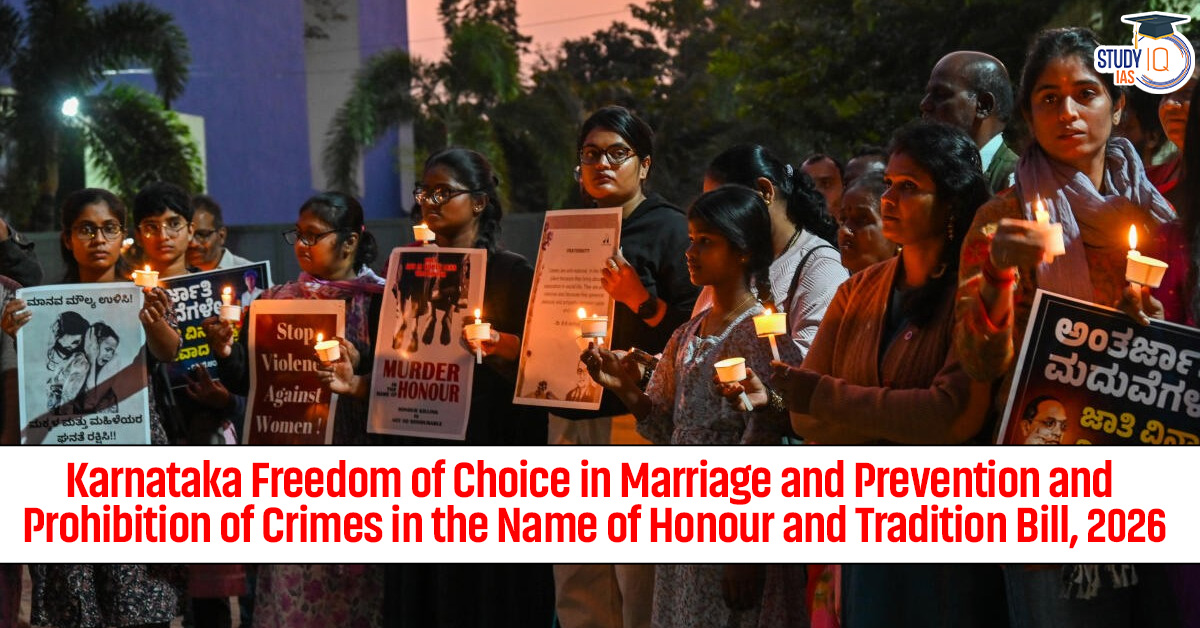
Crimes perpetrated in the name of “honour” exemplify one of the most enduring and violent forms of social control in India, deeply entrenched in caste, patriarchy, and communal traditions. Notwithstanding constitutional assurances of equality, liberty, and personal liberty, individuals- particularly women and members of marginalised communities- persistently encounter severe violence for exercising their matrimonial choices. The Karnataka government has formulated the Karnataka Freedom of Choice in Marriage and Prevention and Prohibition of Crimes in the Name of Honour and Tradition Bill, 2026, in reaction to the increasing occurrences of honour killings and associated crimes. This proposed legislation aims to penalise honour-based violence while simultaneously safeguarding the constitutional freedom of people to select their life partners free from compulsion, violence, or social ostracism.
The Bill arises in response to a particularly heinous event near Hubballi, where a pregnant woman in her early twenties was reportedly slain by her family for engaging in an inter-caste marriage. The act incited widespread public indignation and revitalised demands for a thorough legislative framework to combat honour crimes. The proposed legislation signifies a significant effort to transcend disjointed criminal statutes and confront honour crimes as a unique and systemic type of violence.
Context: Honour Crimes and the Necessity for Specialised Law in India
Honour crimes denote acts of violence, including murder, assault, coercion, and social ostracism, perpetrated by family or community members to penalise individuals deemed to have brought “dishonour” through actions such as inter-caste or inter-religious marriage, relationships outside established norms, or defiance of traditional gender roles. Although such acts are subject to punishment under general criminal law, India has traditionally been devoid of a special statute that identifies honour crimes as a separate type of offence.
The prevalence of honour crimes is intricately connected to the framework of caste endogamy, which Dr. B.R. Ambedkar saw as a fundamental mechanism for sustaining caste hierarchy. Inter-caste marriages confront these frameworks and are consequently frequently faced with significant opposition. A 2024 report by the People’s Union for Civil Liberties (PUCL) indicates that Karnataka experienced a minimum of 13 honour-related attacks from January 2022 to December 2023, leading to 12 fatalities. These estimates are generally considered to be underestimated.
Judicial interventions, notably the Supreme Court ruling in Shakti Vahini v. Union of India (2018), have denounced honour killings as “barbaric and shameful,” instructing governments to implement preventive and corrective measures. The lack of a complete statutory framework has constrained the efficacy of these directives. The Karnataka Bill aims to establish a comprehensive legislative framework for prevention, punishment, protection, and rehabilitation.
Objectives and Philosophical Foundations of the Bill
The legislation is officially designated as the Karnataka Freedom of Choice in Marriage and Prevention and Prohibition of Crimes in the Name of Honour and Tradition Bill, 2026. It is also known as “Iva Nammava, Iva Nammava,” a term derived from a 12th-century Kannada Vachana by social reformer Basavanna, signifying “He is ours; He is ours.” This term represents universal brotherhood, social inclusion, and the repudiation of caste-based discrimination.
The Bill specifically confirms the applicability of fundamental rights under Articles 14 (equality), 19 (freedoms), and 21 (life and personal liberty) of the Constitution, along with rights under the Protection of Human Rights Act, 1993, to decisions concerning marriage and partner selection. It acknowledges that escalating violence, threats, harassment, and social ostracism, frequently rationalised in the name of honour, represent a blatant violation of constitutional morality.
Freedom of Choice in Marriage
A fundamental aspect of the Bill is the clear acknowledgement of adult autonomy about marriage. It asserts that all adults possess the right to marry an individual of their choosing without necessitating the approval of family, caste, clan, or society. An “inter-caste marriage” is characterised as a relationship of persons from distinct castes or sub-castes.
Marriage is comprehensively defined to encompass unions formalised under any legal framework, as well as those that are planned or intended. A “person” is defined as a woman aged 18 years or older and a male aged 21 years or older, in accordance with current legal requirements.
The Bill permits couples planning an inter-caste marriage to submit an oral or written declaration of their age and consent before the District Magistrate or an appointed nodal authority. This statement is sent to the nearest police station, and no measures may be undertaken against the couple at the behest of family members or third parties. The declaration is not a prerequisite for the exercise of the right to marry, therefore preventing bureaucratic interference in personal freedom.
Prohibition and Definition of Honour Crimes
The Bill establishes a comprehensive and precise definition of “honour crimes,” forbidding actions undertaken in the name of caste, culture, custom, tradition, or honour. These encompass causing death, grievous or minor injury; harassment to obstruct association; abduction; unlawful confinement; social and economic ostracism; eviction or excommunication; threats and intimidation; coerced rituals such as designating partners as “brother and sister”; conducting death ceremonies (thithi) for living individuals; interference with property rights; confiscation of communication devices; freezing of bank accounts; loss of employment; defamation; incitement of hatred; sexual violence; coerced abortion or miscarriage; and forced marriage or dissolution of marriage.
The Bill offers a comprehensive definition of social and economic boycott, encompassing activities like restricting access to markets, places of worship, public facilities, education, employment, credit, and customary services.
Crimes and Sanctions
Alongside penalties stipulated by the Bharatiya Nyaya Sanhita (BNS), the Bill mandates severe sanctions. Honour killing is subject to a minimum sentence of five years’ imprisonment. Inflicting severe injury results in a minimum of ten years of rigorous imprisonment, perhaps extending to life, accompanied by a fine of up to ₹3 lakh. Simple hurt is subject to imprisonment for a duration of three to five years and a monetary penalty of up to ₹2 lakh.
Other honour crimes result in imprisonment ranging from two to five years and a fine of up to ₹1 lakh. Criminal intimidation is subject to a penalty of three to five years’ imprisonment, which may be extended to seven years for serious threats. Engagement in illegal assemblies is subject to incarceration for a duration of six months to five years. All offenses under the Bill are cognizable and non-bailable, indicating the gravity with which honour crimes are regarded.
Sexual Intercourse on False Promise of Marriage in Inter-Caste Cases
A notably important aspect is the establishment of an enhanced offence for sexual intercourse procured by a fraudulent promise of marriage in inter-caste situations. If a promise of marriage is retracted based on caste factors, consent is considered to have been acquired through deception. When prima facie evidence suggests that caste-based hatred is the underlying cause, a rebuttable presumption emerges that the promise was inherently untrue. The onus is on the accused to prove their good faith.
The penalty for this offence varies from a minimum of five years of rigorous imprisonment to life imprisonment, accompanied by a fine. The rule pertains exclusively to premarital, voluntary sexual intercourse predicated entirely on the promise of marriage and excludes genuine breaches resulting from circumstances beyond one’s control.
Institutional Mechanisms: Judiciary, Safeguarding, and Reintegration
The Bill authorizes the state government, in collaboration with the High Court, to establish special fast-track courts for the adjudication of honour crimes. It offers comprehensive safeguards for victims, dependents, and witnesses, encompassing police protection within six hours of threat reporting, confidentiality for witnesses, non-disclosure orders, and regular judicial assessments of protective measures.
The State is required to create shelter homes and safe houses in each district headquarters, guaranteeing security, privacy, and access to legal assistance and NGOs. Victims possess the right to express their perspectives at every phase of criminal proceedings, encompassing bail, parole, and punishment.
Responsibilities of Public Officials and Preventive Strategies
Public personnel are mandated by law to document complaints, file FIRs, conclude investigations within 60 days, and refrain from any actions that infringe upon or diminish rights under the Act. The Bill specifically forbids public personnel from directly or indirectly obstructing the enjoyment of fundamental rights.
Preventive tactics encompass prohibitory orders against illegal assembly, dissemination of these orders in local publications, and proactive engagement by District Magistrates and law enforcement when dangers are foreseen.
Judiciary’s Function and Recent Advancements
The judiciary has consistently upheld the supremacy of individual freedom in marriage, particularly in Lata Singh v. State of UP (2006) and Shafin Jahan v. Asokan K.M. (2018). The Karnataka Bill elaborates on this jurisprudence by converting judicial ideas into enforceable legislative rights. Courts are responsible for guaranteeing expeditious trials, implementing protective orders, and maintaining constitutional principles against social majoritarianism.
Comparative and International Perspectives
Honour crimes are internationally acknowledged as infringements of human rights, especially under frameworks like the Convention on the Elimination of All Forms of Discrimination Against Women (CEDAW). Countries such as the United Kingdom have implemented special offences and protection measures targeting honour-based violence. The Karnataka Bill harmonises Indian law with global standards by acknowledging honour crimes as systematic and emphasising victim protection and autonomy.
Conclusion
The Karnataka Freedom of Choice in Marriage and Prevention and Prohibition of Crimes in the Name of Honour and Tradition Bill, 2026 is a crucial advancement in addressing one of India’s most deep-rooted kinds of social violence. By prioritising constitutional morality, human autonomy, and substantive equality, the Bill transcends mere symbolic denunciation to establish a comprehensive legal framework for prevention, punishment, and protection. Although its implementation may pose challenges, the Bill establishes a significant precedent for other states and indicates a definitive transition towards protecting freedom of choice from the oppression of custom and honour.
 Trial by Social Media: Public Shaming, D...
 Governors’ Address to State Legislatur...
 Mandating Prior Approval for Corruption ...










 WhatsApp





