
Table of Contents
Context
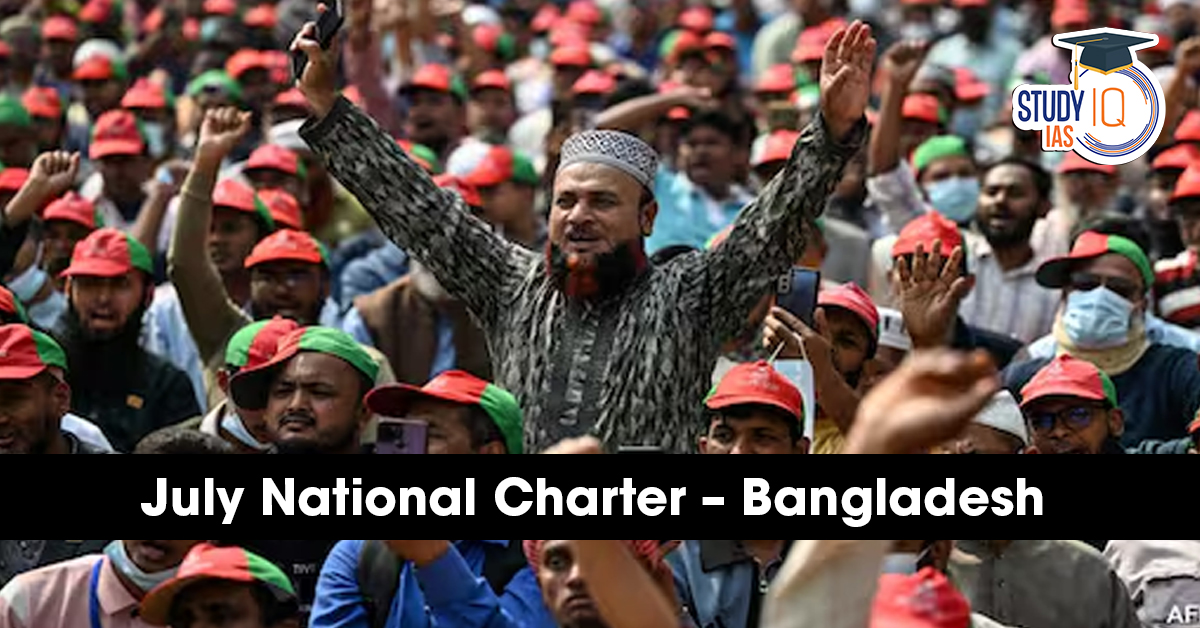
Recently Bangladeshi endorsed the July National Charter in a nationwide referendum.
Background to the July Charter
The July National Charter emerged during a period of deep political transition in Bangladesh, following:
- The banning of the Awami League.
- The exile of Sheikh Hasina to India.
- An interim phase associated with Muhammad Yunus, marked by institutional uncertainty and public mobilisation.
This period saw strong student-led protests and civil society activism, demanding:
- Limits on executive dominance,
- Restoration of institutional balance,
- Electoral transparency,
- And protection of democratic norms.
Against this backdrop, the July National Charter was introduced as a constitutional reform framework aimed at resetting governance structures, strengthening institutional checks, and preventing future authoritarian drift.
|
What the July Charter Contains |
| ● Two-Term Limit for Prime Ministers: It proposes a strict two-term limit for Prime Ministers.
● Strengthening Judicial Independence: Greater autonomy in judicial appointments and administration is meant to reinforce the rule of law and restore public confidence in courts. ● Introduction of a Bicameral Legislature: It proposes moving from a single-chamber Parliament to a bicameral system. ● Greater Representation for Women and Youth: The Charter encourages stronger political participation of women and young citizens. ● Institutional Checks and Accountability: This includes enhancing the role of constitutional institutions in monitoring executive actions. ● Electoral Process Reforms: While details are evolving, reforms seek to ensure fairer elections, transparency, and stronger monitoring mechanisms to prevent manipulation or intimidation.
|
 West Bengal Elections 2026: Full Schedul...
 ISRO Launches Mission MITRA in Ladakh: A...
 Disaster Management in India, Classifica...













 WhatsApp





