
Table of Contents
Judicial Concerns in Vanashakti v. Union of India: Judicial Scrutiny, Doctrinal Tensions, and the Future of Environmental Governance
Context: Environmental governance in India has developed through an intricate interaction of legislative frameworks, executive initiatives, and judicial interventions. A prominent modern question in this field is the legality and appropriateness of post-facto environmental clearance- a process permitting projects to secure permission after initiating operations without previous authorisation. The recent concerns expressed by the Supreme Court of India in Vanashakti v. Union of India indicate significant unease about the environmental and regulatory implications of such a system.
The Court’s remarks underscore a significant conflict between regulatory enforcement and administrative adaptability. The subject matter prompts broader questions regarding environmental rule of law, compliance incentives, and the equilibrium between development and sustainability.

Background and Judicial Remarks
The issue was presented to a panel comprising Chief Justice Surya Kant, Justice Joymalya Bagchi, and Justice Vipul Pancholi. The Court was adjudicating writ petitions contesting the constitutionality of post-facto environmental clearances, including those facilitated by an Office Memorandum (OM) issued by the Union Government.
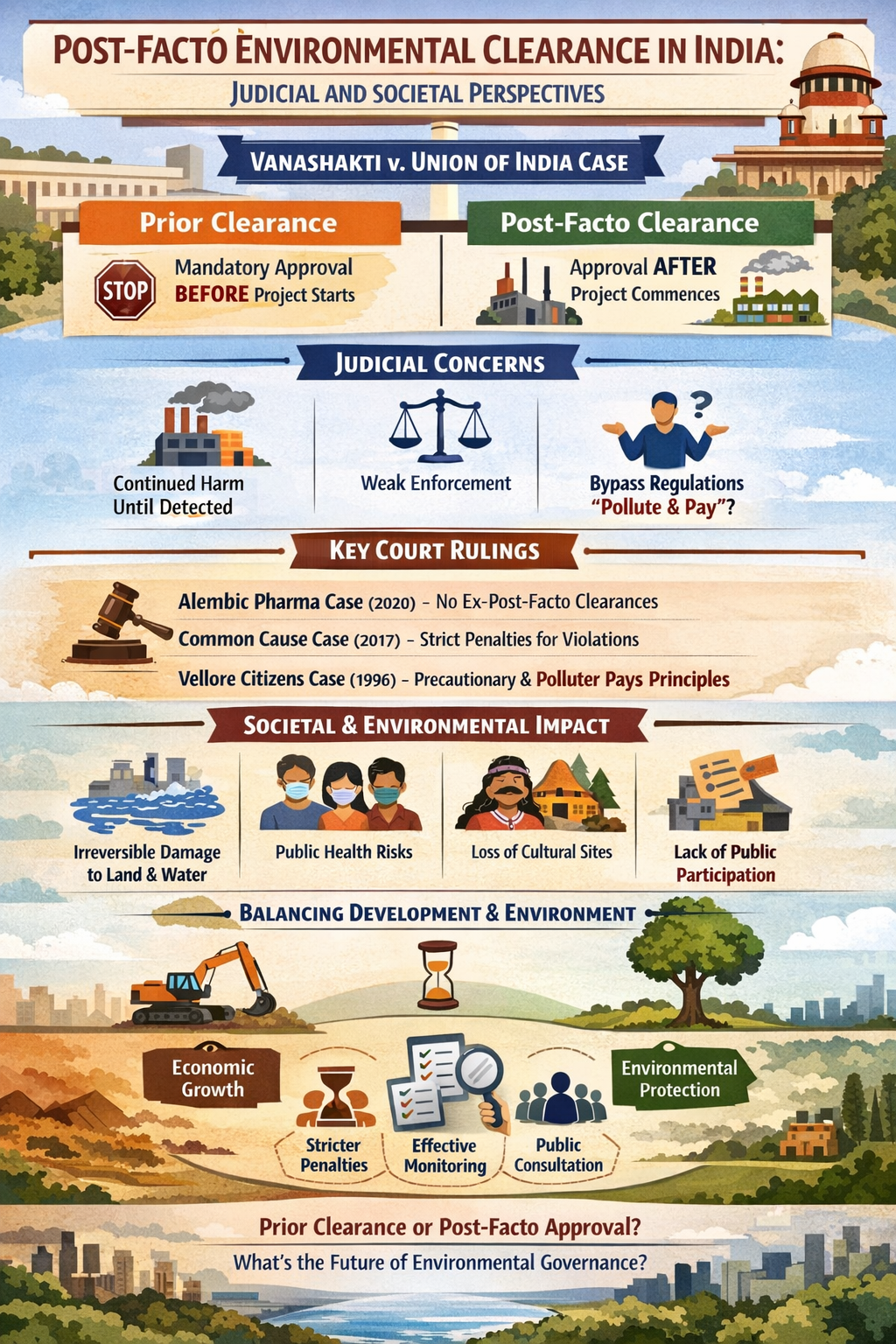
Justice Bagchi articulated a primary concern: enabling post-facto clearance may enable environmentally detrimental developments to persist until state authorities take action. He compared two regulatory methodologies:
Mandatory previous approval system: Any activity without previous environmental approval must cease immediately.
Post-Facto Clearance System (OM Framework): Activities may persist until identified and addressed by authorities.
He noted that regulations are frequently not enforced consistently, rendering the “cleansing effect“ of post-facto rules potentially deceptive. The Court underscored that if previous clearance is deemed non-negotiable, enforcement transitions to being automated and preventive instead of reactive.
The Court emphatically dismissed the idea that governments may claim ignorance of environmental clearance obligations, therefore strengthening responsibility at both the national and state levels.
Arguments Submitted to the Court
Stance of the Union Government
Additional Solicitor General Aishwarya Bhati contended that the contested Office Memorandum does not legitimise illegalities but rather submits non-compliant developments to examination. As per the Union:
- Prohibited activities must be terminated.
- Environmental sanctions are levied against offenders.
- Eligible projects may obtain preliminary approval accompanied by remediation responsibilities.
The government argued that the framework serves as a deterrent rather than a permissive measure, as post-facto compliance is more burdensome than preemptive compliance. It also conveyed a readiness to implement safeguards.
Chief Justice Surya Kant proposed that such a framework may potentially enhance environmental jurisprudence by subjecting unregulated projects to examination.
Arguments of the Petitioners
Advocate Srishti Agnihotri, representing the NGO One Life, One Earth, vehemently opposed ex post facto clearance. Her arguments highlighted structural and constitutional issues:
- The Environmental Impact Assessment (EIA) framework is fundamentally preventive rather than remedial.
- Permitting post-facto approvals encourages a “forgiveness over permission” mentality.
- Environmental damage, once inflicted, is frequently irreparable, particularly in instances of land and water pollution.
- Post-facto clearance precludes public engagement, a fundamental aspect of environmental decision-making.
She emphasised that even governmental initiatives have circumvented previous clearance mandates, thus compromising regulatory legitimacy.
The Notion of Post-Facto Environmental Clearance
Post-facto environmental clearance denotes the authorisation of projects that have initiated operations without securing prior environmental clearance (EC), as required by environmental legislation.
Principal Attributes
- Applied retrospectively to ongoing or completed projects.
- Entails environmental evaluation after the occurrence of damage.
- Generally encompasses sanctions, corrective actions, and provisional authorisation.
Regulatory Framework
The practice has arisen through executive instruments like Office Memoranda instead of clear statutory provisions. This has elicited apprehensions regarding:
Legality: The extent to which executive orders can supersede legislative requirements.
Accountability: The adequacy of deterrence for violators.
Environmental Integrity: The efficacy of retrospective assessments in meaningfully mitigating harm.
Regulatory Framework for Environmental Clearance in India
Environment (Protection) Act, 1986
The principal legislation regulating environmental protection in India is the Environment Protection Act of 1986. Established in response to the Bhopal Gas Tragedy, the Act authorises the central government to implement measures for environmental protection.
Principal attributes comprise:
- Extensive regulatory authority.
- Regulatory authority over industrial operations.
- Authority to make notices, encompassing the EIA framework.
- Notification on Environmental Impact Assessment (EIA), 2006
The EIA Notification 2006 is fundamental to the regulation of environmental clearance.

Goals
- Evaluate environmental impacts before project authorisation.
- Guarantee sustainable development.
- Enable educated decision-making.
Essential Elements
Screening: Assessing the necessity for a comprehensive evaluation of a project.
Scoping: Recognising pertinent environmental issues.
Public Consultation: Engaging impacted communities.
Assessment: Evaluation by Expert Appraisal Committees.
Approval or Denial of Clearance
The notification requires prior environmental approval as a prerequisite for project initiation.
Preventive versus Curative Environmental Governance
A fundamental concern in the discourse is whether environmental regulation ought to be:
- Preventive (pre-authorisation), or
- Remedial (retrospective authorisation)
The EIA framework functions as a proactive measure, guaranteeing that environmental dangers are evaluated prior to any damage occurring. The post-facto clearance transitions the methodology to a remedial model, which is fundamentally constrained due to:
- Environmental degradation may be irreversible.
- Remediation may not completely reinstate ecological equilibrium.
- Social repercussions (e.g., displacement, cultural erosion) are irreversible.
Foundational Doctrines
The resistance to post-facto clearing is grounded in recognised environmental principles:
Precautionary Principle: Demands proactive measures in response to environmental unpredictability.
Principle of Polluter Pays: Requires that polluters assume responsibility for environmental degradation costs. Critics contend that post-facto clearance diminishes the approach to a “pollute and pay” strategy.
Sustainable Development: Harmonises economic development with ecological preservation. Preliminary approval is crucial for assessing sustainability prior to project implementation.
Doctrine of Public Trust: Designates the state as a steward of natural resources, accountable for their preservation for public benefit.
Emerging Issues Identified by the Court
The Supreme Court’s remarks highlight numerous systemic issues:
Prolonged Enforcement: Detrimental projects may function unregulated until identified.
Regulatory Arbitrage: Project proponents may intentionally circumvent earlier approval.
Disparate Enforcement: Legislation is present but applied inconsistently.
Institutional Accountability: Governments have breached clearance regulations.
The Judiciary’s Function in Environmental Governance
The Indian judiciary, especially the Supreme Court of India, has significantly influenced the development of environmental jurisprudence. The Court has integrated environmental preservation within the framework of fundamental rights by a broad interpretation of constitutional provisions, particularly Article 21 (Right to Life).
Judicial intervention has been essential in:
- Ensuring adherence to environmental regulations
- Broadening the parameters of environmental rights
- Confronting bureaucratic inertia
- Progressing tenets such as sustainable development and intergenerational justice
The Court’s examination of retrospective environmental clearance demonstrates its ongoing dedication to proactive environmental stewardship.
Significant Judicial Precedents Regarding Environmental Clearance
Alembic Pharmaceuticals Ltd v. Rohit Prajapati
This case is significant to the discourse on ex post facto environmental approval. The Supreme Court unequivocally determined that:
- Environmental approval is required before initiating any project.
- Ex-post-facto clearance contravenes the foundational principles of environmental jurisprudence.
- The Court underscored that permitting retrospective approvals would encourage infractions and undermine regulatory frameworks.
Common Cause v. Union of India
The Court levied substantial fines and mandated restitution for ecological harm in this case concerning illicit mining activities. It strengthened:
- The Principle of Polluter Pays
- Absolute accountability for ecological damage
- The significance of regulatory adherence
The ruling emphasised that economic advantages cannot excuse environmental transgressions.
Vellore Citizens Welfare Forum v. Union of India
This landmark ruling in Indian environmental law officially acknowledged:
- The Precautionary Principle
- The Principle of Polluter Pays
The Court determined that environmental regulations should proactively foresee and avoid damage rather than solely address it post-factum.
Indian Council for Environmental Legal Action v. Union of India
This judgment established severe accountability for industries responsible for environmental damage and underscored that restoration must be conducted at the expense of the polluter.
Contemporary Judicial Trends and Developments
The ongoing case of Vanashakti v. Union of India demonstrates a persistent court scepticism regarding post-facto clearance systems. Significantly:
- The Court enquired if the Office Memorandum (OM) framework permits ongoing illegality until it is identified.
- It underscored that consistent enforcement is crucial for the efficacy of environmental legislation.
- The court emphasised that prior approval must be mandatory, strengthening the preventive framework.
- The Court recognised the assertion that post-facto methods may enhance regulatory monitoring, but it maintained a prudent stance about their practical consequences.

Societal Implications of Post-Facto Environmental Approval
Deterioration of Public Engagement
The EIA framework requires public engagement, allowing impacted populations to express their concerns. Subsequent authorisation:
- Precludes significant involvement
- Subverts democratic decision-making
- Marginalises at-risk populations, particularly indigenous communities
The current case underscores that environmental issues frequently pertain to culturally sensitive regions, necessitating prior engagement.
Public Health Issues
Projects functioning without prior authorisation may:
- Discharge contaminants into the atmosphere and aquatic systems
- Induce chronic health complications
- Disproportionately impacts marginalised communities
Once damage occurs, mitigation measures may prove inadequate to restore public health.
Governance and Legal Framework
Permitting retrospective approvals may undermine regulatory rigour by:
- Promoting intentional non-compliance
- Establishing an impression of regulatory permissiveness
- Eroding confidence in institutions
The assertion that government projects have evaded clearance requirements underscores systemic enforcement issues.
Ecological Consequences and Irreversibility
- Unauthorised initiatives frequently result in irreversible environmental damage.
- Water pollution is impacting ecosystems and human consumption
- Soil degradation diminishes agricultural productivity.
- Decline in biodiversity
- Devastation of cultural and biological heritage sites
As previously contended before the Court, once a project is operational, reversing it is frequently unfeasible. This underscores the need to do earlier environmental assessments.
Challenges in Policy and Administrative Realities
Notwithstanding the legal requirement for prior authorisation, numerous obstacles endure:
- Deficiencies in Enforcement
- Authorities may be deficient in resources or capability to monitor compliance effectively.
- Delays in the Clearance Procedure
- Prolonged approval processes may encourage project proponents to circumvent rules.
Economic Challenges: Developmental priorities can clash with environmental considerations.
Executive Overreach: The utilisation of Office Memoranda for post-facto clearance raises apprehensions over the circumvention of legislative intent.
Comparative Analysis
Worldwide, environmental governance frameworks prioritise preliminary evaluation:
The National Environmental Policy Act (NEPA) in the United States requires environmental impact assessments before project approval.
The European Union’s EIA Directive mandates prior assessment and public involvement.
Post-facto clearance is typically regarded as incompatible with international best practices, hence substantiating the apprehensions expressed by Indian courts.
Reconciling Development with Environmental Conservation
A sophisticated strategy is necessary to harmonise economic advancement with ecological sustainability.
- Optimising clearance protocols to minimise delays
- Enhancing oversight systems
- Improving transparency and civic engagement
- Enforcing more severe sanctions for infractions
Nonetheless, these approaches must not undermine the essential prerequisite of prior environmental clearance.
Criticism
The discussion surrounding post-facto environmental clearance illustrates a fundamental conflict between pragmatism and principle.
- The government’s strategy prioritises regulatory inclusion and restoration.
- The judiciary and civic society emphasise deterrence and prevention.
Although post-facto methods might subject non-compliant projects to regulatory scrutiny, they may inadvertently normalise infractions and undermine environmental protections.
The Supreme Court’s apprehensions underscore a critical issue: the efficacy of enforcement. Even well-crafted frameworks are ineffective if their execution is inconsistent.
Conclusion
The matter of post-facto environmental clearance fundamentally challenges environmental governance in India. The present scenario of Vanashakti v. Union of India highlights the judiciary’s diligence in maintaining the integrity of the Environmental Impact Assessment framework.
The Supreme Court’s remarks confirm that environmental preservation should be proactive, inclusive, and principled. Permitting retrospective approvals jeopardises these fundamental principles, potentially resulting in irreparable ecological damage.
The decision of this question will determine the future direction of environmental law in India. A stringent requirement for previous environmental clearance, along with vigorous enforcement, is crucial to maintain the rule of law and guarantee sustainable growth.

 Trial by Social Media: Public Shaming, D...
 Governors’ Address to State Legislatur...










 WhatsApp





