
Table of Contents
Context
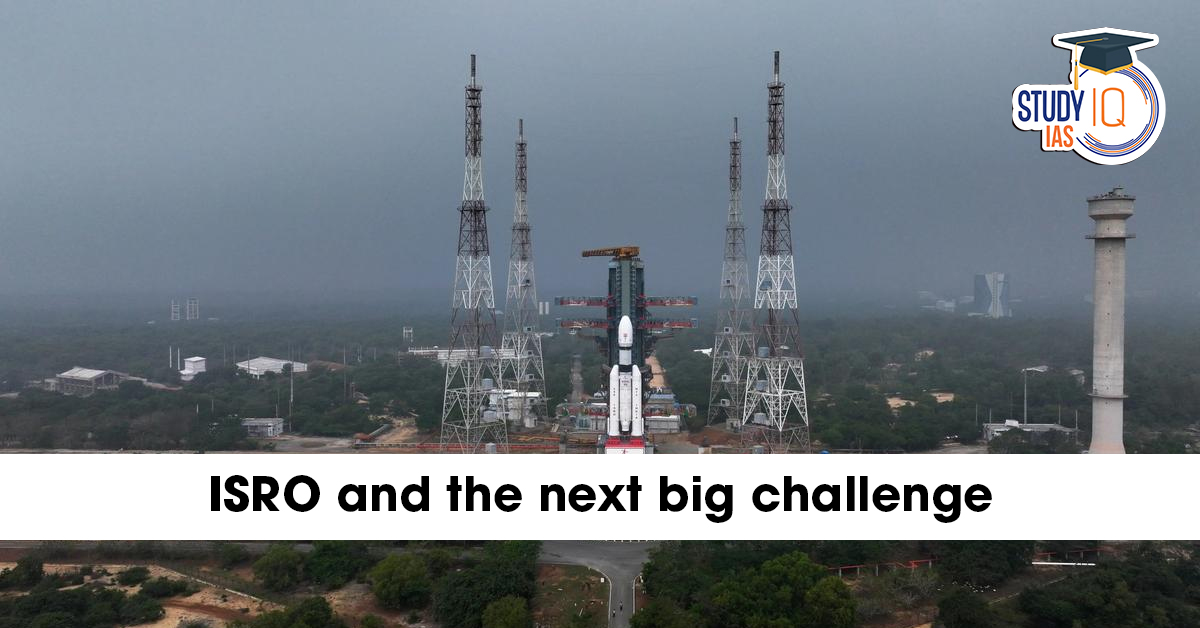
Indian Space Research Organisation (ISRO) has achieved major milestones in lunar, solar, and Earth-observation missions while preparing for human spaceflight and next-generation launch systems. At the same time, concerns are being raised about capacity constraints, governance clarity, and competitiveness in a liberalised space sector.
Recent Achievements of ISRO
- Chandrayaan-3 (2023): Successful soft landing on the Moon, placing India among countries with proven lunar-landing capability.
- Aditya-L1 (Jan 2024): India’s first solar observatory reached the Sun-Earth L1 point.
- NISAR Mission (2025): NASA–ISRO joint Earth-observation mission for climate and disaster monitoring.
- SpaDeX (Dec 2024): Successful demonstration of Space Docking—a critical precursor for building the Bharatiya Antariksh Station (BAS).
- RLV-LEX-03 (June 2024): Completion of autonomous landing tests for “Pushpa,” proving the feasibility of reusable launch vehicles.
- Future roadmap: 7 launches planned by March 2026, including uncrewed Gaganyaan
Reasons Behind the Success
- Low-Cost Innovation: ISRO continues to utilize its “frugal engineering” model, but with increasing complexity (e.g., the modular design of Chandrayaan-4).
- Strategic Reforms: The 2020 reforms led to the creation of Indian National Space Promotion and Authorisation Centre (IN-SPACe) as regulator and NewSpace India Limited (NSIL) as commercial arm, allowing ISRO to focus more on R&D while offloading commercial launches.
- Global Collaboration: Deepening ties with NASA (NISAR) and JAXA (LUPEX/Chandrayaan-4) have provided access to advanced sensors and shared funding.
Challenges
- Capacity and Execution Constraints: The heavy focus on “big-ticket” missions (Gaganyaan, Chandrayaan-4) creates a “Sovereignty Trap,” where routine satellite replenishment and private sector support get delayed.
- g., In 2025, ISRO managed only 5 launches despite a target of 8.
- Private launch firms (Skyroot, Agnikul) still depend on ISRO for test stands and launch pads, meaning if one ISRO mission hits a snag, the entire ecosystem stalls.
- Infrastructure and Industrial Limitations: Insufficient integration facilities, test stands, and supply-chain depth for structures, avionics, and propulsion.
- Private launch providers still depend heavily on ISRO infrastructure, limiting work offloading.
- Medium-lift dependence (PSLV/GSLV) restricts competitiveness in a global market moving towards heavy-lift and reusable systems.
- Governance and Legal Ambiguity: Under the 1972 UN Liability Convention, the government (ISRO) is liable for any private mission failure. Without a National Space Law, private entities hesitate to scale due to insurance and liability uncertainties..
- Despite 2020 reforms, ISRO continues to be treated as a default regulator and technical certifier.
- Overlapping roles between ISRO, IN-SPACe, and NSIL reduce institutional clarity.
- Competitiveness and Financial Constraints: Global space sector is shifting towards High-frequency launches, Partial reusability & Rapid satellite manufacturing.
- While the space budget rose to ₹13,415 crore in 2025-26, private investment saw a global cooling in 2024.
- NGLV development demands large capital, advanced manufacturing, and deep industrial ecosystems, which are still evolving in India.
Way Forward
- NGLV (Soorya): Transitioning to the Next-Generation Launch Vehicle, which targets a 30-tonne payload to Low Earth Orbit (LEO) with a reusable first stage.
- Space Activities Bill: Passing comprehensive legislation to give IN-SPACe statutory authority.
- Industrial Offloading: Shifting the production of established rockets like the PSLV to the HAL-L&T consortium, allowing ISRO scientists to focus solely on R&D.
- VC & Technology Funds: The operationalization of the ₹1,000-crore Venture Capital Fund by IN-SPACe (targeted to support 40 startups over 5 years) aims to bridge the gap between prototypes and scalable products.
 Viksit Bharat Shiksha Adhishthan Bill 20...
 Cyclone Maila Intensifies Over Solomon S...
 List of Military Exercises of India 2026...












 WhatsApp





