
Table of Contents
Context
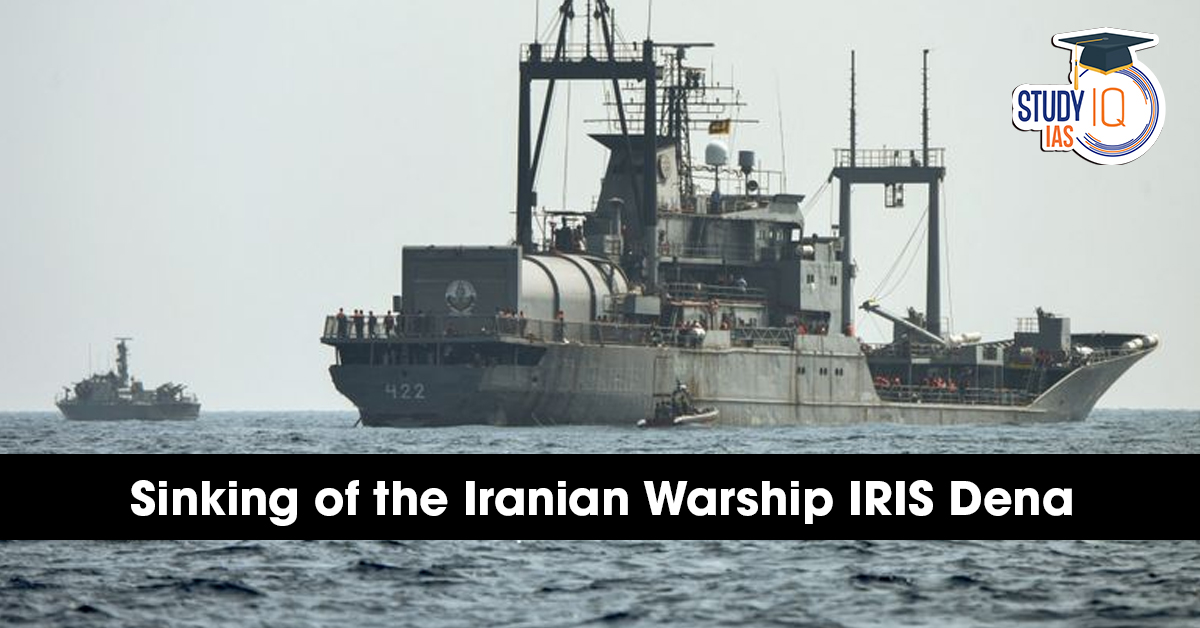
- The torpedoing of the Iranian frigate IRIS Dena by a U.S. submarine near Galle in March 2026 marked a major escalation in the ongoing US–Israel–Iran conflict.
Strategic Implications
- Demonstration of Military Reach: The attack reportedly involved a submarine-launched Mark 48 torpedo, one of the most advanced anti-ship weapons highlighted the U.S. capability to target adversaries far beyond the immediate theatre of conflict.
- Expansion of the War’s Geographic Scope: By sinking the vessel near Sri Lanka, the conflict effectively expanded into the wider Indian Ocean maritime domain rather than in West Asia only.
- Message of Escalation Dominance: The strike demonstrated that adversary naval assets could be targeted anywhere in international waters, signalling Washington’s intent to maintain escalation dominance across global sea lanes.
- Rules-Based Order to Power Politics: The incident illustrates a growing trend where military capability increasingly determines strategic outcomes, echoing the classical realist view expressed by Thucydides that “the strong do what they can and the weak suffer what they must.”
- Signal to Major Powers: By striking near a vital global shipping corridor, the U.S. may also be signalling to China and other global actors that it retains control over strategic sea lanes.
- Erosion of Traditional Norms: The incident reflects a broader trend where classical principles of sovereignty and non-interference—rooted in the Peace of Westphalia and the United Nations Charter—are increasingly challenged by geopolitical power struggles.
Why the Strike Near India Is Strategically Significant
- War Arrives in India’s Maritime Neighbourhood: The attack occurred close to South Asia, signalling that a conflict once perceived as distant had now reached India’s strategic neighbourhood.
- Impact on Regional Maritime Security: The Indian Ocean has long been promoted by India as a stable maritime commons under initiatives like SAGAR. The attack threatens this stability.
- Challenge to India’s Regional Primacy: The incident raises uncomfortable questions regarding India’s ability to monitor and influence security developments in waters close to its strategic zone.
- Strategic Dilemma for New Delhi: India maintains friendly relations with both Iran and the United States, creating a delicate diplomatic balance.
|
India’s Dilemma: LEMOA vs Neighbourhood Security |
| Under the Logistics Exchange Memorandum of Agreement (LEMOA), the United States can request access to Indian naval bases for logistics support such as refuelling, replenishment, and maintenance. If the US seeks such support during operations against Iran, India faces pressure to comply. It raises following concern for India
● Risk of Indirect Involvement in the Conflict: Providing logistical support to US naval assets engaged in operations against Iran could make India appear as an indirect participant in the conflict. This would undermine India’s traditional policy of strategic autonomy and could damage its diplomatic relations with Iran and other West Asian partners. ● Conflict Occurring in India’s Immediate Neighbourhood: The crisis unfolding near Sri Lanka and the wider Indian Ocean Region (IOR) places the conflict in India’s maritime neighbourhood. If India supports US operations through LEMOA while the conflict affects nearby states, it may be perceived as facilitating military action in its own neighbourhood, which could destabilize the region. ● Security Responsibility as a Regional Power: India views itself as a net security provider in the Indian Ocean. If conflict spreads into the region, India’s priority would be to maintain stability and protect sea lanes, not contribute to escalation. Supporting US operations could contradict this responsibility. ● Strategic Balancing Challenge: Therefore, India faces a dilemma: ○ Allow US access under LEMOA, risking regional escalation and harming relations with Iran. ○ Restrict or deny access, which could create friction with the US and affect the strategic partnership. |
|
Read More Notes |
|
| Environment Notes | Art and Culture Notes |
| Science and Tech | History Notes |
| Geography Notes | Indian Polity Notes |
| General Knowledge | International Relation |
|
Explore StudyIQ Courses |
|
 U.S. 30-Day Waiver for India to Buy Russ...
 Upper Indravati Hydroelectric Project (U...
 Nepal’s Election and Its Implications ...







 WhatsApp





