
Table of Contents
Context
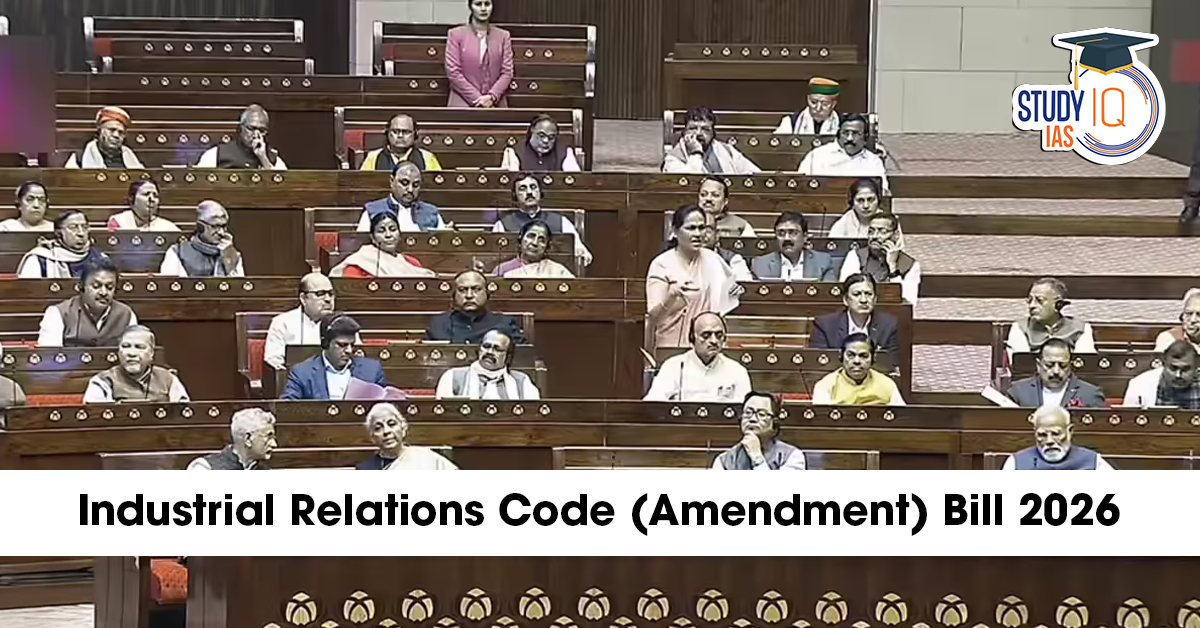
The Lok Sabha passed a Bill to help avoid any “future unwarranted complication” over the continuity of certain laws replaced by the Industrial Relations Code of 2020.
Purpose of the Amendment
- To remove ambiguity regarding the repeal of earlier labour enactments.
- To ensure continuity, legal certainty, and smooth transition under the Industrial Relations Code framework.
- To pre-empt potential legal challenges based on procedural interpretation.
Key Legal Clarification Introduced
- The amendment reinforces Section 104 of the Industrial Relations Code.
- It clarifies that:
- Repeal of earlier laws occurred automatically through the Code itself.
- The repeal was not dependent on executive action or delegated authority.
- This eliminates the risk of misinterpretation in future litigation.
Laws Affected by the Industrial Relations Code
- The Code replaced three major labour laws:
- Trade Unions Act, 1926
- Industrial Employment (Standing Orders) Act, 1946
- Industrial Disputes Act, 1947
- These laws governed trade unions, service conditions, and dispute resolution.
Broader Labour Reform Framework
- The Industrial Relations Code is part of four labour codes implemented recently.
- According to the government, these codes aim to ensure:
- Statutory minimum wages
- Mandatory appointment letters
- Equal wages for equal work, irrespective of gender
| About the Four Labour Codes | |
| The Four Labour Codes, covering Wages, Industrial Relations, Social Security, & Occupational Safety, unify & modernise India’s fragmented labour laws to ensure greater clarity and protection of worker welfare. | |
| Code on Wages, 2019
● Unified Definition: Consolidates four laws to establish a single definition of wages, reducing litigation and compliance burdens. ● Wage includesbasic pay, dearness allowance, and retaining allowance, which form the basis for benefits and social security contributions. ● Minimum Wage:Extends statutory minimum wage entitlement to all workers across sectors, replacing the earlier limit to scheduled employment only. ● Wage Floor: Introduces a National Floor Wage that states must adhere to in order to ensure consistent living standards and minimise regional wage disparities. ● Payment Rules: Standardises payment deadlines for wages and requires issuing physical or digital wage slips to enhance accountability. ● Gender Equality: Prohibits gender-based wage discrimination to promote “equal pay for equal work”. |
Industrial Relations Code, 2020
● Worker Definition: Replaces three previous laws and broadens the definition of worker to include employees earning less than ₹18,000. ● Layoff Threshold: Raises prior-approval requirements for layoffs, retrenchments, and closures from 100 to 300 workers to enhance operational flexibility. ● Fixed‑Term Employment: Introduces fixed-term employment with wage and benefit parity, and ensures gratuity after one year of continuous service. ● Strike Regulation: Expands strike-notice requirements and widens the definition of strike to include mass casual leave by more than half the workforce.
|
| Code on Social Security, 2020
● Legal Recognition: Amalgamates nine social security laws and, for the first time, legally defines ‘gig workers’ and ‘platform workers’. ● Unified Access: Mandates social security funds and creates a national portal with Aadhaar-linked identification for unorganised, gig, and platform workers. ● Expanded Coverage: Expands EPFO and ESIC coverage to more establishments, regions, and includes compulsory coverage for hazardous jobs. |
Occupational Safety, Health and Working Conditions (OSH) Code, 2020
● Safety Expansion: Consolidates 13 laws to extend safety, health, and welfare regulations to all workplaces with over 10 workers, as well as to all mines and docks. ● Health Provision: Requires free annual health check-ups for workers aged 40 or older and mandates safety committees in large workplaces. ● Night-Shift: Permits women to work night shifts with their consent and with safety measures in place. ● Migrant Redefinition: Expands the definition of interstate migrant workers to include directly hired and self-migrating workers. |
|
Read More Notes |
|
| Environment Notes | Art and Culture Notes |
| Science and Tech | History Notes |
| Geography Notes | Indian Polity Notes |
| General Knowledge | International Relation |
|
Explore StudyIQ Courses |
|
 Disaster Management in India, Classifica...
 Good Friday 2026: Date, History, Meaning...
 Removal of the Chief Election Commission...










 WhatsApp





