
Table of Contents
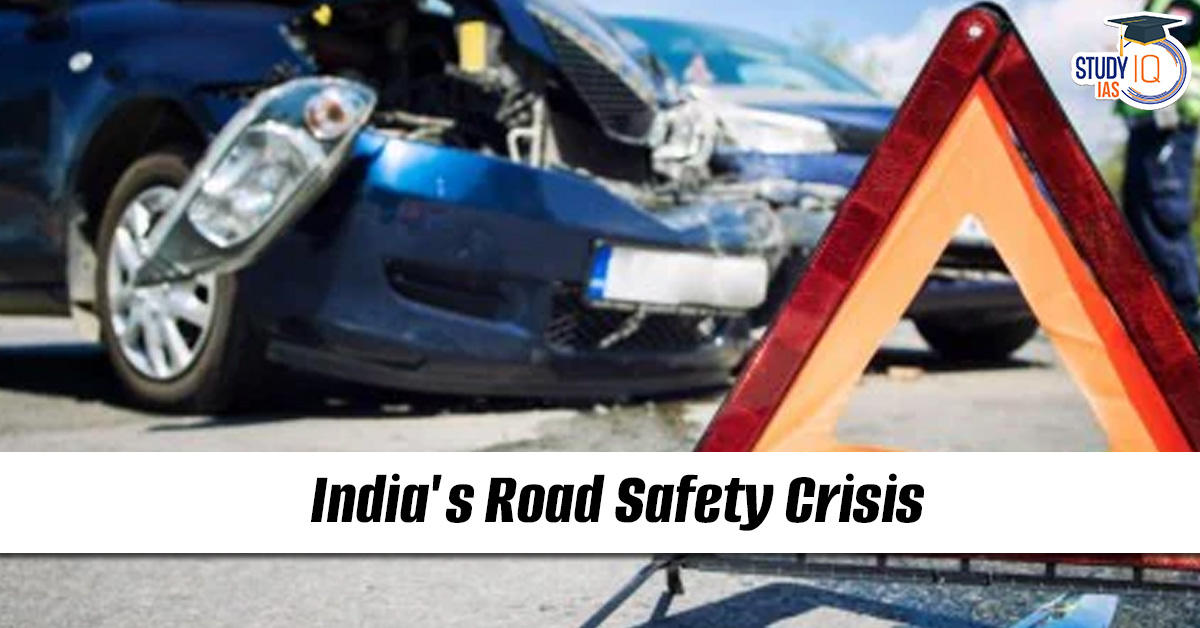
Road safety in India has emerged as a silent public health emergency. Despite having the second-largest road network in the world, India records the highest number of road accident deaths globally. With nearly 3.5 lakh fatalities in 2023–24, the crisis reflects deep-rooted engineering, governance and emergency response shortcomings rather than merely reckless driving.
Understanding the Nature of the Crisis
Traditionally, road safety discourse in India has focused on driver behaviour such as speeding, drunken driving and rash driving. However, recent evidence shows that this approach is inadequate. A significant proportion of accidents occur without any traffic violation, pointing towards failures in road design, maintenance and traffic management systems.
Road accidents must therefore be viewed as a systemic failure, not just individual negligence.
Engineering Deficiencies: The Core Problem
Poor road infrastructure remains the biggest contributor to fatalities. Major gaps include:
-
Faulty road design and improper alignment
-
Absence or damage of crash barriers
-
Inadequate signage and road markings
-
Poor street lighting, especially on highways
-
Unsafe junctions and pedestrian crossings
Such flaws transform ordinary roads into high-risk zones, particularly in rural areas and high-speed corridors.
Geographic Concentration of Accidents
Road fatalities in India are not evenly distributed. A limited number of districts account for a disproportionately high number of deaths.
-
Around 100 districts contribute over one-fourth of total fatalities.
-
States like Uttar Pradesh, Tamil Nadu, Maharashtra, Karnataka and Rajasthan dominate accident statistics.
This highlights that targeted interventions in high-risk districts can achieve large reductions in deaths.
Patterns and Timing of Fatal Accidents
Certain accident patterns reveal systemic vulnerabilities:
-
More than half of fatalities occur between 6 PM and midnight, indicating poor visibility and inadequate lighting.
-
Rear-end, head-on collisions and pedestrian accidents account for the majority of deaths.
-
Speeding accounts for less than one-fifth of fatalities, challenging the narrative that driver misconduct is the primary cause.
These trends show the urgent need for safer road geometry and better traffic management.
Emergency Response and Trauma Care Gaps
Post-accident response in India remains weak:
-
Only a small proportion of victims use government ambulance services like 108.
-
Many depend on private vehicles, leading to delays in critical care.
-
Trauma care facilities are unevenly distributed and poorly equipped in several districts.
The loss of the “Golden Hour” after accidents significantly increases mortality.
Governance and Institutional Shortcomings
Road safety is a multi-agency responsibility involving:
-
Transport departments
-
Police
-
Health services
-
Urban and rural development authorities
However, weak coordination, diffused accountability and lack of sustained leadership undermine outcomes.
Roadmap for Reform
A comprehensive strategy must include:
a) Engineering-Led Safety Approach
-
Mandatory road safety audits
-
Rectification of black spots
-
Compliance with Indian Road Congress and MoRTH guidelines
b) District-Focused Interventions
-
Identify high-fatality districts
-
Concentrate resources where impact is highest
c) Stronger Emergency Response
-
Expansion of 108 ambulance coverage
-
Upgrading trauma care centres
-
Integration of emergency response with police and hospitals
d) Effective Enforcement
-
Data-driven policing
-
Better manpower deployment at high-risk locations
e) Institutional Accountability
-
Clear responsibility for road-owning agencies
-
Performance-based evaluation
-
Continuous monitoring and transparency
Conclusion
India’s road safety crisis is fundamentally an engineering and governance challenge, not merely a behavioural one. Sustainable reduction in fatalities requires a paradigm shift from blaming drivers to building safer systems. With targeted district-level action, safer road design, efficient trauma care and institutional accountability, India can transform its roads from death traps into safe public infrastructure.
Road safety must be treated not just as a transport issue, but as a public health and development priority.
Sharing is caring!
 Navigating Uncharted Waters: What Next f...
 Astronaut Reentry Explained: How Spacecr...
 Missile Interceptors Explained: Role in ...











 WhatsApp





