
Table of Contents
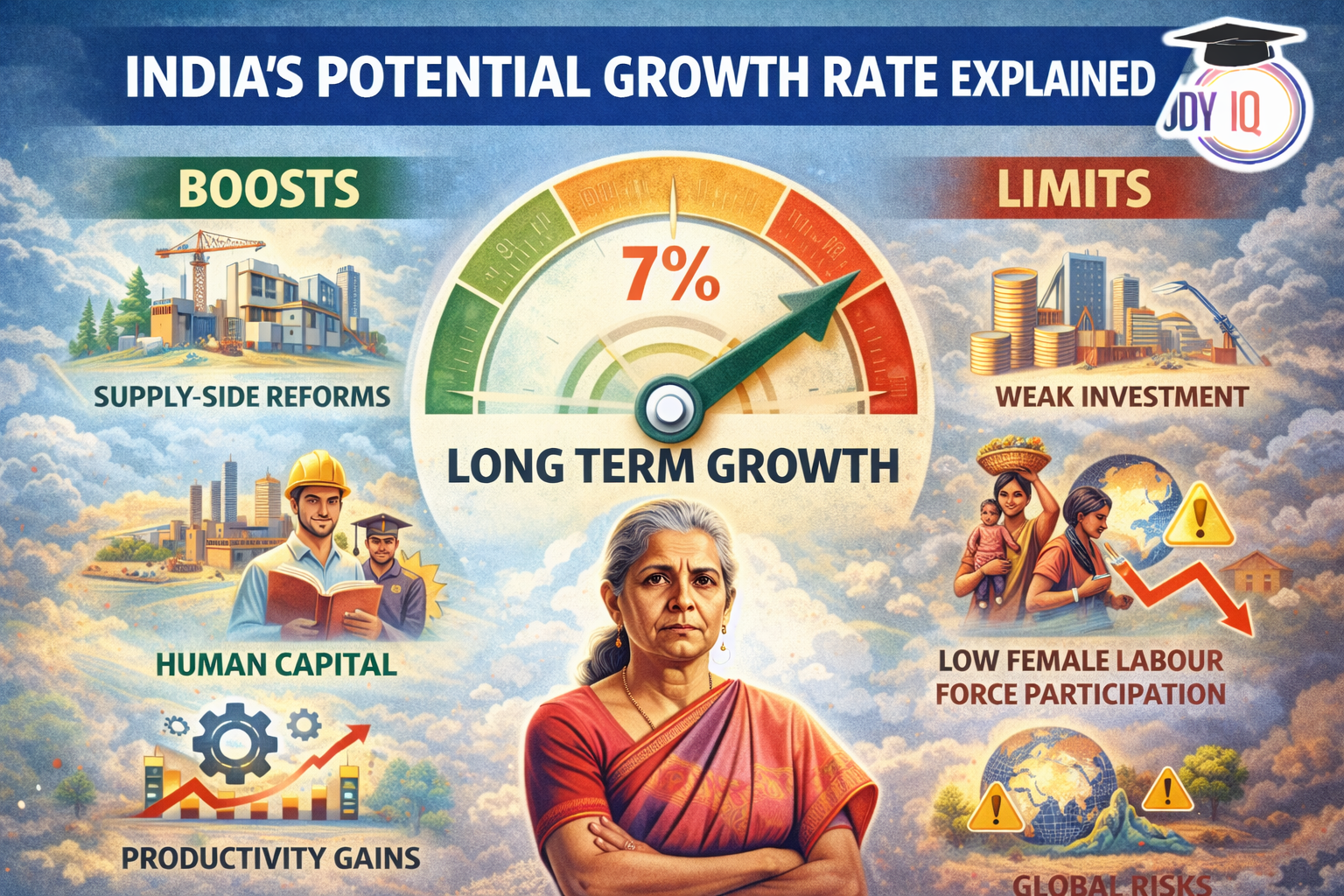
India’s growth story is often discussed in terms of headline GDP numbers, but a more fundamental concept shaping long-term prosperity is potential economic growth. Recently, the Economic Survey reassessed India’s potential growth rate at around 7%, signalling renewed confidence in the economy’s structural strength.
Understanding what potential growth means, what limits it, and what can raise it is crucial for policymakers, investors, and UPSC aspirants alike, as it lies at the heart of fiscal sustainability, employment generation, and inclusive development.
What Is Potential Growth Rate?
Concept Explained
Potential growth rate refers to the maximum rate at which an economy can grow sustainably without triggering high inflation.
-
If actual growth exceeds potential, demand outpaces supply → inflation rises
-
If actual growth falls below potential, resources such as labour and capital remain underutilised
Thus, potential growth represents the economy’s long-term speed limit.
Potential Growth vs Actual Growth
-
Actual GDP growth: Short-term, cyclical, affected by shocks and demand conditions
-
Potential growth: Structural, medium-to-long term, driven by supply-side factors
Why Potential Growth Matters for India
-
Fiscal Planning: Determines sustainable revenue growth and debt dynamics
-
Employment Generation: Higher potential growth allows absorption of India’s large workforce
-
Inflation Control: Aligns growth with price stability
-
Living Standards: Sustained increases raise per capita incomes
For a developing economy like India, raising potential growth is more important than short-term stimulus.
Key Determinants of India’s Potential Growth
1. Capital Formation (Physical Infrastructure)
Capital stock includes:
-
Roads, railways, ports, power, logistics
-
Factories, machinery, technology
Higher and more efficient investment increases productive capacity. Public infrastructure spending and private investment both play a critical role.
2. Labour Input and Human Capital
Labour contributes through:
-
Size of the workforce
-
Skills, education, and health
-
Labour force participation, especially of women
India’s demographic advantage can boost potential growth only if workers are productive and employable.
3. Total Factor Productivity (TFP)
TFP measures how efficiently labour and capital are used together.
TFP improves with:
-
Better technology adoption
-
Ease of doing business
-
Strong institutions and governance
-
Innovation and competition
In the long run, TFP is the most important driver of potential growth.
India’s Potential Growth: The Historical Trend
Studies, including those by the Reserve Bank of India, indicate a fluctuating trajectory:
-
2003–2008: ~8% (high-growth phase driven by reforms and global tailwinds)
-
2009–2015: ~7% (post-global financial crisis moderation)
-
Post-Covid period: ~6.5% (reflecting disruptions and structural stresses)
This decline underscored the need for deep, sustained reforms.
What Has Boosted India’s Potential Growth Recently?
1. Manufacturing and Supply-Side Reforms
-
Production Linked Incentive (PLI) schemes
-
Infrastructure-led industrial expansion
-
Logistics and supply chain improvements
These enhance capital formation and reduce supply bottlenecks.
2. Labour Market Reforms
-
Labour law consolidation
-
Reduced compliance burden
-
State-level flexibility
Along with investments in skilling and apprenticeships, these reduce labour market frictions.
3. Productivity and Formalisation
-
Digital public infrastructure (Aadhaar, GST, UPI)
-
Increased formalisation of firms and workers
-
Financial sector clean-up
These raise efficiency and improve resource allocation.
4. Macroeconomic Stability
-
Better inflation management
-
Credible monetary and fiscal frameworks
-
Improved resilience to shocks
Stability is a necessary condition for sustained potential growth.
What Limits India’s Potential Growth?
1. Weak Private Investment
-
Private corporate investment remains below pre-pandemic levels
-
Demand uncertainty and excess capacity deter expansion
Without private investment, capital accumulation slows.
2. Human Capital Gaps
-
Learning outcomes
-
Health and nutrition challenges
-
Skill mismatches
These limit labour productivity.
3. Low Female Labour Force Participation
-
Social norms and care burden
-
Safety and mobility constraints
This restricts effective labour supply.
4. External and Geopolitical Risks
-
Global slowdown
-
Trade fragmentation
-
Financial market volatility
These can constrain export-led and investment-driven growth.
Recent Reassessment: Potential Growth at 7%
The Economic Survey’s upward revision of India’s potential growth rate to 7% reflects:
-
Cumulative impact of reforms
-
Improved supply-side capacity
-
Stronger macroeconomic fundamentals
However, the Survey cautions that realising potential growth requires persistence, not complacency.
Way Forward: Raising India’s Long-Term Growth Ceiling
-
Revive Private Investment: Policy certainty, faster clearances, deeper financial markets
-
Invest in Human Capital: Health, education, skilling, nutrition
-
Boost Female Workforce Participation: Care infrastructure and flexible work
-
Enhance Productivity: Technology adoption, innovation, competition
-
Manage External Risks: Trade diversification and macro resilience
Conclusion
India’s potential growth rate defines the economy’s long-term possibilities and limits. While recent reforms have lifted potential growth to around 7%, sustaining and raising it further depends on productivity gains, human capital development, and investment revival.
The challenge ahead is not merely to grow fast for a few years, but to institutionalise high, stable, and inclusive growth, ensuring that India’s demographic and reform advantages translate into lasting prosperity.
|
Read More Notes |
|
| Environment Notes | Art and Culture Notes |
| Science and Tech | History Notes |
| Geography Notes | Indian Polity Notes |
| General Knowledge | International Relation |
|
Explore StudyIQ Courses |
|
 Bharat Audyogik Vikas Yojana (BHAVYA Sch...
 NavIC Satellite Clock Failures: Causes, ...
 Rare Earth Elements (REE) Sites in India...











 WhatsApp





