
Table of Contents
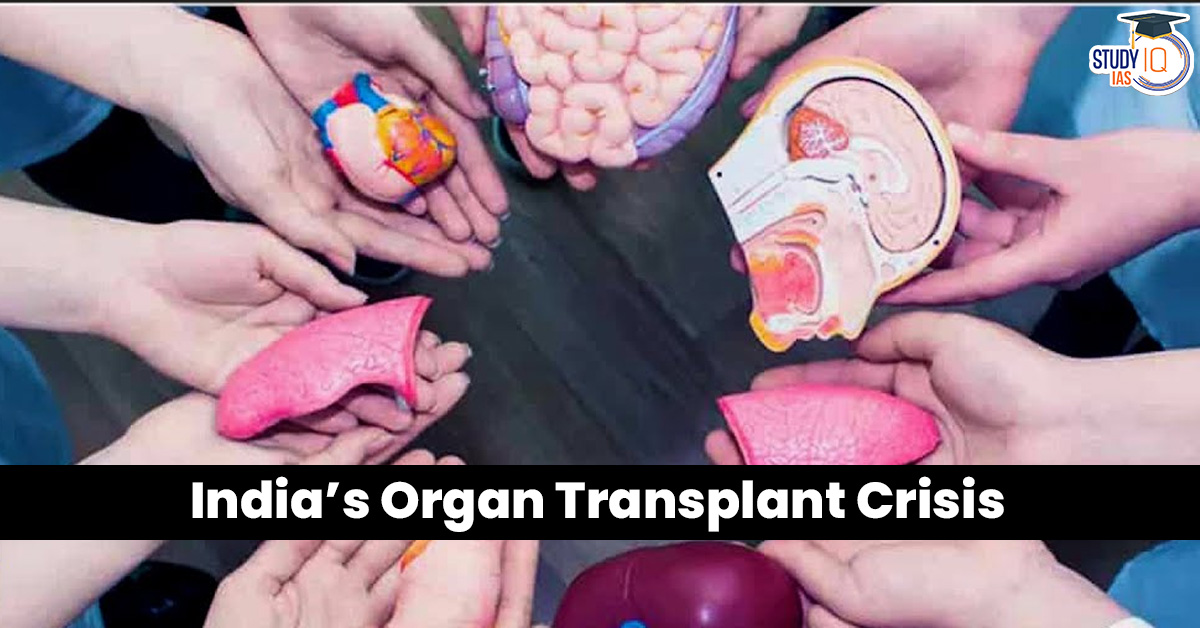
India’s organ transplant ecosystem is at a critical juncture. While the country ranks third globally in the total number of organ transplants, it continues to suffer from an acute shortage of donor organs, especially from deceased donors. Long waiting lists, rising deaths, and stark inter-state disparities have exposed deep structural flaws in India’s transplant framework.
Recent data placed before Parliament by the Union Health Ministry (2020–2024) reveals a grim picture—over 82,000 patients waiting for organs and nearly 3,000 deaths in five years due to delays and shortages. The crisis raises serious concerns about equity, transparency, and the constitutional right to life under Article 21.
Organ Donation in India: Current Scenario
Low Deceased Organ Donation Rate
Despite witnessing nearly 1.6 lakh road accident deaths annually, India records only 1,000–1,200 deceased organ donations per year. This highlights the massive gap between potential donors and actual organ retrieval.
-
Total organ transplants (2024): ~18,900
-
Global rank: 3rd (in absolute numbers)
-
Key issue: Heavy dependence on living donors
Living Donors vs Deceased Donors: An Imbalanced System
India’s transplant system is overwhelmingly dependent on living donors, particularly for kidney and liver transplants.
Key Statistics (2024)
| Category | Numbers |
|---|---|
| Deceased donors | 1,128 |
| Living donors | 15,000+ |
| Kidney transplants | 13,476 |
| Liver transplants | 4,901 |
Over 700 deceased donors were reported from just six southern states, exposing regional concentration and unequal access.
This reliance creates systemic inequity, disadvantaging patients without medically or legally eligible family donors.
Donor Per Million (DPM): Global Comparison
| Country | Donors per million population |
|---|---|
| Spain | ~48 |
| United States | ~36 |
| India | <1 |
India’s DPM rate below one underscores failures in:
-
Brain-death declaration
-
Hospital organ retrieval mechanisms
-
Public awareness and trust
Magnitude of the Crisis
Rising Deaths on Waiting Lists
Between 2020 and 2024, at least 2,805 patients died while waiting for organ transplants.
-
Delhi: 1,425 deaths (nearly half)
-
Maharashtra: 297
-
Tamil Nadu: 233
Ironically, Delhi also conducts the highest number of transplants, indicating that high activity without adequate deceased donation worsens mortality.
Growing Waiting Lists (December 2025)
| Organ | Patients Waiting |
|---|---|
| Kidney | 60,590 |
| Liver | 18,724 |
| Heart | 1,695 |
| Lungs | 970 |
| Pancreas | 306 |
| Total | 82,285 |
Waiting periods often stretch from months to several years, depending on blood group compatibility, body size, and organ availability.
State-Wise Burden of Organ Demand
High-Burden States
| State | Total Waiting Patients |
|---|---|
| Maharashtra | 20,553 |
| Gujarat | 9,592 |
| Tamil Nadu | 9,166 |
| Delhi | 8,853 |
Why Delhi Has the Highest Mortality
-
Heavy inflow of patients from other states
-
Predominance of living-donor transplants
-
Limited deceased donor pool
-
Severe demand-supply mismatch
Fragmented Organ Allocation Systems in India
India lacks a uniform national organ allocation framework, resulting in inconsistent practices across states.
Existing Allocation Models
-
Scoring-based systems: Telangana, Maharashtra, Gujarat
-
First-come-first-served: West Bengal, Karnataka, Rajasthan, Kerala
-
Zonal allocation: Tamil Nadu (three zones)
-
Priority-based models: Madhya Pradesh and Chhattisgarh
Such fragmentation undermines fairness, transparency, and inter-state organ sharing.
Structural Challenges in India’s Organ Transplant Ecosystem
-
Over-reliance on living donors
-
Low deceased organ donation rates
-
Fragmented state-level allocation policies
-
Uneven transplant infrastructure across states
-
High mortality among waiting patients
-
Ethical risks including organ trafficking and coercion
Government Initiatives to Improve Organ Donation
Institutional Measures
-
National Organ and Tissue Transplant Organisation (NOTTO)
-
National Organ Transplant Programme (NOTP)
-
Establishment of ROTTOs and SOTTOs
Legal Reforms
-
Removal of upper age limit for deceased donors (2023)
-
Removal of state domicile requirement
Digital Initiatives
-
NOTTO-ID system for tracking donors and recipients
-
Online transplant registry and monitoring mechanisms
Way Forward: Policy Reforms Needed
1. Uniform National Allocation System
-
Standardised scoring framework
-
Mandatory inter-state organ sharing
-
Transparent prioritisation criteria
2. Boost Deceased Organ Donation
-
Nationwide awareness campaigns
-
Streamlining brain-death certification
-
Incentivising hospitals for organ retrieval
3. Expand Transplant Infrastructure
-
More transplant centres in underserved states
-
Training of transplant coordinators
-
Strengthening cold-chain logistics
4. Digital Integration
-
Real-time national waitlist and organ availability platform
-
Mandatory online reporting by all hospitals
5. Ethical Safeguards
-
Strong oversight to prevent trafficking
-
Robust consent mechanisms for living donors
Conclusion
India’s organ transplant crisis is not merely a medical challenge—it is a governance, equity, and human rights issue. With over 82,000 patients waiting and nearly 3,000 deaths in five years, the need for systemic reform has become urgent.
A uniform national allocation system, increased deceased organ donation, and stronger institutional capacity are essential to ensure that the promise of the Right to Life under Article 21 is meaningfully upheld.
 Tropical Cyclone Vaianu: Formation, Feat...
 CDS 1 2026 Question Paper PDF (All Sets)...
 NDA 1 2026 Question Paper PDF (All Sets)...













 WhatsApp





