
Table of Contents
As India steps into 2026, its foreign policy establishment confronts one of the most complex diplomatic environments in recent decades. The year 2025 delivered a series of geopolitical shocks—ranging from unpredictable great-power behaviour to neighbourhood instability and a weakening multilateral order. Together, these developments have created significant diplomatic headwinds for India, testing its strategic autonomy, economic diplomacy, and regional leadership.
This article examines the key global and regional developments affecting India, evaluates New Delhi’s foreign policy response, and outlines India’s diplomatic priorities for 2026.
Why India’s Diplomacy Faces Headwinds in 2026
The defining characteristic of India’s external engagement in 2025 was uncertainty. Traditional assumptions about alliances, global leadership, and economic interdependence were repeatedly challenged. As a result, India enters 2026 navigating an international system marked by fragmentation rather than cooperation.
Major Global Developments Affecting India
1. The United States and the Trump Factor
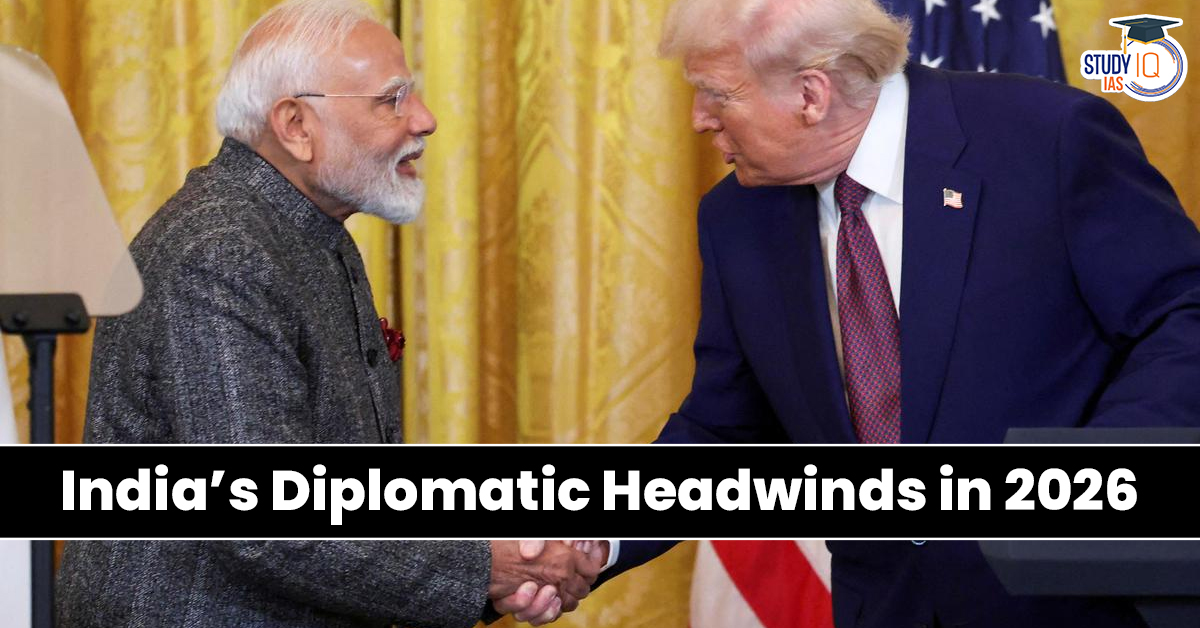
The re-election of Donald Trump emerged as the single most consequential global development for India in 2025.
-
Indian policymakers initially expected policy continuity based on earlier India–US bonhomie.
-
This assumption proved misplaced as Washington adopted punitive trade and immigration measures.
-
Crackdowns on H-1B visas, student visas, and deportations of undocumented Indians strained people-to-people ties.
-
The imposition of a 25% tariff and an additional 25% surcharge on Indian exports, citing India’s Russian oil imports, directly impacted Indian industry.
-
President Trump’s claims of mediating the ceasefire during Operation Sindoor diluted India’s diplomatic narrative on cross-border terrorism.
-
Hosting Pakistani leadership at the White House and approving F-16 supplies to Pakistan weakened India’s regional security posture.
Additionally, Trump’s announcement of “Liberation Day tariffs” destabilised global trade, undermining the credibility of institutions like the World Trade Organization (WTO).
2. U.S. Policy Shifts on Russia and China
The Trump administration’s recalibration of U.S. strategy towards Russia and China disrupted existing geopolitical equations.
-
Russia and China, previously designated as principal threats, were selectively engaged.
-
This unpredictability unsettled traditional U.S. allies in Europe and the Indo-Pacific.
-
For India, balancing ties with Washington while preserving strategic autonomy became more difficult.
3. Decline of Diplomatic Norms and Global Leadership
A visible erosion of diplomatic decorum marked global politics in 2025.
-
Confrontational rhetoric, transactional diplomacy, and public grandstanding weakened established norms.
-
Claims of resolving multiple conflicts to bolster a Nobel Peace Prize bid further eroded confidence in U.S. leadership.
-
India found it increasingly difficult to rely on predictable diplomatic behaviour from major powers.
4. Rise of Global Ultra-Right Politics
Elections across Europe, Japan, and parts of Latin America witnessed the rise of ultra-right and xenophobic political forces.
-
Growing nationalism reduced support for multilateralism and liberal migration regimes.
-
Indian professionals and students faced tightening immigration policies.
-
Diaspora diplomacy, a traditional strength of Indian foreign policy, became more challenging.
5. Global Economic Slowdown and Energy Concerns
-
Global growth projections declined steadily from 3.3% in 2024 to 3.1% by 2026.
-
Oversupply by OPEC countries led to falling oil prices.
-
While this benefited India’s import bill, it weakened global incentives for renewable energy transitions and climate action.
Russia–Ukraine War and Its Economic Fallout
The Russia–Ukraine conflict entered its fourth year without resolution.
-
For the first time, India faced direct economic consequences for importing discounted Russian oil.
-
The EU and UK imposed sanctions on Nayara Energy, an Indian-Russian joint venture.
-
U.S. sanctions on Russian oil majors indirectly threatened India’s energy security.
-
These developments narrowed India’s room for manoeuvre under its strategic autonomy doctrine.
Middle East Instability and IMEC Setbacks
The Israel–Gaza conflict continued through much of 2025, resulting in large-scale humanitarian devastation.
-
India maintained a cautious diplomatic stance, avoiding overt criticism of Israel.
-
Regional instability stalled the India–Middle East–Europe Economic Corridor (IMEC).
-
This delayed India’s ambitions for enhanced connectivity between Asia and Europe.
India’s refusal to criticise Israeli strikes on Iran also caused discomfort within SCO and BRICS, especially after Iran’s inclusion as a full member.
Neighbourhood Turmoil and Regional Challenges
India’s immediate neighbourhood remained unstable, raising questions about the effectiveness of the “Neighbourhood First” policy.
Pakistan
-
Renewed military tensions and international engagement with Pakistan weakened India’s diplomatic leverage.
Nepal
-
Gen-Z–led protests toppled the government, reviving nationalist rhetoric and policy uncertainty.
Bangladesh
-
Mob violence and political instability triggered anti-India sentiment after the killing of a right-wing leader.
Afghanistan
-
India’s engagement with the Taliban created strategic space to counter Pakistan but raised ethical concerns regarding human rights and women’s rights.
India’s Diplomatic Successes in 2025
Despite headwinds, India recorded notable diplomatic gains:
-
Reset with Canada: Improved ties after prolonged tensions over Khalistani extremism.
-
China Engagement: Continued rapprochement after the 2024 Modi–Xi meeting, including reopening the Kailash–Mansarovar Yatra and restoring visas.
-
Selective Neighbourhood Success: Strengthened ties with Bhutan, Sri Lanka, and the Maldives.
-
Humanitarian Diplomacy: $450 million in aid to Sri Lanka after Cyclone Ditwah enhanced India’s image as a first responder.
-
Afghanistan Outreach: Direct engagement diluted Pakistan’s monopoly over Kabul.
What Lies Ahead for India in 2026
1. Trade and Economic Diplomacy
-
Successful FTAs with the UK, Oman, and New Zealand provide momentum.
-
High-stakes agreements with the EU, U.S., ASEAN, and GCC remain pending.
-
The India–EU FTA is expected to be finalised during high-level visits in early 2026.
2. Strategic Multilateral Engagement
-
India will hedge across forums such as BRICS, SCO, Quad, G-20, avoiding bloc entrapment.
-
Hosting the AI Summit 2026 positions India as a norm-setter in emerging technologies.
3. Neighbourhood Stabilisation
-
Development-centric diplomacy and connectivity projects will be prioritised over coercive approaches.
4. Energy and Technology Security
-
Diversified oil sourcing and critical mineral partnerships will remain central.
-
India will integrate Digital Public Infrastructure diplomacy into its strategic outreach.
Conclusion
India’s diplomatic headwinds in 2026 reflect a deeper transformation of the global order rather than isolated policy failures. A fragmented international system, volatile great-power behaviour, and unstable neighbourhoods constrain India’s options. Yet, India’s emphasis on strategic autonomy, economic resilience, and multilateral hedging positions it as a crucial bridging power in an increasingly polarised world.
How effectively India navigates 2026 will depend on its ability to convert uncertainty into leverage—balancing realism with leadership in a turbulent global landscape.
 Viksit Bharat Shiksha Adhishthan Bill 20...
 Cyclone Maila Intensifies Over Solomon S...
 List of Military Exercises of India 2026...












 WhatsApp





