
Table of Contents
Context
- The Union Budget 2026–27 sanctioned two new large telescopes and the upgrade of an existing one in Ladakh, marking a major public investment in astronomy infrastructure.
National Large Solar Telescope (NLST)
- Location: Merak, near Pangong Tso, Ladakh
- Aperture and Design: NLST will be a 2-metre aperture solar telescope designed for high-resolution imaging of the Sun in visible and near-infrared wavelengths.
- Focus on Solar Magnetism: It will study solar magnetic fields, sunspots, and plasma dynamics — crucial for understanding solar storms and space weather.
- Space Weather Monitoring: Data from NLST will help predict solar flares and coronal mass ejections, which can disrupt satellites, GPS systems, and power grids.
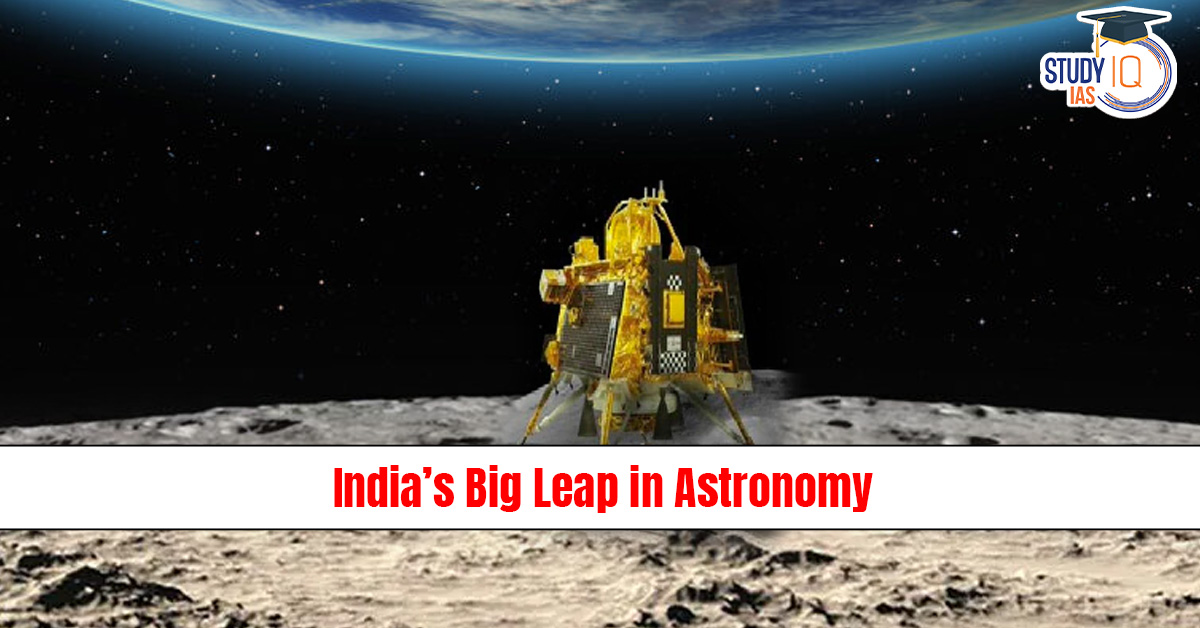
- Complement to Aditya-L1: NLST (ground-based) will work alongside ISRO’s Aditya-L1 (space-based solar observatory), offering multi-layered solar observations.
- Strengthening Heliophysics: It will become India’s third major ground-based solar observatory, after Kodaikanal and Udaipur, strengthening national capability in solar science.
National Large Optical–Near Infrared Telescope (NLOT)
- Location: Hanle, Ladakh
Massive 13.7-metre Segmented Mirror: NLOT will feature 90 hexagonal mirror segments acting together as one large mirror, enabling extremely high light-gathering power.
- Optical and Infrared Observations: It will observe in optical and near-infrared wavelengths, ideal for studying distant galaxies, exoplanets, and early universe signals.
- One of the World’s Largest: With a 13.7-metre aperture, NLOT will rank among the largest telescopes globally in its wavelength category.
- Ideal Atmospheric Conditions: Hanle’s dry, cold, and high-altitude climate reduces atmospheric distortion and diffraction, ensuring sharper images.
- Frontier Research Capability: It will enable research in:
- Exoplanet detection
- Stellar evolution
- Supernovae studies
- Galaxy formation
- Cosmic origins
Upgrade of Himalayan Chandra Telescope (HCT)
- Location: Indian Astronomical Observatory, Hanle
- Mirror Expansion: The current 2-metre mirror will be upgraded to a 3.7-metre segmented mirror, enhancing observational power.
- Focus on Transient Astronomy: HCT has been key in studying short-lived cosmic events like supernovae and gamma-ray bursts.
- Complement to Global Projects: Upgraded HCT will work alongside:
- LIGO-India (gravitational waves)
- Square Kilometre Array (radio astronomy)
- Multi-Messenger Astronomy: It will help detect optical signals corresponding to gravitational waves, strengthening India’s role in multi-messenger astronomy.
- 25-Year Legacy Strengthened: After two decades of scientific contribution, this upgrade ensures continued relevance in cutting-edge astrophysics.
Scientific and Strategic Significance
- Independent Observation Time: Indian scientists will gain preferential access to telescope time, reducing reliance on foreign observatories.
- Technological Advancement: Experience from India’s role in the Thirty Meter Telescope (TMT) project supports indigenous capability in segmented mirror technology.
- Boost to Astrophysics Ecosystem: The facilities will promote advanced research, attract global collaboration, and train the next generation of astronomers.
- Strategic Location: The telescopes will be located in Hanle and Merak (near Pangong Tso). Ladakh offers high altitude, low humidity, minimal light pollution, and clear skies — ideal for astronomical observations.
- Dark Sky Reserve Advantage: Hanle hosts India’s first Dark Sky Reserve, ensuring long-term protection of natural night skies and enhancing observational precision.
- Boost to Multi-Messenger Astronomy: Integration with LIGO-India and radio astronomy projects creates a complete observational ecosystem.
- Increased Research Publications: High-quality indigenous data will significantly boost India’s scientific output.
|
Read More Notes |
|
| Environment Notes | Art and Culture Notes |
| Science and Tech | History Notes |
| Geography Notes | Indian Polity Notes |
| General Knowledge | International Relation |
|
Explore StudyIQ Courses |
|
 Disaster Management in India, Classifica...
 Good Friday 2026: Date, History, Meaning...
 Removal of the Chief Election Commission...


 WhatsApp





