
Table of Contents
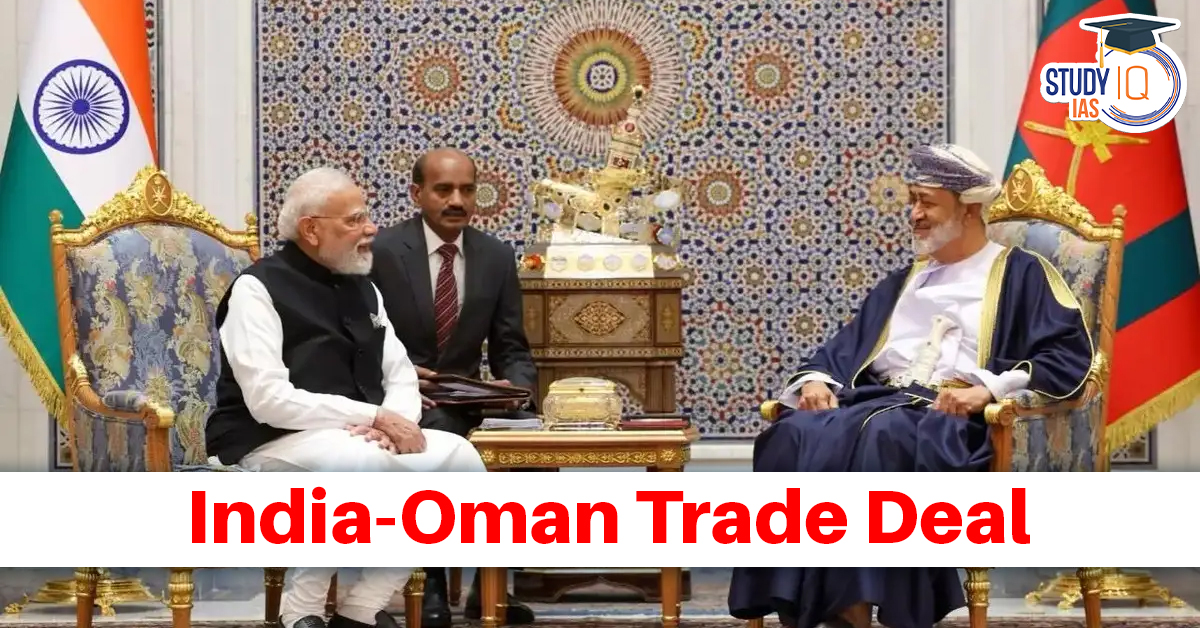
India and Oman have taken a major step in strengthening their bilateral economic relationship with the signing of a Comprehensive Economic Partnership Agreement (CEPA). The landmark trade deal was signed on 19 December 2025 in Muscat during Prime Minister Narendra Modi’s official visit to Oman, marking a new phase in India’s engagement with the Middle East.
This agreement is particularly significant as it is India’s second Free Trade Agreement (FTA) in the last six months, after the India–UK FTA, reflecting India’s renewed push for trade-led economic diplomacy.
What is the India–Oman CEPA?
The India–Oman Comprehensive Economic Partnership Agreement (CEPA) is a broad-based trade agreement that goes beyond conventional FTAs. It covers:
-
Trade in goods
-
Trade in services
-
Investment promotion and protection
-
Professional mobility
-
Regulatory cooperation and capacity building
The agreement aims to reduce trade barriers, enhance market access, and promote long-term economic cooperation between the two countries.
Key Highlights of the India–Oman Trade Deal
1. Duty-Free Access for Indian Exports
One of the most important outcomes of the CEPA is near-universal tariff-free access for Indian goods:
-
Oman has offered zero-duty access on 98.08% of its tariff lines
-
This covers 99.38% of India’s exports by value
This will significantly boost the competitiveness of Indian products in the Omani market.
Major beneficiary sectors include:
-
Textiles and garments
-
Leather and footwear
-
Gems and jewellery
-
Engineering goods
-
Pharmaceuticals and medical devices
-
Plastics and furniture
-
Automobiles and auto components
-
Agricultural products
2. India’s Tariff Liberalisation Commitments
India has adopted a balanced and cautious approach:
-
Tariff concessions on 77.79% of tariff lines
-
Covers 94.81% of imports from Oman by value
To protect domestic interests, India has excluded sensitive sectors, including:
-
Dairy products
-
Chocolates
-
Gold and silver jewellery
-
Footwear
-
Sports goods
This ensures protection for Indian farmers and MSMEs while promoting trade growth.
3. Boost to Services Trade and Professional Mobility
A major strength of the India–Oman CEPA is its strong focus on services, an area where India has a global advantage.
-
Oman has made its first-ever comprehensive services commitments
-
Covers 127 service sub-sectors, including:
-
IT and computer-related services
-
Business and professional services
-
Research and development
-
Education and healthcare
-
Audio-visual services
-
Enhanced Mobility for Indian Professionals
The agreement improves entry and stay provisions for:
-
Intra-corporate transferees
-
Contractual service suppliers
-
Independent professionals
-
Business visitors
Additionally, Oman has committed to allowing 100% Foreign Direct Investment (FDI) by Indian companies in key services sectors.
India–Oman Trade and Investment Snapshot
-
Bilateral trade:
-
FY24: $8.95 billion
-
FY25: $10.61 billion
-
-
India’s exports to Oman (FY25): ~$4.1 billion
-
Petroleum products, machinery, rice, calcined alumina, aircraft
-
-
India’s imports from Oman (FY25): ~$6.6 billion
-
Crude oil, LNG, fertilisers, ammonia, methanol
-
-
More than 6,000 India–Oman joint ventures operate in Oman
-
Indian outward investment in Oman: $675 million
-
Omani FDI inflows into India (2000–2025): $610 million
Strategic and Geopolitical Significance
The India–Oman CEPA is not just a trade agreement; it has strong strategic dimensions:
-
Strengthens India’s presence in the Gulf and West Asia
-
Supports India’s energy security, as Oman is a key supplier of oil, LNG, and fertilisers
-
Reinforces India’s Act West Policy
-
Enhances India’s role as a reliable economic partner in the Middle East
-
Complements India’s broader strategy of FTA-led export growth
With Oman located at the crossroads of the Indian Ocean and the Gulf of Hormuz, the agreement also has indirect maritime and strategic relevance.
Challenges and Limitations
Despite its potential, the agreement has some limitations:
-
Oman’s small domestic market (population ~5 million)
-
Long-term export growth will depend on:
-
Quality upgradation
-
Product diversification
-
Value-added manufacturing
-
Experts note that the real gains may come from investment, joint ventures, and services trade, rather than only merchandise exports.
Why the India–Oman Trade Deal Matters for Exams
-
UPSC Prelims: CEPA, tariff liberalisation, services trade
-
GS Paper II: India–Middle East relations, economic diplomacy
-
GS Paper III: External sector, trade policy, FDI
-
Essay: Globalisation, India’s trade strategy, Act West Policy
Conclusion
The India–Oman CEPA marks a significant milestone in India’s trade diplomacy. By offering near-total duty-free access for Indian exports, expanding services trade, and improving professional mobility, the agreement strengthens economic ties while reinforcing India’s strategic footprint in the Middle East.
While market size constraints remain, the CEPA lays a strong foundation for long-term cooperation, investment-led growth, and regional influence, making it a crucial development in India’s evolving global trade strategy.
 Mahad Satyagraha 1927, History and Signi...
 Punjab–Rajasthan River Dispute: Raviâ€...
 Approved List of Models and Manufacturer...











 WhatsApp





