
Table of Contents
Context
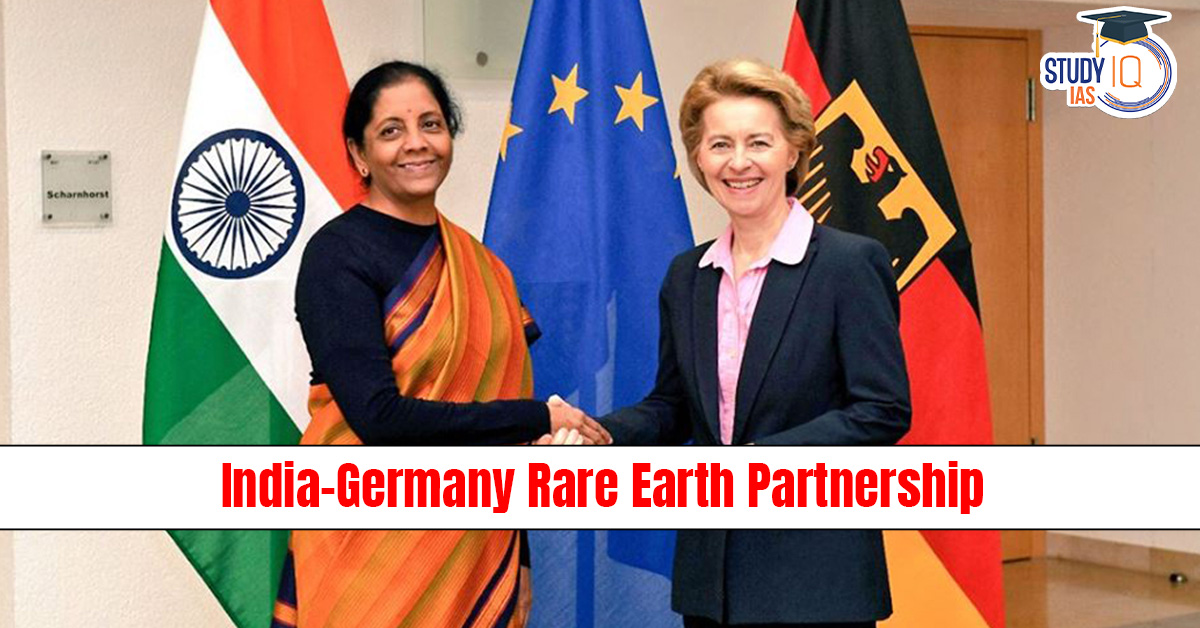
India and Germany are intensifying cooperation on rare earth elements (REEs) amid growing concerns over China’s dominance in critical mineral supply chains.
|
Why Rare Earths Matter |
| ● Strategic inputs: REEs—especially neodymium, praseodymium, dysprosium—are essential for permanent magnets used in wind turbines, EVs, semiconductors, defence, and aerospace.
● Energy transition: Offshore wind turbines require ~200 kg of permanent magnets per MW, making secure REE supply critical for climate goals. China’s Dominance: The Shared Vulnerability ● China controls over 90% of global rare-earth magnet processing. ● India imported more than 90% of its permanent magnets from China (2025). ● Germany/EU source >90% of wind-turbine magnets from China. ● Past export curbs by China exposed risks to industrial continuity and energy targets for both countries. |
How India and Germany Complement Each Other in REEs
- Resource Availability vs Demand Security: India possesses the third-largest rare earth reserves globally, mainly in monazite sands, while Germany faces acute shortages due to heavy dependence on Chinese imports. India can supply raw materials; Germany offers assured long-term demand.
- Manufacturing Potential vs Industrial Utilisation: India is building domestic capacity through the National Critical Mineral Mission, rare earth corridors, and permanent magnet manufacturing programmes. Germany provides a stable and advanced industrial market.
- Cost-Effective Production vs High-End Technology: India provides cost-competitive manufacturing, whereas Germany contributes advanced engineering and precision standards. This combination enables globally competitive rare-earth value chains outside China.
- Processing and Recycling Synergies: Germany’s expertise in recycling technologies and circular economy models complements India’s mineral base. Joint ventures in processing, magnet-making, and recycling can reduce China’s dominance in downstream REE segments.
- Offshore Wind Energy as a Strategic Anchor: Germany’s ambitious offshore wind targets (30 GW by 2030) require large quantities of permanent magnets, while India has identified 70 GW offshore wind potential but lacks experience. Technology transfer and component manufacturing can benefit both sides.
- Shared Goal of Supply Chain Resilience: Both countries aim for reduced strategic vulnerability. Cooperation allows diversification of suppliers, stabilises prices, and strengthens energy security by reducing reliance on China.
Challenges
- Exploration Risk: India’s rare earth reserves are mostly inferred, meaning exact quantity and quality are uncertain, making private investment risky.
- Regulatory Complexity (Thorium Issue): Rare earth minerals often occur with radioactive thorium, which brings strict safety, environmental and legal controls.
- Cost Premium of Diversification: Moving supply chains away from China is costlier; it is unclear whether governments, companies or consumers will bear this extra cost.
- Speed and Skills Gap: Rapid scale-up needs trained manpower, advanced processing skills and technology transfer, which India is still developing.
Way Forward
- Reducing Exploration Risk: Joint India–Germany funding for geological mapping, pilot mining projects and data sharing can reduce uncertainty and attract private players.
- Managing Thorium & Regulatory Issues: Germany’s safety standards and India’s atomic expertise can help develop safe mining, handling and regulatory frameworks for thorium-linked minerals.
- Handling Higher Costs of Diversification: Long-term supply contracts, government subsidies and strategic stockpiling can absorb initial cost premiums of non-Chinese supply chains.
- Bridging Technology & Skills Gap: Technology transfer, joint R&D centres, workforce training and industry-academia collaboration can speed up India’s manufacturing readiness.
|
Areas of cooperation between India and Germany |
| ● Trade and Investment: Germany is India’s top trading partner in Europe.
○ India-Germany bilateral trade in goods and services surpassed USD 50 billion in 2024, amounting to over 25% of India’s trade with the EU. ○ Export: Major Indian exports to Germany include electrical products and auto components, textile and garments, chemicals, pharma, electronics, metal/metal products etc ○ Fast Track Mechanism (FTM) in India: resolve issues faced by German investors in India. Similar mechanisms also exist in Germany. ● Climate and Sustainability: Germany actively supports India-led initiatives like the ISA and CDRI. ● Defence and Security Cooperation: The 2006 Defence Cooperation Agreement led to mechanisms like Joint Working Groups on Counter-Terrorism, Cybersecurity, and Defence. ○ Defence Industrial Cooperation Roadmap signed in Jan 2026 for co-development, co-production and technology transfer. ○ Germany is keen to join India’s Project-75I for building conventional submarines. ○ Conduct of joint exercises such as MILAN, PASSEX, and TARANG SHAKTI-1 reflects growing strategic alignment. ● Strategic Trade Diversification: India offers Germany a “China+1” alternative, especially amidst rising EU-China tensions. ○ Semiconductor Ecosystem Partnership agreed through a Joint Declaration of Intent. ○ Critical Minerals cooperation initiated for exploration, processing and recycling. ● Development cooperation: Germany engages with India on development cooperation, both of a technical and financial nature. Some examples of the fruitful collaboration include ○ Green Energy Corridor Projects in various states (such as Gujarat, Rajasthan, Maharashtra, Andhra Pradesh & Tamil Nadu), and ○ Urban Mobility Integrated Water Transport in Kochi. ○ Indo-German partnership on Green Urban Mobility is also an important flagship programme to finance projects for efficient public transport systems. ■ i.e Nagpur Metro Rail project ● Indian Diaspora: ○ There are around 2.46 lakh (December 2023) Indian passport holders and Indian-origin people (about 1.93 lakh NRIs/Indian Passport holders and around 52,864 PIOs) in Germany. ○ There are approximately 49,483 (2024) Indian students who are studying in Germany, a number which has doubled in the last 4 years. |
|
Explore StudyIQ Courses |
|
 Petrol Prices in India: Comprehensive Li...
 Excise Duty on Petrol: Impact on Petrol ...
 Racism Against the Northeastern Communit...












 WhatsApp





