
Table of Contents
Context
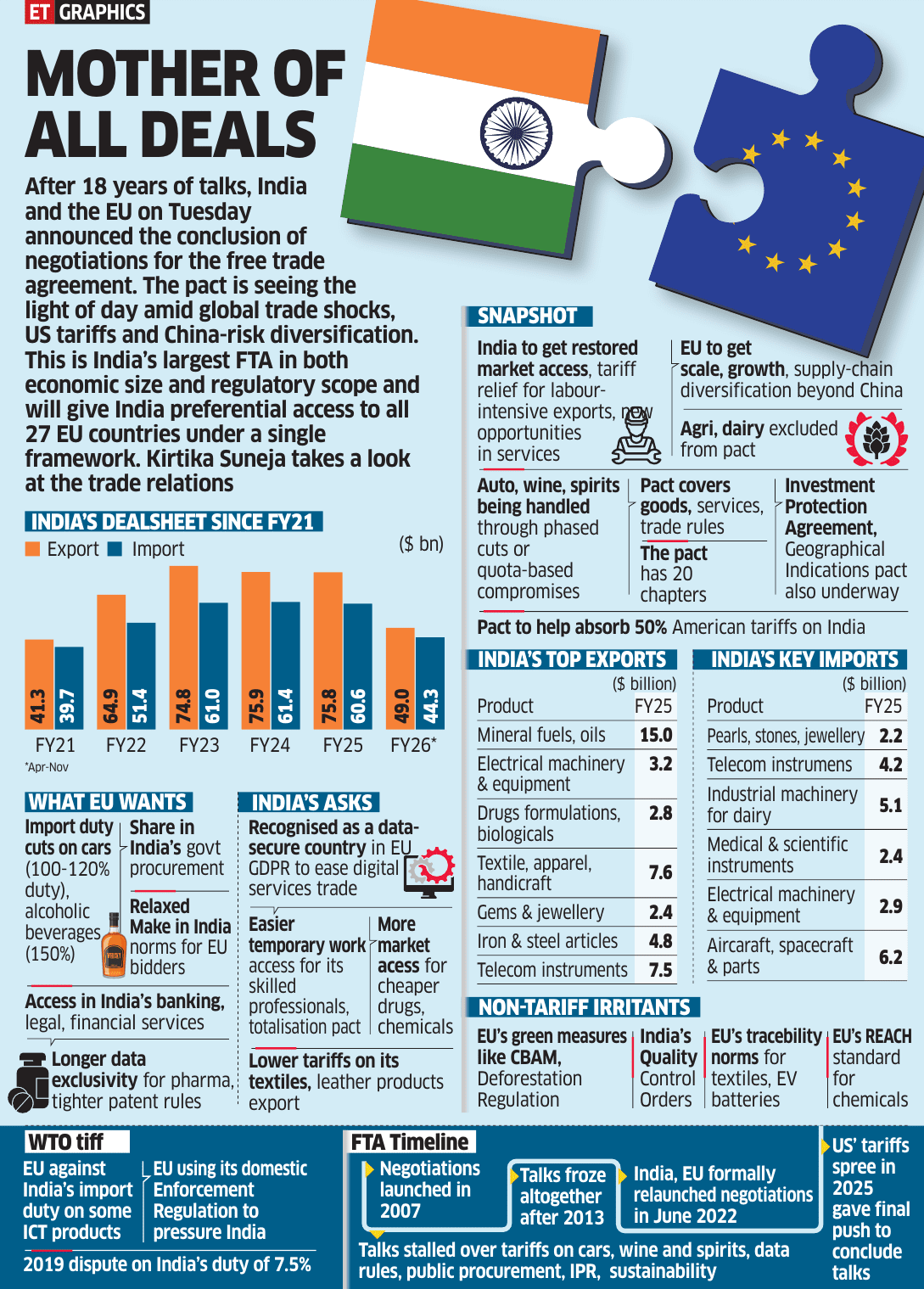
India–EU FTA Concluded: During the visit of the President of the European Commission, Ursula Von Der Leyen, and Prime Minister Narendra Modi jointly announced the conclusion of negotiations of the India-EU Free Trade Agreement (India-EU FTA). The FTA has been concluded after 18 years of negotiations, which started in 2007.
USA’s President Donald Trump has increasingly pursued a policy of weaponisation of tariffs. This increased protectionism and uncertainty across the globe has pushed both the EU and India to increasingly pursue trade deals. In the recent past, India has finalised trade deals with Australia, New Zealand & Oman, while the EU has announced trade deals with Mercosur (South American bloc), Indonesia, Mexico and Switzerland.
India’s Strategic Access to European Markets
- India has gained preferential access to European markets across 97% of tariff lines, covering 99.5% of trade value.
- Immediate duty removal on 70% of tariff lines, covering over 90% of India’s exports.
- Large number of zero-tariff lines: Zero tariffs for 93% of Indian goods within seven years. Partial cuts/quotas apply to 6% of goods, offering calibrated liberalisation.
- Wide in scope: 99.5% of bilateral trade receives some form of tariff concession.
- Safeguards for Sensitive sectors—notably automobiles and agriculture—are kept outside full tariff elimination.
- Reduction in the EU’s Average Tariff on Indian Exports: EU’s average tariff on Indian products falls steeply from 3.8% to 0.1%, boosting export competitiveness.
- Ends Duty Disadvantage: Currently, India’s exporters face tough competition from duty-free and quota-free shipments from least developed countries such as Bangladesh. The FTA will end this duty disadvantage for the Indian Industry.
- Benefits for labour-intensive sectors: 70.4% of tariff lines covering 90.7% of India’s exports will have immediate duty elimination for important labour-intensive sectors such as textiles, leather, footwear, tea, coffee, spices, sports goods, toys, gems & jewellery and certain marine products etc.
- Facilitative & predictable framework for business mobility: India-EU FTA provides a liberal framework for business mobility covering short-term, temporary & business travel in both directions. This will allow professionals to travel between the two economies
- Intra-Corporate Transferees (ICT) & Business Visitors: Both economies have mobility commitments for ICTs & Business Visitors along with entry & working rights for dependents & family members of ICTS.
- Contractual Service Suppliers (CSS): EU has offered commitments in 37 sectors/sub-sectors for
- Independent Professionals (IP):
- Social Security Agreements:
- Product Specific Rules (PSR) aligned with Supply Chains:
- FTA mandates adequate processing in India/EU for originating status, with PSRs requiring key processing while allowing flexible sourcing from global supply chains.
- Reduces time and cost of compliance for Indian exporters by allowing self-certification through a Statement of Origin.
- PSRs support MSMEs by granting quotas for key products, letting them use non-originating inputs flexibly like shrimps & prawns, and downstream aluminium products.
- Promote ‘Make in India’ by providing transition periods for PSRs in machinery and aerospace sectors.
- Boost for Services Exports:
- India has secured access to 144 service subsectors in EU, including IT/ITES, professional services, education and other business services.
- EU will gain access 102 service subsectors such as professional, business, telecom, maritime, financial and environmental services.
- Boost for Indian Traditional Medicine:
- Allows practitioners of Indian traditional medicine to provide their services using Indian professional qualifications in EU member states where regulations do not exist.
- Provides future certainty and commits the EU to the establishment of AYUSH wellness centres and clinics in EU member states.
- Greater exchange with the EU to facilitate trade in Indian Traditional Medicine services.
- Intellectual Property:
- Reinforces IPR protections provided under TRIPS – Copyright, Trademarks, Designs, Trade Secrets, Plant Varieties, Enforcement of IPRs & affirms Doha Declaration.
- Recognises the importance of digital libraries, especially the Traditional Knowledge Digital Library (TKDL) project of India.
- Exchange views and information on respective IP Laws, practices related to transfer of technology, facilitate information flows, and business partnerships.
Sectoral Gains for India under India-EU FTA
- Preferential Access for Agricultural Exports: India will secure preferential market access for its agricultural exports, enhancing export competitiveness for processed foods, tea, coffee, spices, table grapes, gherkins & cucumbers, sheep and lamb meat, sweet corn, dried onion, some other fruits and vegetable products.
- Safeguards: India has safeguarded sensitive sectors like dairy, cereals, poultry, soymeal, certain fruits and vegetables, etc.
- Benefits for India: Strengthen farmers’ income and rural livelihoods, & boosts competitiveness of Indian agricultural products.
- Preferential market access for engineering goods: FTA is expected to boost India’s engineering exports to the EU and increase India’s share in EU $2 trillion engineering goods imports. Presently, engineering goods from India face tariffs as high as 22% and stand at $16.6 billion.
- Benefits for India: Empowerment of MSME-led industrial hubs, boost industrial modernisation & competitiveness.
Plastic & Rubber Exports
- Chemicals Sectors: FTA will result in zero duty on 97.5% of India’s chemical exports by value.
- Mines & Minerals Sector: FTA will result in zero duties across 100% tariff lines for mineral products. This will reduce costs and ensure India’s exports of quality, reliable and value-added minerals to the EU.
- Preferential Market Access for Home Décor, Wooden Crafts & Furniture: Lower duties of up to 10.5% provides enhanced access, boosting competitiveness for Indian wooden, bamboo and handcrafted furniture. FTA will support growth of high-value, design-oriented segments and strengthen India’s integration in global furniture supply chains.
India’s offer to EU
India is offering 92.1% of its tariff lines covering 97.5% of EU exports. Some highlights of which are:
- Immediate duty elimination: India’s 49.6% tariff lines will have immediate duty elimination.
- Phased elimination: 39.5% of tariff lines will be subject to phased elimination over 5, 7 and 10 years.
- Gains for European Industry: India-EU FTA is expected to double EU exports to India by 2032 by cutting tariffs on 96.6% of traded goods by value. The EU will also save 4 billion euros in duties on exports to India.
- Competitive advantage for EU exporters, with the biggest trade opening provided by India to any trade partner.
- Privileged access to India for EU service providers in key areas of financial and maritime services.
Sectoral Benefits for European Industry
- Automobile Industry of Europe: Currently, European cars attract an import duty of over 100%. Under the India-EU FTA, cars costing more than 15,000 euros (Around Rs 16 lakhs) will attract a duty of 40%. This duty will be further reduced by 10%, making European cars significantly cheaper for Indian consumers.
- Safeguards for Indian Automobile Sector: The trade deal has a quota based duty concessions.
- Wine Industry of Europe: Currently, India applies an import duty of 150% on imported wine. Under the India-EU FTA this duty will be reduced to 20%, significantly reducing prices of European wines imported in India. This reduction will be implemented gradually over a period of 5-10 years to contain the impact on domestic manufacturers.
- Safeguards for Indian Wine makers: There will be no duty concessions for European wines costing less than 2.5 Euros. India wines will also get duty concessions in EU member countries.
- European Medical Industry: Tariffs on pharmaceutical exports from Europe to India will drop to zero from 11% currently for almost all medicinal products. This will make access to life-critical innovative medicines and systems available in India.
Unresolved Issues in India-EU Trade
- EU’s Regulatory Maze: The EU has been protecting its international trade through its ever-expanding regulations that tend to:
- Discourage exporters due to the steep compliance burden
- Impose complex compliance mechanisms, increasing the cost of imports and protecting local producers.
- India does not have compliance standards in place
Some protectionist EU regulations
- Carbon Border Adjustment Mechanism (CBAM): EU’s CBAM remains an unresolved issue because even with tariff elimination under the India-EU FTA, carbon-related charges could still apply to India’s carbon-intensive exports such as steel, aluminium, oil refinery, paper, glass, chemical & fertilisers.
- New Recycling Policy: The EU is restricting its exports of scrap under its new recycling policy. The EU is the world’s largest producer of steel scrap, a critical input for low-carbon steel production.
- EU Deforestation Regulation: EUDR aims prevent imports of products sourced from deforested land into the EU. Analysts expect EUDR to adversely impact India’s agricultural exports due to India’s higher deforestation rate.
- EU’s stringent SPS/TBT & Non-tariff barriers: EU’s strict SPS (Sanitary and Phytosanitary) and TBT (Technical Barriers to Trade) regulations pose compliance challenges for Indian agri-exports and manufactured goods.
- EU Directive on Corporate Sustainability Due Diligence (CSDD): Requires companies to identify and address adverse human rights and environmental impacts of their actions inside and outside Europe.
- Industrial Accelerator Act: Aims to introduce local content norms mandating minimum domestic value addition.
- Asymmetric benefit to Europe vis-a-vis India: Presently, almost 80% of India’s exports to the EU attract less than 1% tariffs without the India-EU FTA. Critics argue Indian goods will not gain significant market access under the FTA compared to what European companies can reap in one of the fastest-growing markets across the world.
Challenges in India–EU FTA
- Limited additional market access for India as most exports already face low EU tariffs
- Asymmetric gains: EU benefits more from tariff cuts in Indian market
- Adjustment pressure on Indian MSMEs and protected industries
- High productivity gap between Indian and European firms
- EU’s regulatory barriers (CBAM, EUDR, CSDD, SPS/TBT) dilute FTA benefits
- Carbon competitiveness risk for steel, aluminium, cement, chemicals
- Weak standards, testing and certification infrastructure in India
- Low awareness among MSMEs about Rules of Origin and PSRs
- Logistics and supply-chain inefficiencies
- Risk to sensitive sectors like automobiles and wines
Significance of India-EU FTA (Mother of all Deals)
- EU is one of the largest trading partners of India, with bilateral trade in goods and services standing at approx. 220 billion in FY 2024-25.
- The EU is the world’s 2nd largest economy, and India the world’s 4th largest economy, together accounting for 25% of Global GDP and one-third of global trade.
- Integrate a market of over 1.9 billion people, creating one of the world’s largest free trade agreements.
- Promotion of bilateral trade, mutual foreign direct investment and business collaborations between the two countries.
- Provides a framework for political collaboration and certainty in a world increasingly marked by conflict and uncertainty.
Way Forward
- Set up a Trade Adjustment Fund for MSMEs and vulnerable sectors
- Accelerate PLI, technology upgradation and cluster development
- Seek transition periods and financial/technology support for CBAM & green norms
- Improve logistics, ports, customs and digital trade facilitation
- Strengthen quality infrastructure aligned with EU standards
- Promote export diversification into engineering, green tech, medical devices
- Build India as a China+1 and EU supply-chain partner
- Create FTA helpdesks for MSMEs on compliance and self-certification
- Push green manufacturing and renewable-based industry
- Include periodic review and correction mechanisms in the FTA
Conclusion
The India–EU FTA is not just a trade agreement but a strategic partnership to rebalance global trade, de-risk supply chains and deepen economic cooperation. While it offers vast opportunities in market access, services, green technology and investment, its real success will depend on India’s ability to enhance competitiveness, support MSMEs, meet regulatory standards and transition towards sustainable manufacturing. If implemented with strong domestic reforms and strategic diplomacy, the FTA can become a catalyst for inclusive growth and position India as a trusted economic partner of Europe in an increasingly uncertain world.
 Supreme Court Upholds the Right to Die w...
 GDP Growth vs Employment Reality: Unders...
 Bill to Codify IPS Deputation in CAPFs: ...











 WhatsApp





