
Table of Contents
Context
A recent report by the Council on Energy, Environment and Water (CEEW) titled ‘Building a Green Economy for Viksit Bharat’ asserts that India’s goal of becoming a $30 trillion economy by 2047 is unattainable unless women are systematically integrated into green value chains.
Opportunities for Women in the Green Sector
- Untapped Labour Supply for Green Growth: Women’s labour force participation is 7%, compared to 78.8% for men, indicating a large reserve workforce for India’s green transition.
- Productivity Gains from Gender Inclusion: A 1% increase in gender diversity in formal manufacturing is associated with ~2.9% higher labour productivity, highlighting economic returns from women’s participation.
- Renewable Energy Workforce Expansion: Women already constitute ~32% of the global renewable energy workforce, offering scope to scale participation in solar, wind, hydrogen, and grid modernisation.
- Circular Economy and Waste Value Chains: Nearly 5 million women (≈49% of waste pickers) are engaged in waste collection and segregation, forming a base for formalisation, skilling, and income upgrading.
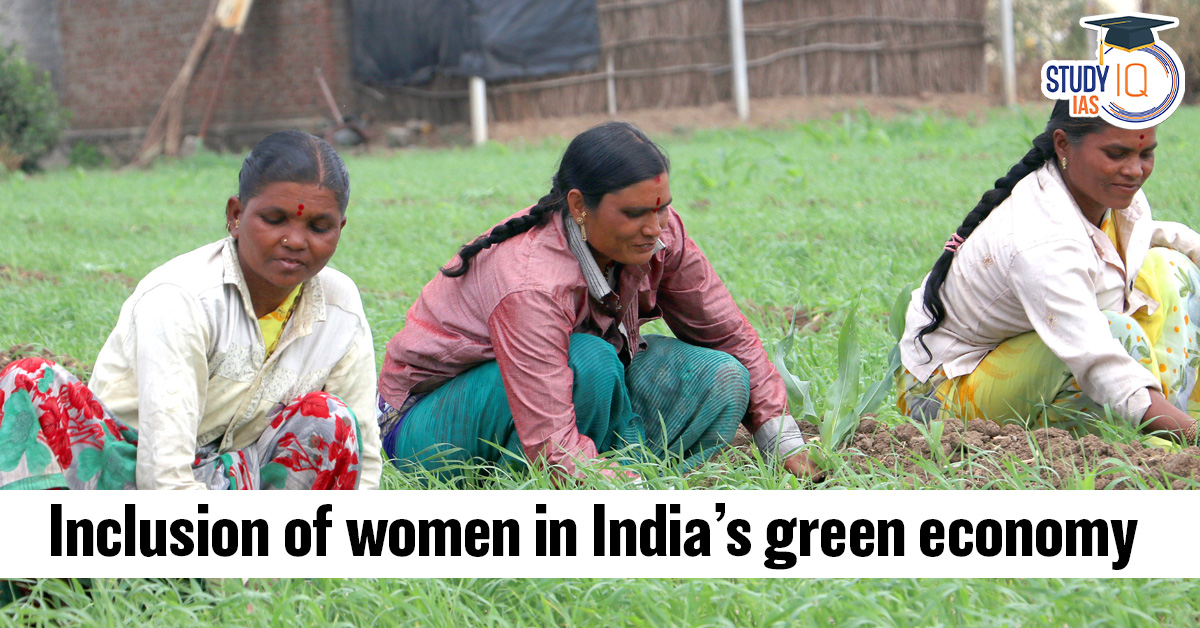
- Bio-economy and Nature-based Solutions (NbS): Women are central to agroforestry, seaweed farming, bio-inputs, and ecosystem restoration, sectors expected to grow with climate action and carbon markets.
Issues Facing Women in the Green Sector
- Low Participation in High-Value Green Jobs: Women are concentrated in administrative and non-STEM roles, with weak representation in engineering, construction, and site-based green jobs.
- Severe Gender Gaps in Renewable Deployment: Indian rooftop solar firms report only ~11% female workforce, with negligible participation in construction, commissioning, and O&M activities.
- Informality and Wage Inequality: In circular economy roles, women earn ~33% less than men for identical work and remain largely informal without social security.
- Caste–Gender Intersectional Vulnerability: A majority of women in waste and recycling value chains belong to Dalit and Adivasi communities, facing hazardous work, stigma, and exclusion from formal jobs.
- Invisible and Unpaid Labour in Bio-economy: Women perform labour-intensive, unpaid or underpaid work, while value addition, ownership, and formal employment remain male-dominated.
Way Forward
- Targeted Green Skilling and STEM Inclusion: Prioritise women in engineering, construction, O&M, and energy storage training to address under-representation.
- Link Green Jobs with Formal Employment and Social Security: Formalise circular economy and waste value chains by ensuring minimum wages, PPE, ESIC, and EPFO coverage.
- Industry Incentives for Gender-Diverse Hiring: Provide fiscal incentives and procurement preferences to green firms increasing female workforce share.
- Women-Centric Apprenticeships and On-Site Employment: Mandate women’s quotas in green apprenticeships and rooftop solar deployment.
- Value-Chain Upgradation in Bio-economy and NbS: Move women from unpaid labour to value addition and ownership in agroforestry, seaweed, and bio-inputs through SHGs, FPOs, and market-linked enterprises, addressing persistent gendered segmentation.
 Viksit Bharat Shiksha Adhishthan Bill 20...
 Cyclone Maila Intensifies Over Solomon S...
 List of Military Exercises of India 2026...













 WhatsApp





