
Table of Contents
Context
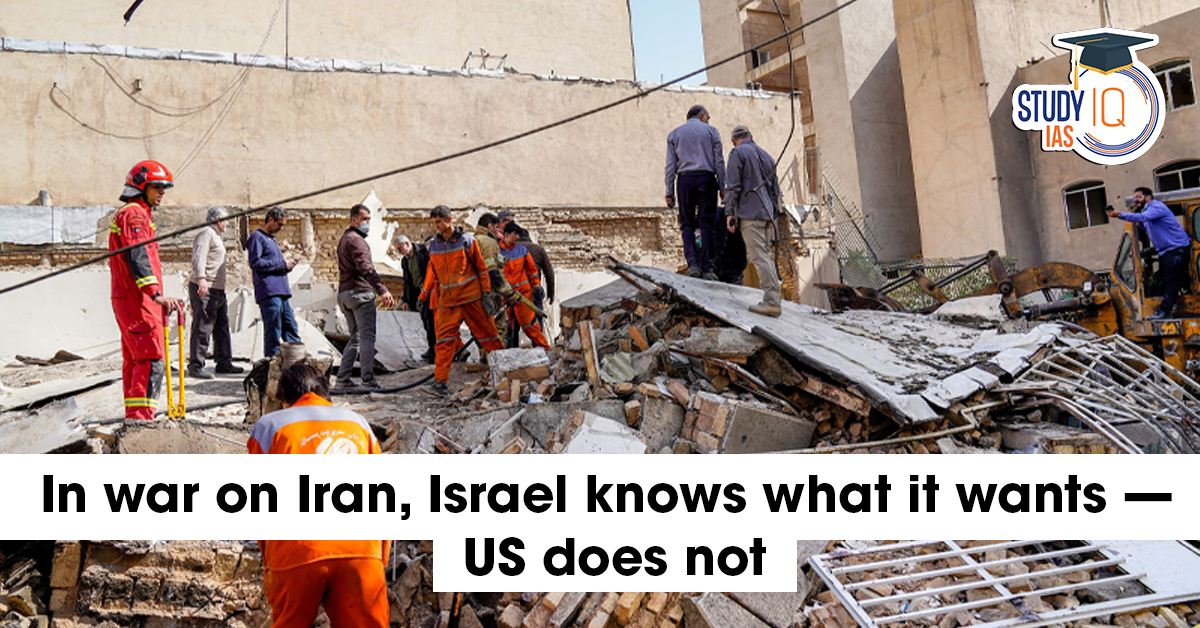
- The ongoing conflict involving Iran, Israel, and the United States highlights a deeper strategic reality: while Israel pursues a clear objective of regime change, the United States appears to have shifting and ambiguous goals. Meanwhile, Iran is not trying to win in a conventional sense but is focused on regime survival, a principle embedded in its political system since the 1979 Islamic Revolution. This asymmetry in objectives shapes the trajectory and outcomes of the conflict.
How Iran Maintains the Survival of the Revolution/Regime
- Institutionalised Survival Doctrine: The Islamic Republic is built around the principle that preserving the regime is the highest priority, guiding all political, military, and strategic decisions.
- Role of the Islamic Revolutionary Guard Corps (IRGC): The IRGC functions as a parallel military force loyal to the regime, tasked not just with national defence but with protecting the ideological and political system.
- Dual Military Structure: Iran maintains both a regular army (for territorial defence) and the IRGC (for regime protection), ensuring internal stability even during external threats.
- Rapid Leadership Continuity Mechanism: The swift appointment of a new Supreme Leader reflects the regime’s ability to ensure political continuity even under crisis conditions.
- Adaptation through Pressure: The regime has survived sanctions, protests, proxy wars, and external attacks by adopting a strategy of resilience, repression, and long-term endurance.
- Use of Proxy Networks: Iran extends its influence through groups like Hezbollah and allied militias, creating strategic depth and indirect deterrence against adversaries.
Difference in War Aims: Israel vs United States
| Aspect | Israel | United States |
| Core Objective | Regime change in Iran: Aims to end the Islamic Republic system completely. | Mixed and shifting goals: Focus ranges from nuclear rollback to limited military success. |
| Strategic Clarity | Clear and consistent strategy: Sees Iran as an existential threat that must be eliminated. | Lack of coherence: Strategy fluctuates between military pressure and diplomatic engagement. |
| Approach to Conflict | Long-term transformation: Seeks fundamental political change in Iran. | Short-term outcomes: May aim for quick exit with a claim of victory. |
| View on Regime Survival | Regime must not survive: Believes deterrence is insufficient. | Regime survival acceptable: If nuclear threat is reduced, regime continuity may be tolerated. |
| Post-War Vision | End of Islamic Republic: Advocates a new political order in Iran. | Unclear endgame: No clear plan for post-conflict governance or stability. |
Iran’s Strategy to Counter the Attacks
- Survival over Victory: Iran’s primary objective is not to defeat Israel or the US, but to ensure regime survival by raising the cost of war.
- Escalation through Regional Leverage: Iran expands the conflict by targeting multiple regions and actors, increasing the geopolitical cost for adversaries.
- Control of Strategic Chokepoints: By threatening or restricting traffic through the Strait of Hormuz, Iran leverages its position to disrupt global oil supply and economic stability.
- Use of Missile and Drone Warfare: Iran employs asymmetric warfare tools such as missiles and drones to compensate for conventional military limitations.
- Economic Pressure through Oil Markets: By driving up global oil prices, Iran creates indirect pressure on Western economies and global markets.
- Exploiting Strategic Divisions: Iran benefits from the lack of alignment between Israel and the United States, using this gap to prolong the conflict and avoid decisive defeat.
- Cost-Imposition Strategy: The aim is to make the war so economically, politically, and militarily costly that adversaries prefer containment over regime change.
|
Read More Notes |
|
| Environment Notes | Art and Culture Notes |
| Science and Tech | History Notes |
| Geography Notes | Indian Polity Notes |
| General Knowledge | International Relation |
|
Explore StudyIQ Courses |
|
 Neighbourhood Diplomacy and the West Asi...
 Key Takeaways from the Expanding Conflic...
 World Happiness Report 2026: Finland Top...






 WhatsApp





