
Table of Contents
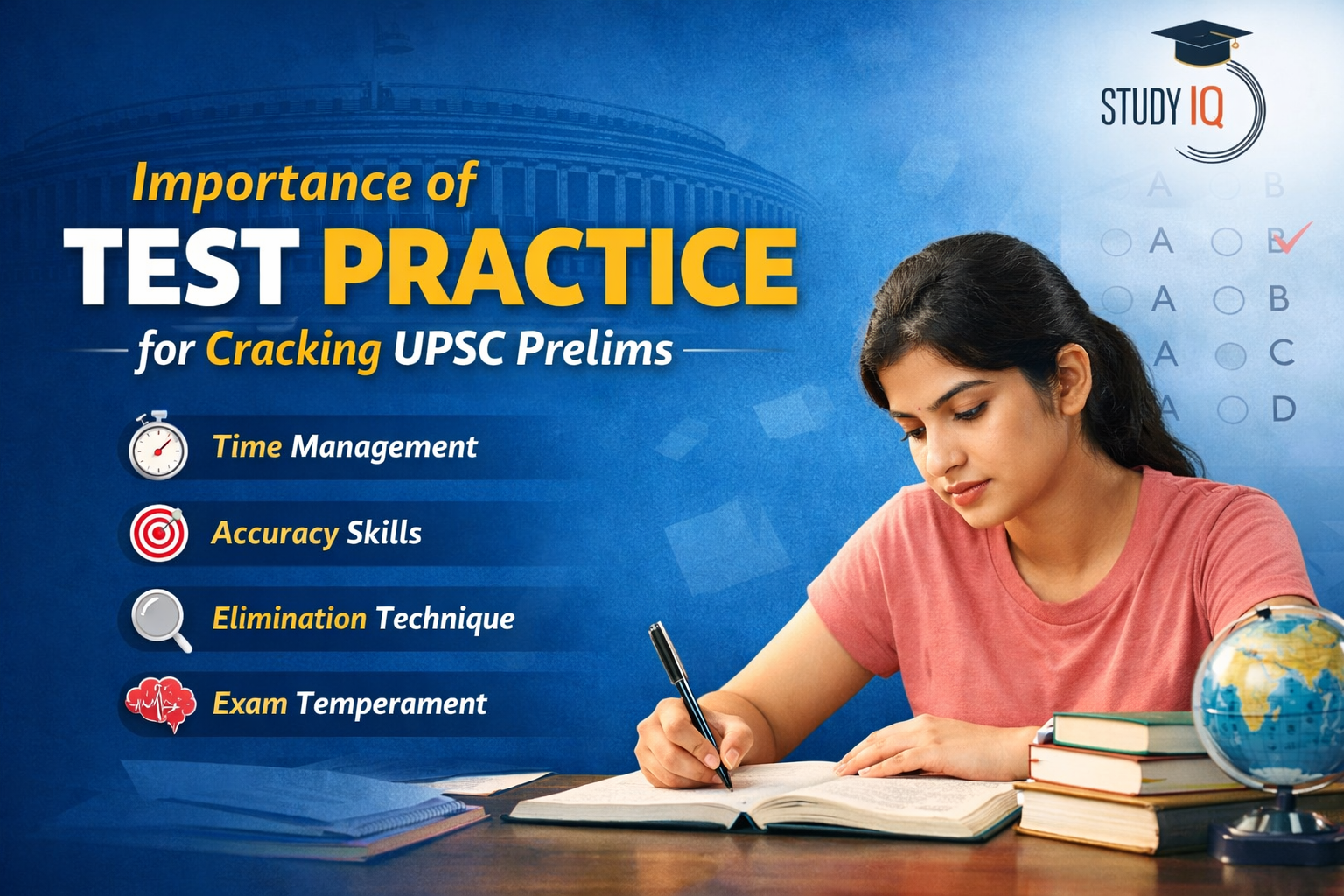
Preparing for the Civil Services Examination conducted by the Union Public Service Commission (UPSC) requires much more than just completing the syllabus. One of the most decisive factors in clearing the exam is consistent and structured test practice. A well-planned UPSC Prelims mock test strategy helps aspirants convert knowledge into marks, improve accuracy, and develop the exam temperament needed to perform under pressure.
For serious aspirants, test practice is not an optional add-on — it is a core pillar of a successful UPSC Prelims preparation strategy.
Why Test Practice is Critical for UPSC Prelims
UPSC Prelims is not just a knowledge-based exam — it is a decision-making test under strict time pressure.
Key Prelims Reality
-
Around 10–12 lakh candidates apply every year.
-
Roughly 5–6 lakh candidates appear for Prelims.
-
Only 10,000–13,000 candidates qualify for Mains (≈ 2–3%).
Even well-prepared aspirants often fail due to:
-
Poor time management
-
Over-attempting questions
-
Low accuracy
-
Panic during the exam
Regular mock testing directly addresses these problems and improves overall exam performance.
Data Insight: Why Many Aspirants Fail Despite Studying
Based on trends from major coaching test series and topper interviews, the most common reasons for failure include:
| Reason | Approx Impact |
|---|---|
| Lack of revision | Very High |
| Poor test practice | Very High |
| Weak elimination skills | High |
| Ignoring PYQs | High |
| Poor exam temperament | High |
Many successful candidates report solving 40–70+ full-length mock tests before the actual exam.
How Mock Tests Improve Prelims Performance
1. Builds Exam Temperament
UPSC Prelims requires:
-
2 hours of continuous focus
-
Handling unfamiliar and tricky questions
-
Staying calm under pressure
Mock tests simulate real exam conditions and reduce exam-day anxiety.
2. Improves Time Management
Average time per question:
-
GS Paper → About 1.2 minutes per question
Without practice:
-
Aspirants waste time on difficult questions
-
Easy questions get skipped
Mock practice trains aspirants to select questions smartly and maintain speed.
3. Develops Elimination Technique
UPSC questions often:
-
Have very close options
-
Test conceptual clarity
-
Reward logical elimination
Mock tests improve:
-
Option filtering ability
-
Risk assessment
-
Intelligent guessing
Many toppers solve 15–25 questions through elimination techniques alone.
4. Improves Accuracy (Most Important Factor)
UPSC Prelims has negative marking (1/3 penalty).
Example:
-
Attempted = 90
-
Correct = 60
-
Wrong = 30
-
Final score drops significantly due to negative marking
Mock practice helps aspirants:
-
Reduce silly mistakes
-
Avoid risky attempts
-
Improve attempt-to-accuracy ratio
Role of Test Practice in Revision
Mock tests act as active revision tools.
Why Active Revision is More Effective
-
Reading → Passive memory
-
Testing → Active recall + Concept application
After each test, aspirants revise:
-
Weak areas
-
Wrong concepts
-
Guesswork errors
This creates a powerful Test → Analysis → Revision loop.
Ideal UPSC Prelims Mock Test Strategy
Early Preparation Stage
Focus: Learning concepts
Tests: Occasional sectional tests
Mid Preparation Stage
Focus: Concept application
Tests: Regular sectional + full-length tests
Final Preparation Stage
Focus: Accuracy + Speed
Tests: Frequent full-length mock tests
Importance of Test Analysis (Most Ignored Step)
Taking tests alone is not enough. Proper analysis is equally important.
Good Test Analysis Includes
-
Why was the answer wrong?
-
Concept gap or factual gap?
-
Misreading the question?
-
Overconfidence attempt?
Serious aspirants spend 2–3 times the test duration in analysis.
How Test Practice Helps in Current Affairs Questions
UPSC current affairs questions are rarely direct. Mock tests help aspirants:
-
Apply current affairs knowledge in MCQ format
-
Link current affairs with static subjects
-
Recognize trap options
This strengthens the overall preparation strategy.
CSAT and Test Practice
Many aspirants underestimate CSAT, which can be risky.
Mock tests help in:
-
Improving comprehension speed
-
Increasing logical reasoning accuracy
-
Managing time between sections
Regular CSAT testing prevents last-minute panic.
Psychological Benefits of Test Practice
Confidence Building
Regular score improvement boosts confidence.
Stress Reduction
Familiarity with exam pattern reduces exam fear.
Better Decision Making
Helps aspirants decide:
-
When to attempt
-
When to skip
-
When to guess
Common Mistakes in Test Practice
-
Taking tests without analysis
-
Comparing scores blindly with others
-
Ignoring weak subjects in mocks
-
Panicking over low initial scores
Low initial scores are normal — improvement trend matters more than starting score.
Golden Rule: Knowledge Does Not Equal Marks
UPSC rewards:
-
Concept application
-
Smart question selection
-
Risk management
-
Accuracy consistency
Test practice is the bridge between knowledge and marks.
|
Read More Notes |
|
| Environment Notes | Art and Culture Notes |
| Science and Tech | History Notes |
| Geography Notes | Indian Polity Notes |
| General Knowledge | International Relation |
|
Explore StudyIQ Courses |
|
 NATO Countries List 2026, Members, Funct...
 UPSC CMS Notification 2026 Out – Apply...
 UPSC CMS Previous Year Papers – Downlo...







 WhatsApp





