
Table of Contents
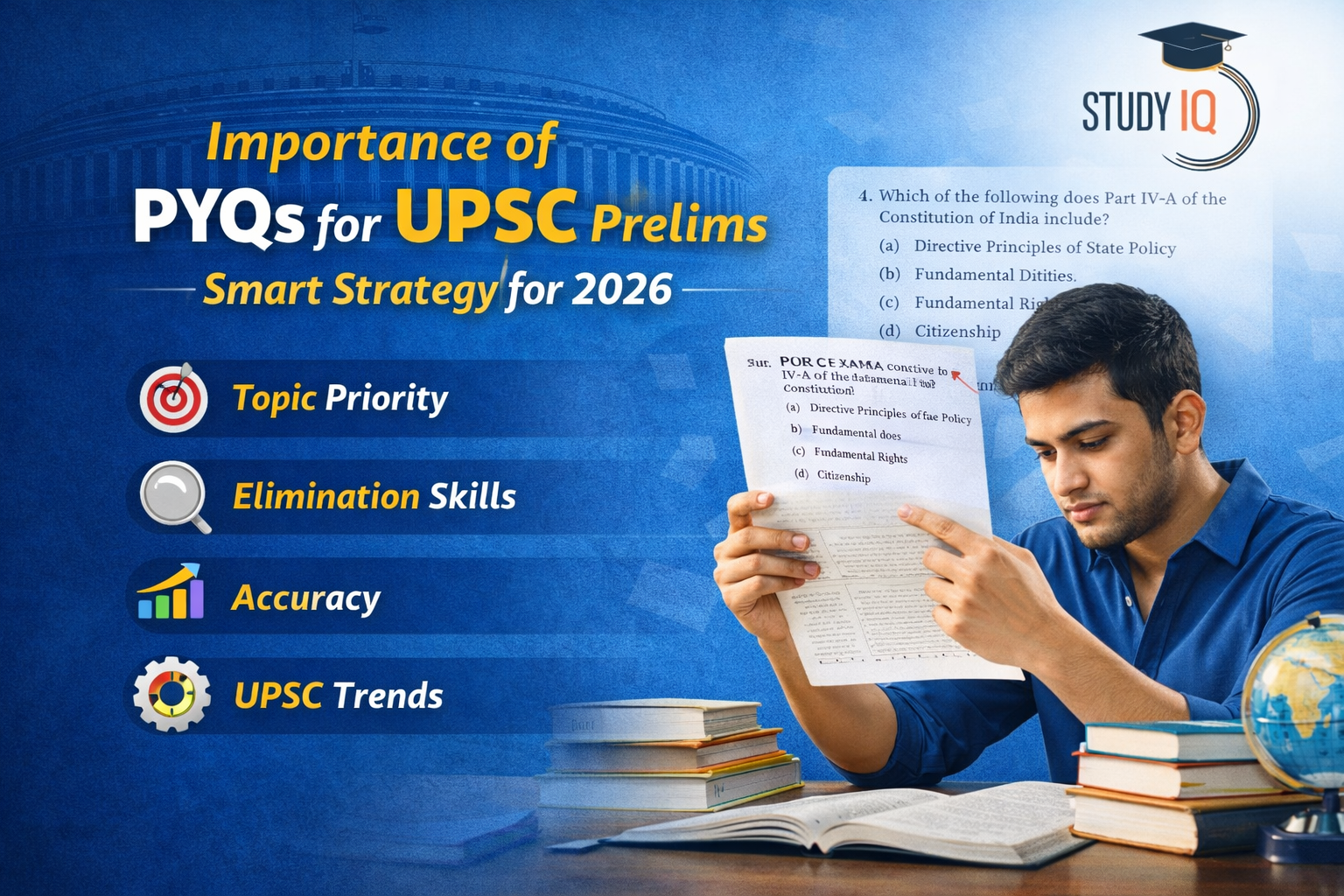
Preparing for UPSC Prelims 2026 without solving Previous Year Questions (PYQs) is like preparing for a match without understanding the opponent. PYQs are not just old questions—they are direct indicators of how the Union Public Service Commission (UPSC) thinks, frames options, and tests concepts. A smart PYQ strategy can significantly improve accuracy, reduce unnecessary study load, and align preparation with actual exam demand.
This article explains why PYQs are critical for UPSC Prelims 2026, how to use them smartly, and how they fit into an exam-oriented preparation strategy.
Why PYQs Matter More Than Any Other Resource
UPSC does not ask random questions. Over time, clear patterns have emerged in:
-
Topic selection
-
Concept depth
-
Option framing
-
Repetition of themes (not exact questions)
Key Fact
Analysis of the last 25 years of UPSC Prelims papers shows that 60–70% of questions are directly or indirectly linked to PYQs through repeated concepts, themes, or option traps.
This makes PYQs the most reliable compass for UPSC Prelims preparation.
What PYQs Reveal About UPSC Prelims
UPSC Tests Concepts, Not Just Facts
Many aspirants complete books but fail because they don’t understand how concepts are tested.
Example:
Topic → Fundamental Rights
PYQs show focus on:
-
Reasonable restrictions
-
Exceptions
-
Judicial interpretations
Without PYQs, aspirants often over-study low-yield areas and ignore high-impact areas.
PYQs Define Priority Areas
Not all syllabus topics carry equal weight.
Trend-Based Observation
-
Polity: Parliament, Constitutional Bodies, FR–DPSP linkage
-
Environment: National Parks, Conventions, Species Status
-
Economy: Inflation, Monetary Tools, Government Schemes
-
Geography: Mapping, Physical Processes
PYQs help aspirants prioritize smartly instead of studying everything equally.
PYQs and the Art of Option Elimination
UPSC Prelims is increasingly elimination-based.
Data Insight
In most Prelims papers:
-
15–25 questions can be solved using elimination
-
Extreme words like always, only, never are often incorrect
-
UPSC repeats similar trap options across years
PYQs train aspirants to:
-
Identify trap statements
-
Recognize recurring distractors
-
Avoid overconfidence errors
This skill alone can add 15–20 marks.
How PYQs Improve Accuracy (Most Important Factor)
UPSC Prelims has negative marking (–1/3). Clearing cutoff depends more on accuracy than attempts.
Without PYQs
-
Blind guessing
-
Over-attempting
-
High negative marks
With PYQs
-
Informed guessing
-
Controlled attempts
-
Better accuracy ratio
Most successful aspirants maintain:
-
Attempts → 85–95
-
Accuracy → 60–65%+
PYQ practice is the fastest way to reach this zone.
PYQs as a Revision Tool (Active Recall)
Reading is passive. Solving PYQs forces:
-
Recall
-
Application
-
Decision-making
Each PYQ revises:
-
Multiple concepts
-
Static + current linkage
-
Analytical thinking
This makes PYQs one of the most efficient revision tools for Prelims 2026.
How Many Years of PYQs Are Enough?
Ideal Range
-
Last 25–30 years for GS Paper 1
-
Last 10–15 years → Multiple revisions
Why Older PYQs Matter
Even if facts change, conceptual frameworks remain constant—especially in Polity, Economy, and Geography.
How to Use PYQs Smartly for UPSC Prelims 2026
Step 1: Topic-Wise PYQ Solving
Solve PYQs after completing each subject or topic.
Step 2: PYQ Mapping
Map each PYQ to:
-
NCERT topic
-
Standard book chapter
-
Current affairs linkage
Step 3: Error Analysis
Maintain a notebook for:
-
Repeated mistakes
-
Weak concepts
-
Guesswork errors
Step 4: PYQ Revision
Revisit PYQs:
-
Before mock tests
-
During final revision
PYQs + Mock Tests = Winning Combination
-
PYQs → Show what UPSC asks
-
Mock Tests → Train how to answer under pressure
Together they improve:
-
Speed
-
Accuracy
-
Decision-making
Aspirants who combine PYQs with mock test analysis consistently outperform content-only learners.
Common Mistakes Aspirants Make with PYQs
-
Solving PYQs only once
-
Treating PYQs as just practice questions
-
Not analyzing incorrect options
-
Ignoring older PYQs
-
Solving PYQs too late
PYQs are not an end-stage resource — they should be used throughout preparation.
PYQs and Current Affairs Integration
UPSC often asks static questions triggered by current events.
Example:
Current → Climate Agreement
PYQ Link → Conventions, Protocols, Environmental Frameworks
PYQs help aspirants understand how current affairs are converted into MCQs.
Final Takeaway: PYQs Are Non-Negotiable
For UPSC Prelims 2026, PYQs are not optional—they are foundational.
Smart PYQ Strategy Means:
-
Understanding UPSC mindset
-
Focusing on high-yield topics
-
Developing strong elimination skills
-
Improving accuracy with controlled risk
If content builds knowledge, PYQs build selection.
|
Read More Notes |
|
| Environment Notes | Art and Culture Notes |
| Science and Tech | History Notes |
| Geography Notes | Indian Polity Notes |
| General Knowledge | International Relation |
|
Explore StudyIQ Courses |
|
 NATO Countries List 2026, Members, Funct...
 UPSC CMS Notification 2026 Out – Apply...
 UPSC CMS Previous Year Papers – Downlo...







 WhatsApp





