
Table of Contents
Context
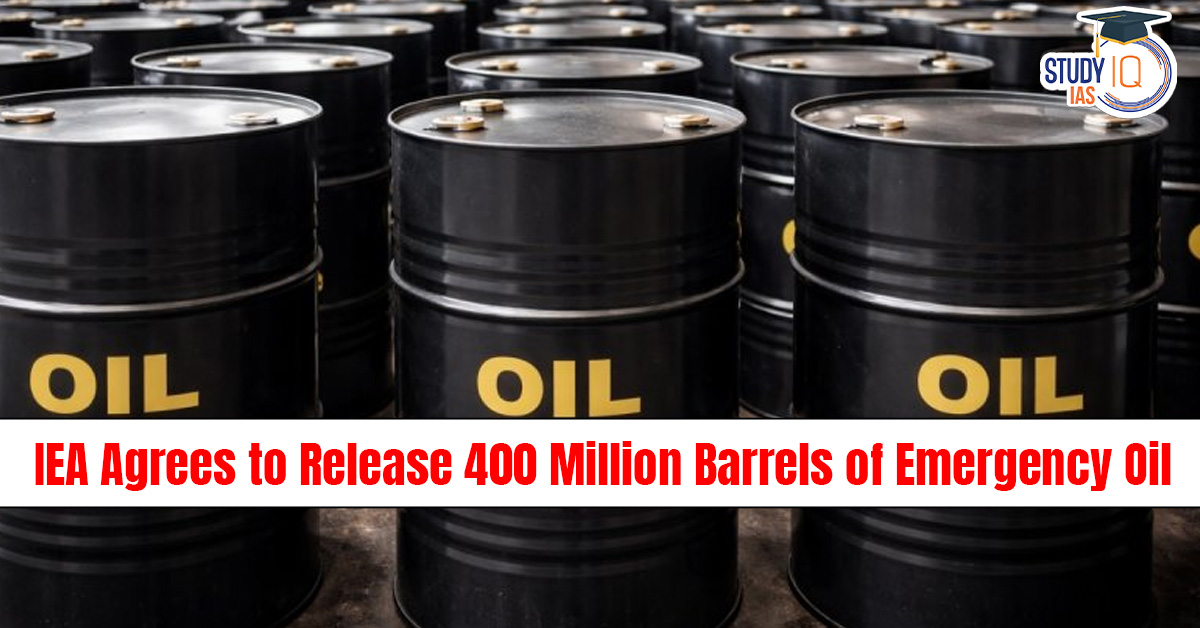
- The International Energy Agency (IEA) has announced the release of 400 million barrels of oil from emergency reserves. The move aims to stabilise global energy markets after the conflict disrupted shipping routes and reduced oil exports from the Persian Gulf, causing global crude prices to surge above $100 per barrel.
|
Global Strategic Oil Reserves: Size and Significance |
| ● Global Reserve Holdings: IEA member states collectively hold massive emergency oil stocks:
○ 1.2 billion barrels of public strategic oil reserves ○ 600 million barrels of industry stocks held under government mandate ○ These reserves act as a global buffer against sudden supply disruptions. ● National Strategic Reserves: Individual countries maintain their own emergency reserves: ○ The United States maintains the world’s largest Strategic Petroleum Reserve. ○ Japan, Germany, and France also maintain significant oil stockpiles. ○ These reserves typically cover 90 days or more of net oil imports, ensuring energy security during crises. ● Purpose of Strategic Reserves: Strategic reserves are designed to: ○ stabilise markets during supply disruptions ○ prevent extreme price spikes ○ ensure essential fuel supply for transportation and industry ○ Reduce economic shocks during geopolitical crises |
How the IEA Releases Strategic Oil Reserves
- Coordinated International Mechanism: The IEA operates a coordinated emergency response system among its 32 member countries. When global oil supply is disrupted, the agency can request member states to release oil from their Strategic Petroleum Reserves (SPR).
- Types of Emergency Measures: IEA responses generally include:
- Releasing government-held strategic reserves into the market
- Mandating industry stock releases held under government obligations
- Demand restraint measures, such as fuel consumption limits
- Fuel switching and energy conservation policies
- Emergency Release Process: Once the decision is taken:
- Member countries announce their contribution volumes
- Oil is auctioned or released to refiners and energy companies
- Supplies enter the market gradually over weeks to stabilise prices
- This system was created after the **1973 oil crisis to protect global economies from energy shocks.
Impact of the Current Oil Reserve Release
- Stabilising Global Oil Prices: The release of 400 million barrels aims to increase supply in the short term, easing market panic and preventing extreme oil price spikes.
- Energy analysts believe this could temporarily stabilise crude prices and reduce inflationary pressures on global economies.
- Response to Strait of Hormuz Disruption: The move was triggered by the near shutdown of shipping through the Strait of Hormuz, through which roughly 15 million barrels of crude oil per day and 5 million barrels of refined products per day normally pass—accounting for nearly 25% of global seaborne oil trade.
- Disruptions at this chokepoint have reduced export volumes to less than 10% of pre-conflict levels.
- Protection of Critical Fuel Supplies: The crisis has also disrupted refinery operations in the region, affecting supplies of diesel, jet fuel and liquefied natural gas (LNG)
- The reserve release helps maintain fuel availability for aviation, transportation, and industry.
- Coordinated Response by Major Economies: Several countries have already announced their contributions:
- France pledged about 5 million barrels
- Germany, Austria, and Japan confirmed releases from national reserves
- The Group of Seven (G7) countries together account for roughly 70% of the total reserve release.
|
Read More Notes |
|
| Environment Notes | Art and Culture Notes |
| Science and Tech | History Notes |
| Geography Notes | Indian Polity Notes |
| General Knowledge | International Relation |
|
Explore StudyIQ Courses |
|
 Black Rain Crisis in Iran: Causes, Envir...
 Anna Mani: Pioneer of Indian Meteorology...
 Lakkundi Treasure: Rare Gold Coins Disco...











 WhatsApp





