
Table of Contents
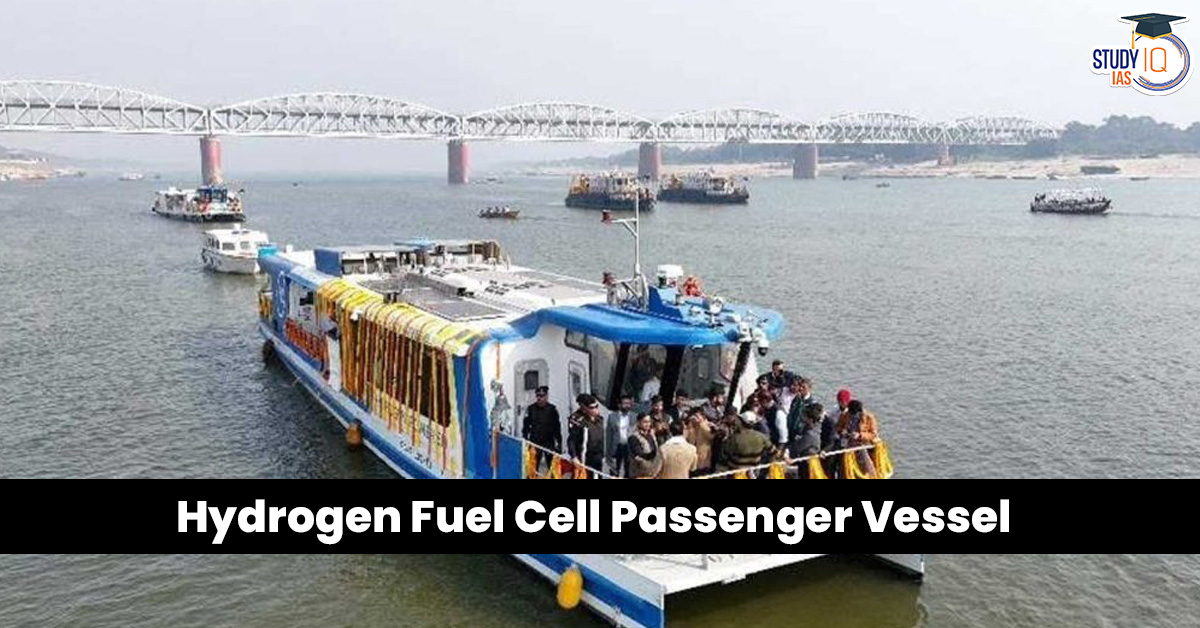
India has taken a historic step towards green and sustainable inland water transport with the launch of its first indigenous hydrogen fuel cell passenger vessel. Flagged off in Varanasi on 11 December 2025, this zero-emission vessel marks a major milestone in India’s journey towards decarbonising the maritime sector and promoting clean mobility.
The hydrogen-powered vessel operates on the Ganga River (National Waterway-1) and represents the successful convergence of Make in India, clean energy transition, and modern inland navigation.
What is a Hydrogen Fuel Cell Passenger Vessel?
A hydrogen fuel cell passenger vessel uses hydrogen as fuel to generate electricity through a fuel cell, which powers electric motors for propulsion. Unlike conventional diesel vessels, it produces no harmful emissions—only water and heat as by-products.
This technology is increasingly seen as the future of green maritime transport, especially for inland waterways and short-distance ferry services.
Key Features of India’s Hydrogen Fuel Cell Passenger Vessel
| Feature | Details |
|---|---|
| Vessel Type | Catamaran |
| Length | 24 metres |
| Passenger Capacity | 50 passengers |
| Propulsion Technology | LT-PEM Hydrogen Fuel Cell |
| Configuration | Hybrid (Hydrogen + Battery + Solar Panels) |
| Speed | 6.5–9 knots |
| Operational Range | Up to 8 hours on a single hydrogen refill |
| Emissions | Zero (only water vapour) |
| Noise | Silent operation |
| Certification | Indian Register of Shipping |
| Fare | ₹50 per passenger |
Technology Used: LT-PEM Fuel Cell
The vessel uses Low-Temperature Proton Exchange Membrane (LT-PEM) fuel cell technology:
-
Hydrogen reacts with oxygen to generate electricity
-
No combustion involved
-
High efficiency and rapid response
-
Suitable for maritime and transport applications
-
Ideal for urban and inland waterways
This technology ensures safe, stable, and eco-friendly propulsion.
Indigenous Development and Infrastructure
-
Built by: Cochin Shipyard Limited
-
Owned by: Inland Waterways Authority of India (IWAI)
-
Operator: Inland and Coastal Shipping Ltd
-
Hydrogen Refuelling Station: Multi-Modal Terminal, Ramnagar (Varanasi)
The entire project is fully indigenous, reinforcing India’s self-reliance in advanced green maritime technologies.
Operational Route in Varanasi
-
Route Length: ~5 km
-
Route: Namo Ghat → Lalita Ghat
-
Target Users: Pilgrims, tourists, and daily commuters
The vessel provides a smooth, vibration-free and noise-free experience, enhancing tourism on the Ganga.
Significance of Hydrogen Fuel Cell Vessel for India
1. Environmental Significance
-
Zero air and water pollution
-
Protects fragile river ecosystems
-
Supports Clean Ganga Mission
-
Reduces dependence on fossil fuels
2. Transport & Urban Mobility
-
Reduces road congestion in heritage cities
-
Promotes modal shift to waterways
-
Efficient last-mile connectivity
3. Economic Impact
-
Boosts river tourism
-
Generates green jobs
-
Promotes indigenous shipbuilding
4. Strategic & Policy Significance
-
Aligns with:
-
Maritime India Vision 2030
-
Maritime Amrit Kaal Vision 2047
-
National Green Hydrogen Mission
-
-
Positions India alongside Norway, Japan, and China in hydrogen transport adoption
Why Varanasi is Important for This Project
-
Located on National Waterway-1
-
High tourist and pilgrim footfall
-
Cultural and symbolic importance
-
Ideal testbed for green urban transport solutions
Hydrogen Fuel Cell Vessels and India’s Green Future
The successful commercial operation of this vessel opens doors for:
-
Hydrogen-powered ferries in other riverine cities
-
Adoption in coastal shipping
-
Decarbonisation of inland logistics
-
Export of indigenous green maritime technology
This initiative strengthens India’s commitment to net-zero emissions and sustainable infrastructure development.
Conclusion
The launch of India’s first indigenous hydrogen fuel cell passenger vessel is not merely a technological achievement but a symbol of India’s green ambitions. By combining sustainability, self-reliance, and innovation, this initiative sets the foundation for a pollution-free future of inland water transport.
As India moves towards Amrit Kaal 2047, hydrogen-powered mobility on rivers may soon become the norm rather than the exception.
 Viksit Bharat Shiksha Adhishthan Bill 20...
 Cyclone Maila Intensifies Over Solomon S...
 List of Military Exercises of India 2026...













 WhatsApp





