
Table of Contents
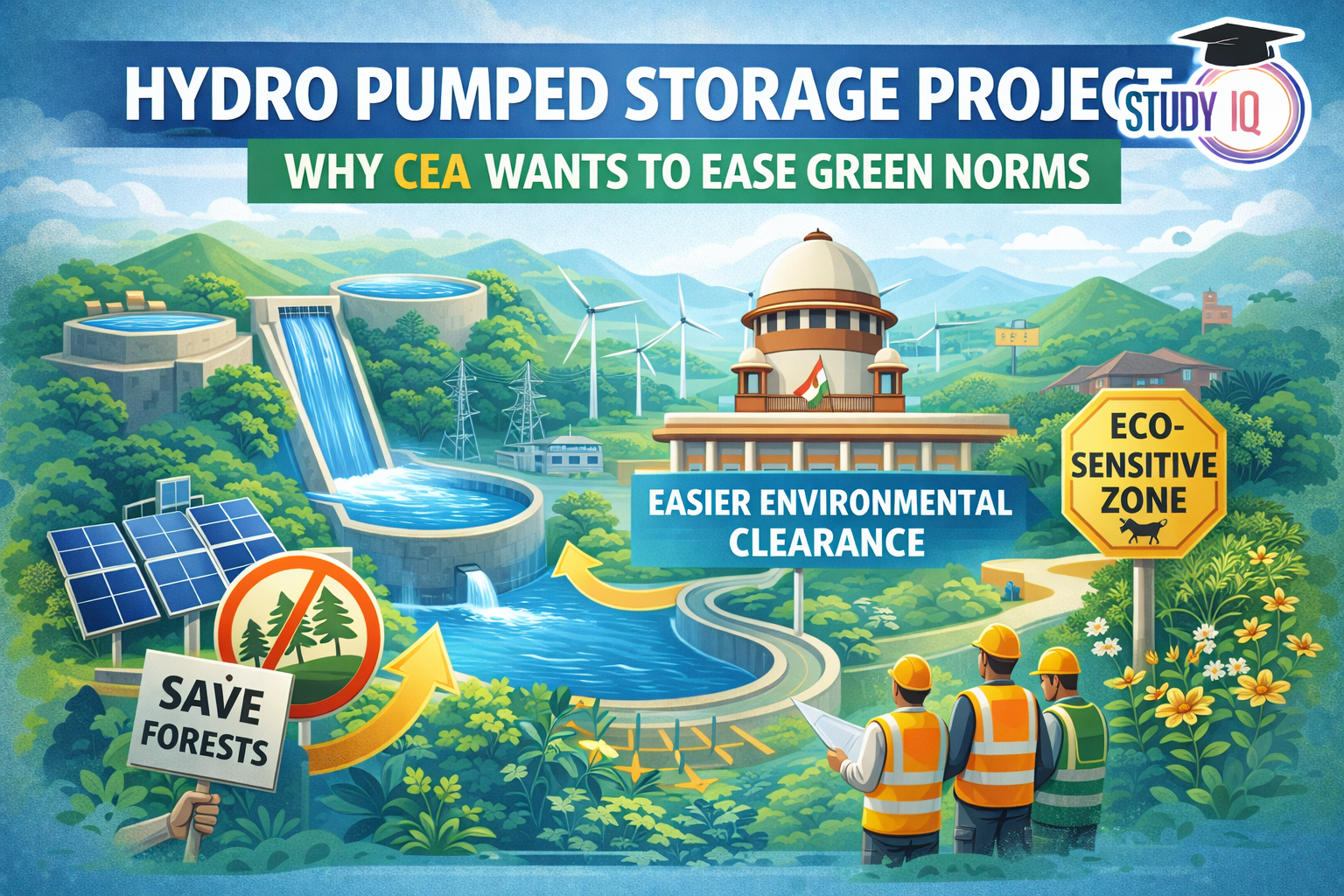
As India accelerates its transition towards renewable energy, energy storage has emerged as the critical missing link. In this context, the Central Electricity Authority (CEA) has proposed easing environmental and forest-related norms for Hydro Pumped Storage Projects (PSPs). The move aims to fast-track large-scale storage capacity essential for managing the intermittency of solar and wind power, while addressing regulatory delays that have slowed PSP development.
What Are Hydro Pumped Storage Projects (PSPs)?
Hydro PSPs are grid-scale energy storage systems that operate by:
-
Pumping water from a lower reservoir to an upper reservoir during periods of surplus electricity.
-
Releasing water back through turbines to generate power during peak demand.
Key advantages:
-
Long-duration energy storage
-
Rapid grid balancing
-
High efficiency and reliability
-
Ability to support renewable-heavy power systems
Why Energy Storage Has Become Critical for India
1. Rising Renewable Energy Penetration
India is rapidly expanding solar and wind capacity, which are:
-
Variable
-
Intermittent
-
Weather-dependent
Without adequate storage, renewable power cannot be fully utilised.
2. Limitations of Battery Storage
While Battery Energy Storage Systems (BESS) are useful, they:
-
Are expensive at scale
-
Have shorter discharge durations
-
Depend on imported critical minerals
PSPs provide longer-duration and cost-effective storage.
CEA’s Key Proposals to Ease Green Norms
1. Allowing PSPs in Eco-Sensitive Zones (ESZs)
-
Permit PSPs within eco-sensitive zones and within 10 km of protected areas where ESZs are not formally notified.
-
Currently, such areas are largely off-limits for hydropower projects.
2. Differentiated Regulatory Treatment
-
Treat PSPs separately from conventional hydropower projects for:
-
Environmental Clearance (EC)
-
Forest Clearance (FC)
-
-
Especially for:
-
Projects on existing reservoirs
-
Off-the-river PSPs
-
3. Relaxation of Western Ghats Norms
-
Ease stringent environmental conditions in the Western Ghats, a region rich in PSP potential but environmentally fragile.
4. Reforming Compensatory Afforestation
-
Allow degraded forest land (twice the diverted area) for compensatory afforestation.
-
Propose a national GIS-based land bank for afforestation and monitoring.
5. Financial Support
-
Extend Viability Gap Funding (VGF) to PSPs, similar to support given to BESS.
Why the CEA Is Pushing These Reforms
1. Massive Capacity Expansion Targets
-
Current PSP capacity: ~7.1 GW
-
Projected capacity:
-
~87 GW by 2033–34
-
Over 100 GW by 2035–36
-
Achieving this scale requires faster approvals and investor confidence.
2. Environmental Clearances as Major Bottlenecks
CEA highlights:
-
Lengthy EC and FC procedures
-
Long delays between Stage-I and Stage-II forest clearance
-
Fresh ECs required for even minor capacity changes
-
Difficulty in finding non-forest land for afforestation
3. Lower Environmental Impact of PSPs
-
Minimal displacement compared to large dams
-
Limited rehabilitation and resettlement
-
Lower ecological footprint when built on existing reservoirs
Environmental and Social Concerns
1. Ecological Sensitivity
-
ESZs and regions like the Western Ghats are biodiversity hotspots.
-
Risks include forest fragmentation and wildlife disturbance.
2. Local Resistance
-
Protests reported in Tamil Nadu, Karnataka, Rajasthan, and Maharashtra.
-
Communities fear long-term environmental degradation and water stress.
3. Risk of Regulatory Dilution
-
Blanket relaxations may weaken environmental safeguards.
-
Site-specific impact assessments remain essential.
Way Forward
-
Balanced Approach: Speed up approvals without compromising ecological safeguards.
-
Project-Specific Assessment: Differentiate between greenfield and existing-reservoir PSPs.
-
Robust Monitoring: GIS-based tracking and post-clearance compliance audits.
-
Stakeholder Engagement: Early involvement of local communities to reduce conflict.
-
Integrated Storage Strategy: Combine PSPs with batteries for optimal grid resilience.
Conclusion
The CEA’s proposal to ease green norms for hydro pumped storage projects reflects India’s urgent need for scalable, reliable, and long-duration energy storage. While the reforms can significantly strengthen renewable energy integration and grid stability, they also raise legitimate environmental concerns. The challenge lies in striking a careful balance between energy security and ecological sustainability, ensuring that India’s clean energy transition remains both fast and responsible.
|
Read More Notes |
|
| Environment Notes | Art and Culture Notes |
| Science and Tech | History Notes |
| Geography Notes | Indian Polity Notes |
| General Knowledge | International Relation |
|
Explore StudyIQ Courses |
|
Sharing is caring!
 Bharat Audyogik Vikas Yojana (BHAVYA Sch...
 NavIC Satellite Clock Failures: Causes, ...
 Rare Earth Elements (REE) Sites in India...








 WhatsApp





