
Table of Contents
Context
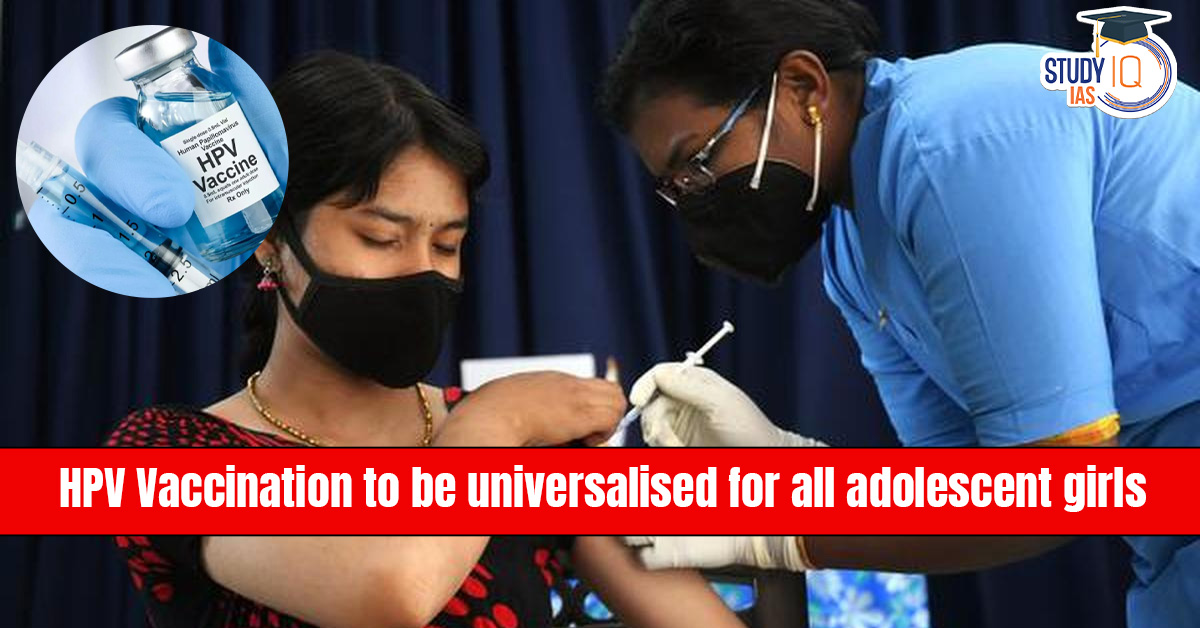
- India is preparing to launch a free nationwide Human Papillomavirus (HPV) vaccination programme targeting adolescent girls aged around 14 years.
About India’s HPV Vaccination Programme
- Target Population: The programme primarily targets girls aged about 14 years, as vaccination before exposure to HPV provides maximum protection.
- Free Vaccination: The vaccine will be provided free of cost across all States and Union Territories, ensuring equitable access regardless of income or geography.
- Voluntary Vaccination: Participation remains voluntary to maintain ethical consent-based healthcare delivery.
- Vaccine Being Used: India will administer Gardasil, a quadrivalent HPV vaccine that protects against:
- HPV 16 and 18 — major cervical cancer causing strains.
- HPV 6 and 11 — responsible for genital warts.
- The vaccine is non-live and cannot cause HPV infection.
- Single-Dose Strategy: Following emerging global evidence, India plans a single-dose vaccination schedule, which studies show provides durable protection. More than 90 countries globally have adopted similar simplified schedules to improve coverage and affordability.
- Institutional and Delivery Mechanism: Vaccination will be conducted exclusively at government health facilities including Ayushman Arogya Mandirs (Primary Health Centres), Community Health Centres and District Hospitals
- Global Procurement and Quality Assurance: India has secured vaccines through internationally supported procurement mechanisms under partnership with Gavi, ensuring affordability and quality compliance.
|
About HPV |
| ● Human Papillomavirus is a group of more than 200 related viruses transmitted primarily through skin-to-skin or sexual contact. While many HPV infections resolve naturally, certain high-risk strains persist and lead to cancers.
HPV and Cervical Cancer Link ● Scientific evidence shows that almost all cervical cancer cases are caused by HPV infection. In India: ● Cervical cancer is a type of cancer that begins in the cervix, the lower part of the uterus that connects to the vagina (birth canal). ● Nearly 80,000 new cervical cancer cases occur annually. ● Around 42,000 deaths are reported every year. ● HPV types 16 and 18 alone account for over 80% of cases. Cervical cancer remains the second most common cancer among Indian women, especially affecting women in lower socio-economic and rural populations where screening access is limited |
|
Read More Notes |
|
| Environment Notes | Art and Culture Notes |
| Science and Tech | History Notes |
| Geography Notes | Indian Polity Notes |
| General Knowledge | International Relation |
|
Explore StudyIQ Courses |
|
 Central India’s Jumbo Crisis: Human-El...
 UN Road Safety Project: Objectives, Impl...
 Repeated Failures of PSLV: Causes, Conce...











 WhatsApp





