
Table of Contents
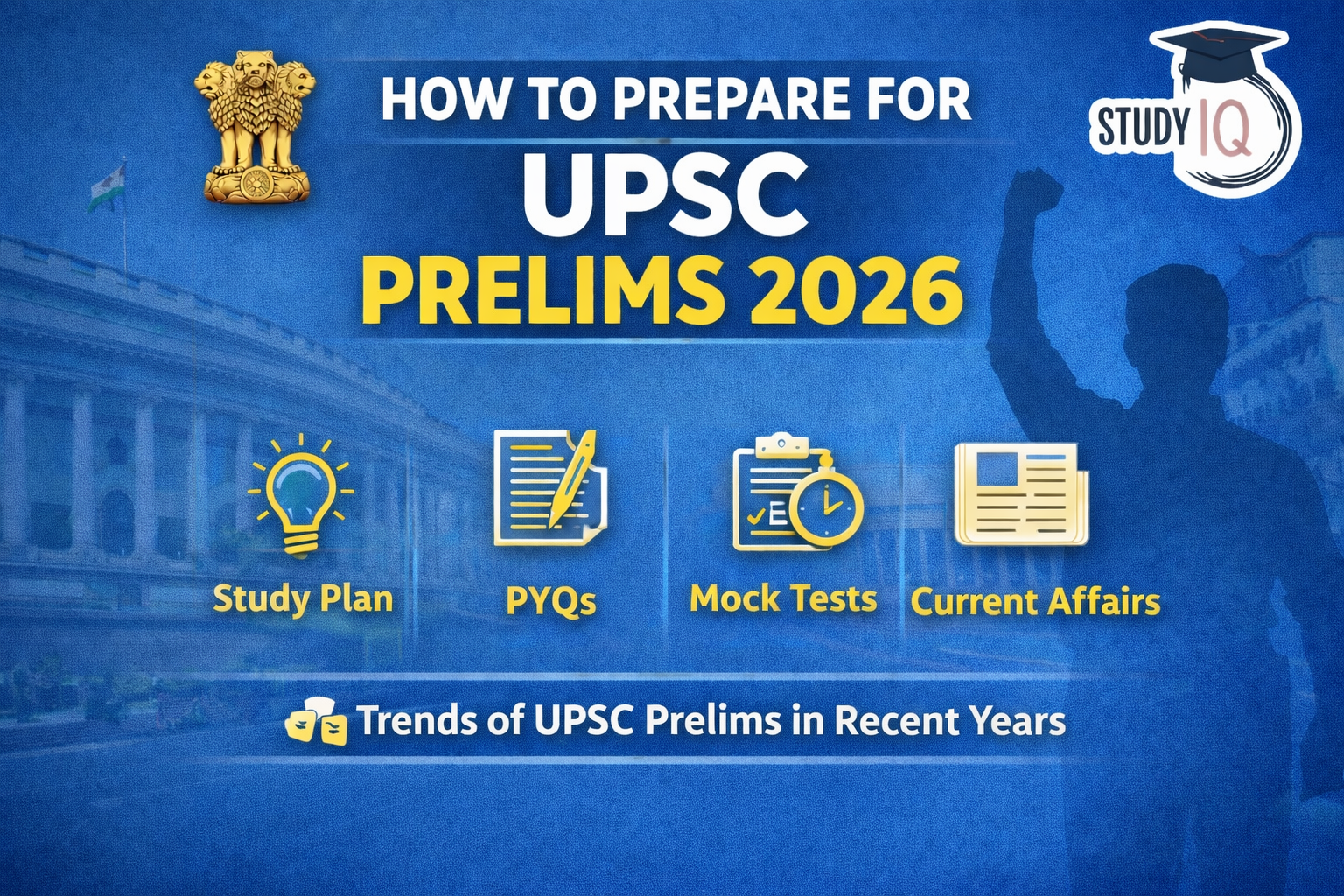
Preparing for the Civil Services Examination conducted by the Union Public Service Commission is a challenging task that demands consistency, clarity, and a smart strategy. The UPSC Prelims 2026 strategy is not just about covering the syllabus but about mastering concepts, practising questions, and building exam temperament, mindset & confidence through structured revision and testing.
This detailed guide explains the UPSC Prelims preparation strategy 2026, including a UPSC 180-day study plan, mock test approach, PYQ usage, and current affairs integration to help aspirants understand how to prepare for UPSC in 6 months effectively.
Understanding UPSC Prelims 2026 Exam Structure
Before starting preparation, aspirants must clearly understand the exam format, marking scheme, and paper structure.
UPSC Prelims 2026 Exam Pattern (Expected)
| Paper | Subject | No. of Questions | Marks | Duration | Nature |
| Paper 1 | General Studies (GS) | 100 | 200 | 2 Hours | Merit Ranking |
| Paper 2 | CSAT (Aptitude Test) | 80 | 200 | 2 Hours | Qualifying (33% Required) |
UPSC Prelims 2026 Marking Scheme
| Criteria | Details |
| Correct Answer | +2 Marks (GS Paper 1) |
| Wrong Answer | -0.66 Marks (1/3 Negative Marking) |
| CSAT Qualifying Marks | 66 Marks (33%) |
| Unanswered Question | No Penalty |
Trends of UPSC Prelims Cut-Off in Recent Years
In the last few years, the UPSC Prelims cut-off trend has generally remained below 90 marks for the General category. This shift reflects the increasing difficulty level of the paper, more application-based questions, and the inclusion of unpredictable and unconventional topics that were traditionally not asked.
| Year | Cut-Off Marks (Approx) |
|---|---|
| 2023 | ~75–80 Marks |
| 2022 | ~88–90 Marks |
| 2021 | ~87–90 Marks |
| 2020 | ~92–95 Marks |
| 2019 | ~98 Marks |
Subjects Covered and their weightage in UPSC Prelims GS Paper 1
| Subject | Key Areas | Weightage | Difficulty |
| Polity | Constitution, Governance, Rights, Parliament | 15-20 Questions | Most doable & scoring – Needs of High Accuracy |
| History | Ancient, Medieval, Modern, Freedom Struggle | 15-20 Questions | Cannot be predicted some years easy some years very difficult |
| Geography | Physical, Indian, World Geography | 7-10 Questions | Mostly straight from NCERT – Needs high Accuracy |
| Economy | Basic Concepts, Budget, Banking, Inflation | 15-20 Questions | Some conceptual questions are doable with a solid understanding. Some Current Questions need CA preparation. |
| Environment | Ecology, Biodiversity, Climate Change | 15-20 Questions | Cannot be banked. Prepare topics like basics, legislations, climate change & current affairs. |
| Science & Tech | Space, Defence, Biotechnology, IT | 10-12 Questions | Doable if good understanding of science, biology, biotech & CA. |
| Current Affairs & Misc. | National + International Events | 5-10 Questions | IR locations and International Organisations & doable. One or Two Questions on Government Schemes. |
CSAT Paper Coverage
| Section | Focus Areas | Weightage |
| Reading Comprehension | Passages + Understanding | 25 – 30 Questions |
| Logical Reasoning | Analytical & Logical Problems | 15 – 20 Questions |
| Basic Numeracy | Class 10 Level Maths | 15 – 25 Questions |
UPSC Prelims 2026 Strategy: Core Preparation Pillars
A successful UPSC Prelims 2026 strategy depends on four main pillars:
1. Conceptual Clarity- Understanding topics rather than memorizing facts.
2. PYQ-Based Preparation-Following a structured UPSC Prelims PYQ strategy to understand exam trends.
3. Mock Test Practice- Using a reliable UPSC Prelims mock test strategy to improve accuracy.
4. Revision Cycles-Multiple revisions to strengthen retention and recall.
Build Strong Conceptual Foundation
The first step in any successful UPSC Prelims preparation strategy 2026 is building strong basics.
Focus on Core Subjects
- Polity
- History
- Geography
- Economy
These subjects form the backbone of Prelims preparation. Once these are strong, other subjects become easier to manage.
How to Study Static Subjects
- Read standard books multiple times
- Make short revision notes
- Link concepts with current affairs
Concept clarity improves elimination skills and helps solve tricky questions.
UPSC Prelims Mock Test Strategy
A strong UPSC Prelims mock test strategy is essential for clearing the exam.
Why Mock Tests Are Important
- Improve time management
- Increase accuracy
- Develop elimination skills
- Build exam temperament
How to Use Mock Tests Effectively
- Attempt tests regularly
- Analyse mistakes deeply
- Maintain an error notebook
- Revise weak areas after every test
Mock tests convert knowledge into marks.
UPSC Prelims PYQ Strategy
The UPSC Prelims PYQ strategy is one of the most important preparation tools.
Benefits of Solving PYQs
- Understand UPSC question pattern
- Identify important topics
- Learn option elimination techniques
- Avoid studying irrelevant areas
How to Use PYQs Smartly
- Solve topic-wise PYQs
- Analyse repeated themes
- Revise PYQs multiple times
PYQs help you think like the examiner.
UPSC Current Affairs Strategy for Prelims
An effective UPSC current affairs strategy prelims focuses on understanding rather than memorizing.
Smart Current Affairs Approach
Daily
- Newspaper reading
- Short concept notes
Weekly
- Issue-based revision
Monthly
- Current affairs compilation revision
Always connect current affairs with static subjects for better retention.
CSAT Strategy for UPSC Prelims 2026
CSAT is qualifying but cannot be ignored.
Focus Areas
- Reading comprehension
- Logical reasoning
- Basic maths
Preparation Strategy
- Practice weekly
- Solve previous year CSAT questions
- Attempt CSAT seriously in mock tests
Consistent practice ensures safe qualification.
Revision Strategy for UPSC Prelims 2026
Revision is the most important part of preparation.
Effective Revision Method
- Multiple revisions of same source
- Use short notes and one-pagers
- Revise PYQs regularly
- Revise mock test mistakes
Without revision, retention and accuracy decrease significantly.
Common Mistakes to Avoid
- Using too many study sources
- Ignoring mock tests
- Making bulky notes
- Ignoring CSAT preparation
- Studying current affairs without static linkage
Avoiding these mistakes improves overall performance.
Final Preparation Approach for UPSC Prelims 2026
A strong UPSC Prelims 2026 strategy is built on balance:
- Static knowledge builds a foundation
- Current affairs provide application
- PYQs provide direction
- Mock tests provide performance improvement
- Revision provides retention
|
Read More Notes |
|
| Environment Notes | Art and Culture Notes |
| Science and Tech | History Notes |
| Geography Notes | Indian Polity Notes |
| General Knowledge | International Relation |
|
Explore StudyIQ Courses |
|
 NATO Countries List 2026, Members, Funct...
 UPSC CMS Notification 2026 Out – Apply...
 UPSC CMS Previous Year Papers – Downlo...




 WhatsApp





