
Table of Contents
Rhino poaching has long been one of the most alarming wildlife crimes globally, driven by the illegal trade in rhino horns. However, recent evidence from African wildlife reserves shows that rhino poaching can be drastically reduced through a combination of scientific intervention, economic logic, and governance reforms.
A landmark study published in the journal Science (2025) reveals how rhino dehorning nearly eliminated poaching in several African reserves, offering valuable lessons for global conservation efforts.
Why Rhino Poaching Was a Major Crisis
Global Rhino Population Status
-
Fewer than 28,000 rhinos survive worldwide (as of 2024)
-
Five species remain across Africa and Asia
-
Poaching for horns is the single biggest threat
Economic Drivers of Poaching
-
Rhino horn fetches extremely high prices in illegal markets
-
Global illicit horn trade generated $874 million–$1.13 billion (2012–2022)
-
Poverty in surrounding communities
-
Weak criminal justice systems
-
Transnational trafficking networks
Despite heavy investments in armed patrols, drones, AI cameras, and sniffer dogs, poaching continued at alarming levels in Africa’s major reserves.
The Breakthrough: Rhino Dehorning Strategy
What is Rhino Dehorning?
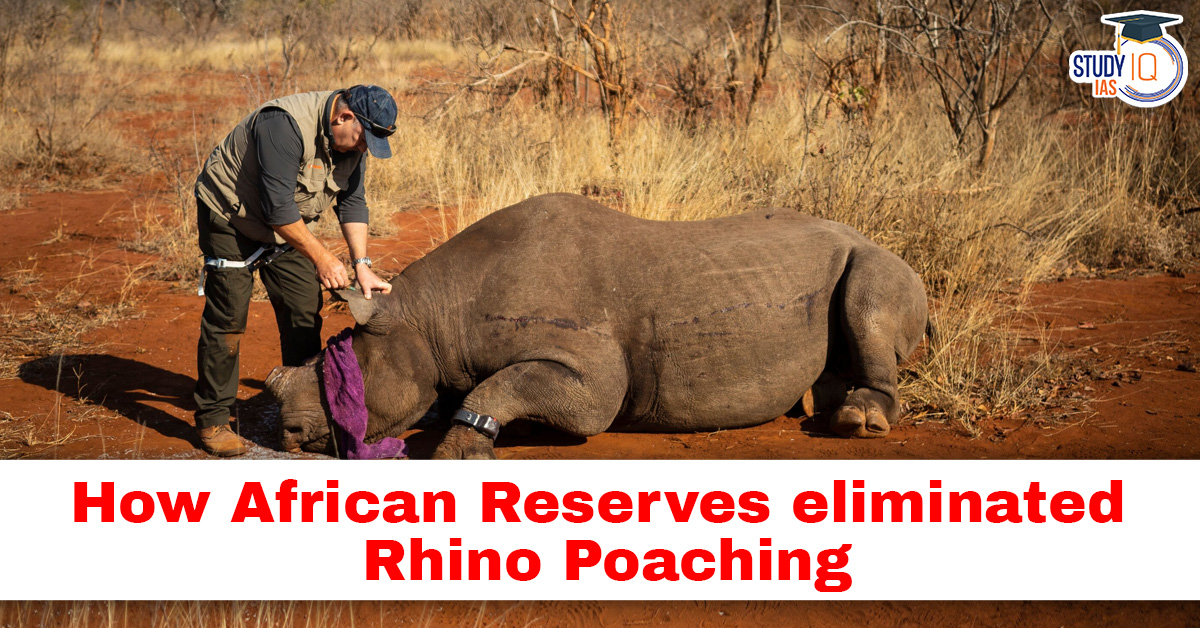
Rhino dehorning is the controlled removal of the horn, without killing or permanently harming the animal.
Scientific Method Used
-
Rhinos are sedated and blindfolded to minimise stress
-
90–93% of the horn is removed above the germinal layer
-
Horn stump is sealed to prevent infection
-
The horn regrows naturally over time
Evidence from African Reserves
Study Area and Period
-
11 wildlife reserves in the Greater Kruger region, South Africa
-
Time period: 2017–2023
-
2,284 rhinos were dehorned
Impact Findings
-
75% reduction in rhino poaching overall
-
78% reduction where dehorning was conducted rapidly (within 1–2 months)
-
95% lower risk of poaching for dehorned rhinos
-
Achieved using just 1.2% of the total anti-poaching budget
These findings established dehorning as one of the most cost-effective wildlife protection strategies ever recorded.
Why Dehorning Worked: The Economic Logic
Poaching is fundamentally a profit-driven crime.
Dehorning:
-
Removes the primary incentive (the horn)
-
Converts poaching into a high-risk, low-reward activity
-
Alters the cost–benefit calculation for criminal syndicates
Unlike patrols and surveillance that focus on enforcement, dehorning targets the economic root of the crime.
Complementary Measures in African Reserves
While dehorning was central, it worked best alongside:
-
Targeted intelligence-led patrols
-
Community engagement
-
Strategic monitoring of known poaching corridors
-
Limited but focused law enforcement
This multi-layered approach ensured sustained results.
Challenges and Ethical Concerns
Not a Silver Bullet
-
Some poachers still kill rhinos for horn stumps
-
Dehorning must be repeated as horns regrow
Behavioural and Ecological Concerns
Rhino horns are used for:
-
Defence
-
Digging roots and water
-
Mating and dominance displays
Removing horns may affect natural behaviour, though no population-level collapse has been observed.
Operational Challenges
-
Requires skilled veterinarians
-
Continuous monitoring needed
-
Logistically demanding in remote reserves
Governance Gaps Still Persist
The study highlighted that:
-
Arrests alone are ineffective
-
Corruption and weak prosecution limit deterrence
-
Cross-border trafficking networks remain active
Thus, dehorning works best when governance failures are acknowledged and mitigated.
Indian Context: Why Africa’s Model Is Not Fully Replicable
Kaziranga National Park Example
-
One of the world’s largest populations of greater one-horned rhinos
-
India and Nepal lost only 1–2 rhinos in the last three years
Reasons for India’s Success Without Dehorning
-
Strong state protection
-
Smart patrolling and intelligence
-
Community participation
-
Human–wildlife conflict mitigation
Hence, rhino dehorning is not preferred in India, as ethical costs outweigh marginal benefits under strong enforcement conditions.
Way Forward: Context-Specific Conservation
Where Dehorning is Suitable
-
Extremely high poaching pressure
-
Weak enforcement capacity
-
Large, open reserves
Long-Term Conservation Strategy
-
Community-centred livelihoods
-
Incentivising wildlife protection
-
Ranger welfare (pay, training, safety)
-
Use of local ecological knowledge
-
Global demand reduction campaigns
-
Strict enforcement of wildlife trade bans
Conclusion
African reserves nearly eliminated rhino poaching not through force alone, but by changing the economics of crime. Rhino dehorning emerged as a scientifically proven, cost-effective intervention, capable of sharply reducing poaching when enforcement alone fails.
However, it is not a universal solution. Long-term success in wildlife conservation lies in combining science, community participation, governance integrity, and global demand reduction. The African experience provides a powerful blueprint—but only when adapted to local ecological and institutional realities.
 Extracellular RNA (exRNA): Types, Functi...
 Sperm Whales: Physical Features, Habitat...
 Jungle Cats: Habitat, Characteristics an...













 WhatsApp





