
Table of Contents
Context
India’s urban landscape has consistently faced the persistent problem of ineffective waste management and inadequate sanitation. The evident manifestation of this tragedy in urban areas is characterised by towering landfills, contaminated water bodies, and declining public health conditions. Landfill sites like Ghazipur and Deonar exemplify systemic inefficiencies and regulatory failures. These sites represent not only environmental degradation but also the systemic failure of governance frameworks to handle waste properly.
India produces more than 62 million tonnes of waste each year, with forecasts indicating that this amount will nearly triple by 2030. The historical, legal and administrative reaction to this escalating situation has been disjointed and reactive. Local authorities have predominantly concentrated on the collection and transportation of waste to disposal sites, frequently overlooking its treatment and recycling. In response to these enduring issues, the government has enacted the Solid Waste Management Rules, 2026, and the Construction and Demolition Waste Management Rules, 2025, signifying a substantial transformation in regulatory policy.
Legislative Structure and Regulatory Jurisdiction
The new waste management rules are authorised under the Environment Protection Act of 1986, namely Sections 3, 6, and 25, which empower the central government to implement environmental protection measures. The rules issued by the Ministry of Environment, Forest and Climate Change are delegated legislation designed to tackle intricate environmental issues via comprehensive regulatory frameworks.
The new standards provide a more rigorous and enforced approach, in contrast to previous frameworks that mostly served as advisory suggestions. They aim to establish responsibility among various stakeholders, including local government, private entities, and residents.
Background: Development of Waste Management Policy in India
Initial Policy Reactions
India’s preliminary efforts in waste management regulation were constrained in both breadth and efficacy. Municipal rules predominantly concentrated on sanitation in a limited context, emphasising cleanliness above sustainable waste management.
The 2016 Framework
The Solid Waste Management Rules, 2016 marked a substantial progress by including principles such as waste segregation and decentralised processing. Nonetheless, their execution was inconsistent, largely due to administrative inefficiencies and insufficient enforcement.
Judicial Intervention and Policy Development
The courts have significantly influenced waste management policies. In Almitra H Patel v Union of India, the Supreme Court examined municipal solid waste management following the Surat epidemic of 1994. The example underscored the inadequacy of municipal authorities in executing efficient waste management systems, despite their awareness of the issue.
Over the course of nearly two decades, the Court rendered numerous directives, encompassing recommendations for the privatisation of waste collection, enforcement of penalties, and the appointment of magistrates to ensure compliance. The issue was ultimately sent to the National Green Tribunal, which persists in overseeing compliance at the state level.
Construction and Demolition Waste: A Neglected Disaster
The construction sector in India accounts for approximately 10 per cent of the national GDP and has expanded at a rate far exceeding the global average. This expansion has led to the production of substantial amounts of construction and demolition debris.
The demolition and reconstruction of existing structures yield a uniform amalgamation of elements, including concrete, bricks, wood, metals, sand, and polymers. These materials frequently contain toxic compounds such as asbestos, which can infiltrate the environment and present significant health hazards.
Notwithstanding its environmental ramifications, construction and demolition waste has traditionally garnered insufficient consideration within legislative frameworks. The Construction and Demolition Waste Management Rules, 2025, aim to rectify this deficiency by encouraging the recycling and repurposing of these materials.
Structural Obstacles in the Current Waste Management Framework
Financial Constraints of Urban Local Authorities
A major difficulty confronting waste management in India is the insufficient financial resources of urban local authorities. Most towns rely significantly on state and federal government funding, possessing minimal ability to produce their own revenue.
An exception is the Brihanmumbai Municipal Corporation, which possesses a rather large budget. Nonetheless, such instances are rare. The difficulty in securing sufficient funding is intensified by low user fees for services such as waste collection and a pervasive unwillingness among residents to pay for sanitation services.
Corruption and Governance Deficiencies
Corruption in municipal entities further diminishes the efficacy of waste management systems. Cases like the purported ₹934 crore scandal concerning the Bruhat Bengaluru Mahanagara Palike expose systemic anomalies, including the presence of fictitious employees on payrolls.
These behaviours deplete financial resources and undermine public confidence in governmental institutions. The avoidance of property taxes by homeowners exacerbates the financial crises of metropolitan entities.
Inadequacies in Urban Planning
The absence of adequate urban planning becomes a substantial challenge. Indian cities have traditionally evolved through unregulated migration, leading to heavily populated regions with insufficient infrastructure.
In Dipak Kumar Mukherjee v Kolkata Municipal Corporation, the Supreme Court emphasised the influence of socio-economic inequalities on urban development. The Court observed that a considerable percentage of the urban population resides in slums, where waste collection and sanitation services are markedly inadequate.
Constricted thoroughfares, congested accommodations, and inadequate access for refuse collection vehicles render efficient waste management virtually unfeasible in many locations. These settings foster unhygienic activities and pose public health dangers.
New Regulatory Framework: A Paradigm Transformation
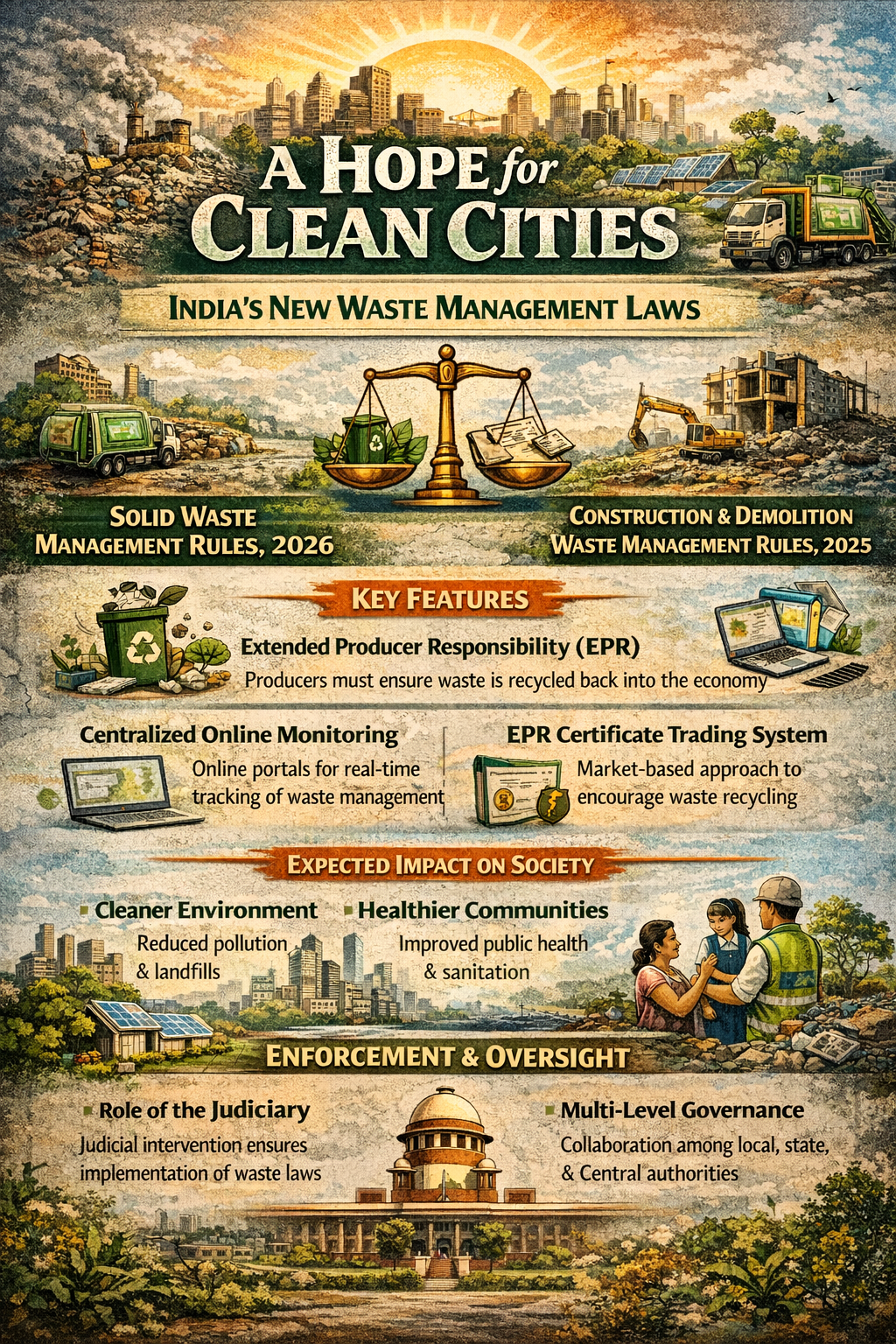
The Solid Waste Management Rules, 2026, and the Construction and Demolition Waste Management Rules, 2025, signify a definitive transition from a reactive to a proactive regulatory framework. These regulations seek to rectify the structural inadequacies of the previous system by employing a blend of legal mandates, technical incorporation, and market-oriented strategies.
Extended Producer Responsibility (EPR)
The adoption of Extended Producer Responsibility is one of the most revolutionary aspects of the new regulations. This system transfers the responsibility of waste management from public agencies to private companies, mandating that producers guarantee the recycling or correct disposal of waste generated by their products.
The National Green Tribunal, in Aryavart Foundation v Union of India, has underscored the necessity for stringent adherence to Extended Producer Responsibility targets and the imperative for real-time data surveillance. The Tribunal has emphasised the significance of including the informal sector in waste management systems, especially with plastic and electronic waste.
Source Segregation and Bulk Waste Producers
The new rules require the segregation of waste at the source into categories, including organic waste, recyclable waste, sanitary waste, and hazardous waste. This criterion is crucial for effective recycling and treatment procedures.
The notion of Extended Bulk Waste Generator Responsibility has been introduced. Entities that generate substantial waste, determined by factors such as floor area, water usage, or daily waste production, must either manage waste on-site or secure compliance certification.
Recycling Requirements under Construction and Demolition Rules
The Construction and Demolition Waste Management Rules establish certain responsibilities for developers designated as producers. These entities must recycle a specified percentage of their generated waste, with targets incrementally rising from 25 per cent to 100 per cent over a designated timeframe.
This method diminishes environmental impact while fostering the utilisation of recycled resources in building, hence advancing sustainable development.
Centralised Digital Oversight and Governance
A notable breakthrough established by the Solid Waste Management Rules, 2026 is the implementation of a centralised digital monitoring system. The regulations establish a comprehensive online platform intended to monitor the complete lifecycle of waste management, encompassing generation, collection, transportation, processing, and final disposal. This system includes biomining and bioremediation of historical waste sites, therefore mitigating persistent environmental threats.
The digitisation of registration and authorisation processes for waste processing facilities signifies a shift from the previous multi-step, paper-based methods that were frequently inefficient and susceptible to manipulation. The regulations improve transparency and accountability in the system by requiring online reporting and audits. The mandate for regular audits, accompanied by reports submitted to the centralised portal, guarantees ongoing supervision and supports data-informed policy decisions.
A comparable digital framework has been proposed under the Construction and Demolition Waste Management Rules, 2025. The centralised site, overseen by the Central Pollution Control Board, mandates the registration of stakeholders, including producers, recyclers, and collection point operators. This digital infrastructure rectifies a significant deficiency of the 2016 framework, which was devoid of a cohesive system for monitoring compliance and tracking waste movements.
Certificate Trading System: Market-Oriented Compliance Framework
A new feature implemented in the Construction and Demolition Waste Management Rules is the certificate trading system associated with Extended Producer Responsibility. Through this approach, recyclers produce certificates contingent upon the volume and quality of garbage processed. These certificates can thereafter be exchanged among producers, enabling businesses that do not meet their recycling objectives to get compliance credits from others.
This market-oriented strategy incorporates adaptability and efficacy into the regulatory structure. Assigning economic value to waste processing incentivises investment in recycling infrastructure and fosters innovation in waste management systems. The certificates possess a defined validity period and are subject to audit, thereby ensuring the system’s integrity and reliability.
The lack of a comparable trading system for Extended Bulk Waste Generator Responsibility certificates under the Solid Waste Management Rules constitutes a squandered opportunity. A cohesive credit-based system encompassing waste categories might have further fortified the regulatory structure. Simultaneously, apprehensions about the potential for abuse and the creation of counterfeit credentials underscore the necessity for stringent monitoring and enforcement measures.
Industrial Responsibilities and Refuse-Derived Fuel
The Solid Waste Management Rules, 2026 mandate industries to utilise Waste as a resource. The term Refuse-Derived Fuel denotes fuel generated from the non-recyclable elements of municipal solid trash, including plastics, paper, and textiles.
Cement factories must integrate Refuse-Derived Fuel into their operations, with a progressively rising replacement rate over time. This strategy fulfils two objectives by diminishing dependence on traditional fossil fuels and tackling the issue of non-recyclable waste.
The Construction and Demolition Waste Management Rules require the utilisation of processed waste in building and infrastructure initiatives. Projects in the public and private sectors that exceed a designated threshold must use a minimum percentage of recycled materials, with targets incrementally escalating over time. This method fosters the circular economy by converting waste into a useful asset.
Incorporation within the Institutional Framework
The new regulations signify a transition from a localised methodology to a multi-tiered governance framework encompassing diverse stakeholders. Although Urban Local Bodies remain pivotal in waste collection and transportation, the task has now been disseminated over a wider institutional framework.
According to the updated Solid Waste Management Rules, Material Recovery Facilities are identified as essential elements of the waste management system. These facilities are tasked with the sorting and processing of waste and may additionally serve as collecting sites for specialised waste streams, including electronic and sanitary waste.
The Construction and Demolition Waste Management Rules establish supplementary institutional frameworks, including a national steering council tasked with oversight, conflict resolution, and policy revisions. State-level monitoring committees are responsible for assuring adherence and assisting execution. Different ministries, including the Ministry of Jal Shakti and the Ministry of Commerce and Industry, have been designated particular responsibilities, demonstrating a unified strategy for waste management.
Societal Impact and Civic Engagement
The efficacy of the new waste management approach is heavily reliant on public engagement. Source segregation, a fundamental aspect of the Solid Waste Management Rules, necessitates active participation from individuals. In the absence of extensive adherence, even the most sophisticated regulatory frameworks may not fulfil their intended goals.
The societal effects of enhanced waste management are significant. Efficient waste management mitigates environmental contamination, promotes public health, and elevates the quality of life in urban settings. It also generates economic opportunities in sectors such as recycling and waste management.
The incorporation of the informal sector into the formal waste management system is crucial for achieving inclusivity and sustainability. Informal waste pickers are integral to recycling and resource recovery; their engagement can improve system efficiency and create livelihood opportunities.
Judiciary’s Role in Waste Management Governance
The courts have been a pivotal force in environmental governance in India. Courts have emphasised the significance of efficient waste management through their interventions and have held agencies liable for non-compliance.
The continuous oversight of waste management procedures by the National Green Tribunal demonstrates the judiciary’s dedication to enforcing environmental legislation. Judicial decisions have not only resolved particular matters but have also advanced overarching ideas of environmental stewardship.
The judiciary’s function includes not just judgment but also policy formulation and the direction of administrative actions. By prioritising accountability and transparency, courts have significantly enhanced the regulatory system.
Critical Examination of the New Regulations
The Solid Waste Management Rules, 2026, and the Construction and Demolition Waste Management Rules, 2025, exemplify a thorough and progressive strategy for waste management. The implementation of legal obligations, computerised monitoring technologies, and market-based procedures rectifies numerous shortcomings of the previous framework.
The efficacy of these rules is contingent upon their execution. Obstacles such as budgetary limitations, corruption, and inadequate infrastructure persist as substantial challenges. The efficacy of the regulatory structure is contingent upon the institutions’ ability to enforce compliance and the stakeholders’ readiness to fulfil their obligations.
The shift from an advising to a compliance-oriented framework signifies a substantial policy change, necessitating ongoing effort and cooperation across many governance tiers.
The Path Ahead
India is at a pivotal point in its urban development trajectory. The escalating volume of waste production, together with its environmental and public health consequences, demands immediate and resolute intervention. The newly established waste management rules offer a comprehensive framework for tackling these issues; however, their efficacy relies on successful execution and community engagement.
The amalgamation of technology, market dynamics, and institutional collaboration presents a potential trajectory ahead. Continuous monitoring, capacity enhancement, and policy changes are needed to ensure the attainment of the rules’ objectives.
Conclusion
The implementation of the Solid Waste Management Rules, 2026, and the Construction and Demolition Waste Management Rules, 2025, signifies a crucial advancement in tackling India’s waste management dilemma. By transcending basic administrative norms and implementing a systematic, enforceable framework, these regulations seek to revolutionise waste management in both urban and rural settings.
The challenges are significant, while the opportunities are equally substantial. Through successful implementation, institutional accountability, and active public engagement, these regulations have the capacity to foster cleaner, healthier, and more sustainable urban environments.
The problem, as accurately noted, is urgent. As Indian cities contend with escalating waste and environmental deterioration, the efficacy of these reforms will ascertain the realisation of clean and habitable urban environments.











 WhatsApp





