
Table of Contents
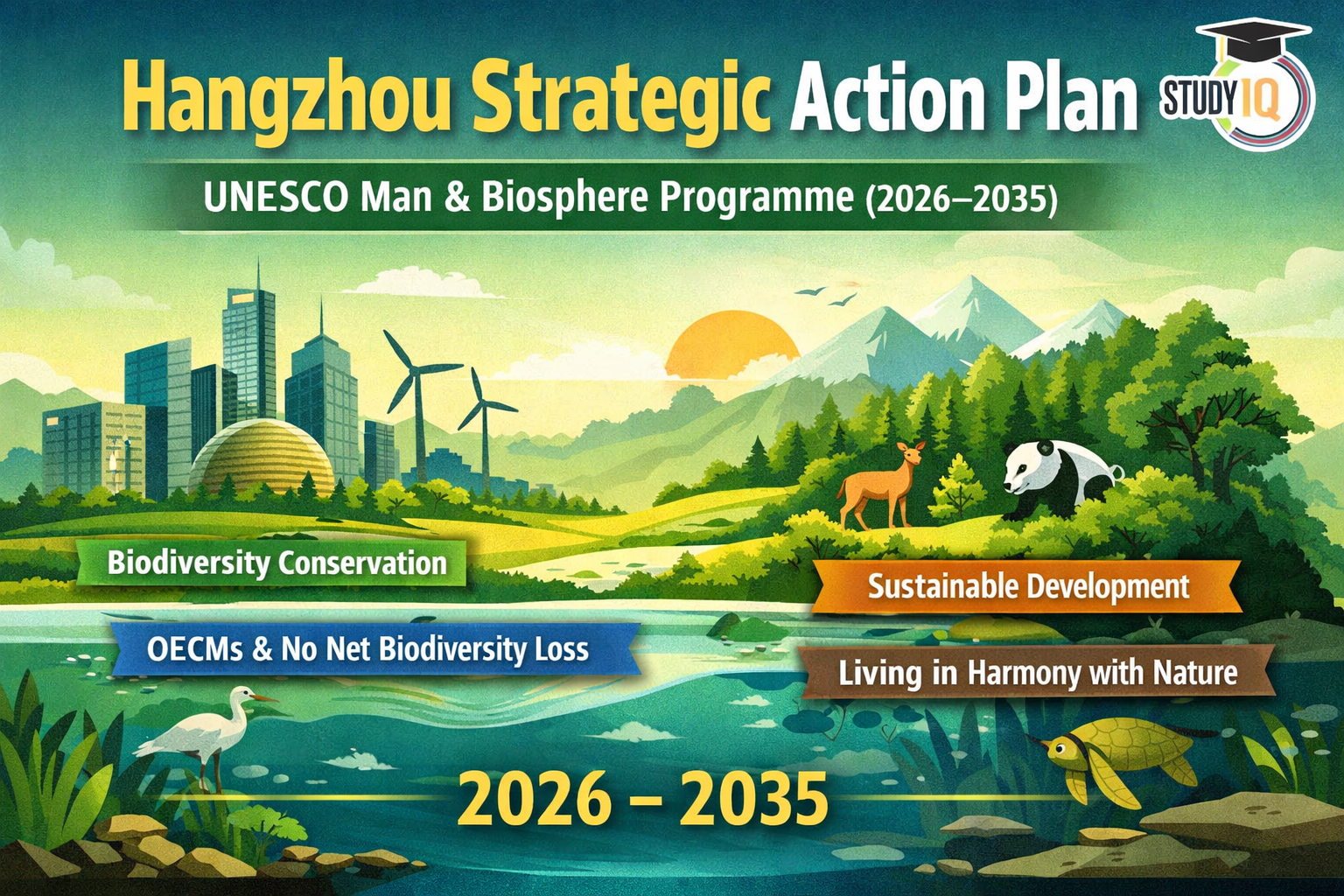
The Hangzhou Strategic Action Plan (HSAP) is a landmark roadmap adopted for strengthening UNESCO’s Man and Biosphere (MAB) Programme and its World Network of Biosphere Reserves (WNBR) for the period 2026–2035. It was approved during the Fifth World Congress of Biosphere Reserves (WCBR) held in Hangzhou, China, in September 2025, after a gap of ten years since the last congress in Lima, Peru (2016).
The HSAP reflects the global commitment to conserve biodiversity while promoting sustainable development and ensuring a balanced relationship between humans and nature.
What is the Man and Biosphere (MAB) Programme?
The MAB Programme was launched by UNESCO in 1971 with the aim of:
-
Promoting sustainable development,
-
Conserving biodiversity,
-
Encouraging scientific research and knowledge sharing,
-
Strengthening the relationship between people and their natural environment.
Its main operational tool is the World Network of Biosphere Reserves (WNBR), which currently includes hundreds of biosphere reserves across different countries.
Each Biosphere Reserve has three zones:
-
Core Zone – Strict protection of biodiversity.
-
Buffer Zone – Limited activities such as research, education, and eco-tourism.
-
Transition Zone – Sustainable human activities and development.
World Congress of Biosphere Reserves (WCBR)
UNESCO organizes the World Congress of Biosphere Reserves every 10 years to:
-
Review the progress of the MAB Programme,
-
Share best practices,
-
Adopt new strategic frameworks.
| Congress | Year | Location | Outcome |
|---|---|---|---|
| 4th WCBR | 2016 | Lima, Peru | Lima Action Plan (2016–2025) |
| 5th WCBR | 2025 | Hangzhou, China | Hangzhou Strategic Action Plan (2026–2035) |
What is the Hangzhou Strategic Action Plan (HSAP)?
The Hangzhou Strategic Action Plan (HSAP) is the strategic vision document for the MAB Programme and WNBR for 2026–2035. It aligns biosphere reserve management with:
-
The 2030 Agenda for Sustainable Development,
-
Multilateral Environmental Agreements (MEAs),
-
The global vision of “Living in Harmony with Nature.”
Main Objectives of HSAP
Objective 1
To contribute to the achievement of:
-
Multilateral Environmental Agreements (like CBD, UNFCCC, UNCCD),
-
The 2030 Agenda for Sustainable Development and SDGs.
Objective 2
To strengthen and develop:
-
The MAB Programme,
-
The World Network of Biosphere Reserves,
-
Human resources,
-
Financial sustainability,
-
Excellence and credibility of biosphere reserves.
Objective 3
To enhance:
-
Research,
-
Knowledge-sharing,
-
Innovation from biosphere reserves,
-
Pathways for Living in Harmony with Nature and sustainable futures beyond 2030.
Action Targets under the Hangzhou Strategic Action Plan
HSAP contains 34 voluntary action targets that countries can adopt based on national circumstances. Some of the most important targets include:
1. No Net Loss of Biodiversity
-
By 2035, high-biodiversity areas within Biosphere Reserves should experience no net loss of biodiversity.
2. Recognition of OECMs
-
By 2028, the potential of:
-
Buffer zones,
-
Transition areas
should be explored as Other Effective Area-Based Conservation Measures (OECMs).
-
OECMs are areas not officially designated as protected areas but effectively managed for biodiversity conservation.
3. Universal Coverage of Biosphere Reserves
-
By 2035, each UNESCO Member State should have at least one Biosphere Reserve.
This target promotes equitable global representation in the MAB Programme.
Why HSAP is Important
-
Integrates Conservation with Development
HSAP promotes biodiversity conservation while supporting livelihoods and sustainable economic activities. -
Strengthens Climate and Biodiversity Governance
It links biosphere reserves with:
-
Climate change adaptation,
-
Ecosystem-based solutions,
-
Nature-based solutions.
-
Supports Global Biodiversity Goals
HSAP aligns with:
-
Convention on Biological Diversity (CBD),
-
Post-2020 Global Biodiversity Framework,
-
UN Sustainable Development Goals (SDGs).
-
Boosts Research and Innovation
Biosphere reserves become living laboratories for sustainable practices. -
Encourages International Cooperation
HSAP strengthens global collaboration through UNESCO platforms.
HSAP vs Lima Action Plan
| Feature | Lima Action Plan | HSAP |
|---|---|---|
| Period | 2016–2025 | 2026–2035 |
| Adopted at | 4th WCBR, Lima | 5th WCBR, Hangzhou |
| Focus | Governance and networking | SDGs, OECMs, no biodiversity loss |
| Approach | Strengthening BR management | Transformational sustainability framework |
Conclusion
The Hangzhou Strategic Action Plan (2026–2035) marks a new era for UNESCO’s Man and Biosphere Programme. By focusing on biodiversity conservation, sustainable development, research excellence, and international cooperation, HSAP strengthens biosphere reserves as global models of “Living in Harmony with Nature.”
It transforms biosphere reserves from conservation spaces into dynamic platforms for sustainability, climate resilience, and human–nature coexistence.
 Navigating Uncharted Waters: What Next f...
 Astronaut Reentry Explained: How Spacecr...
 Missile Interceptors Explained: Role in ...









 WhatsApp





