
Table of Contents
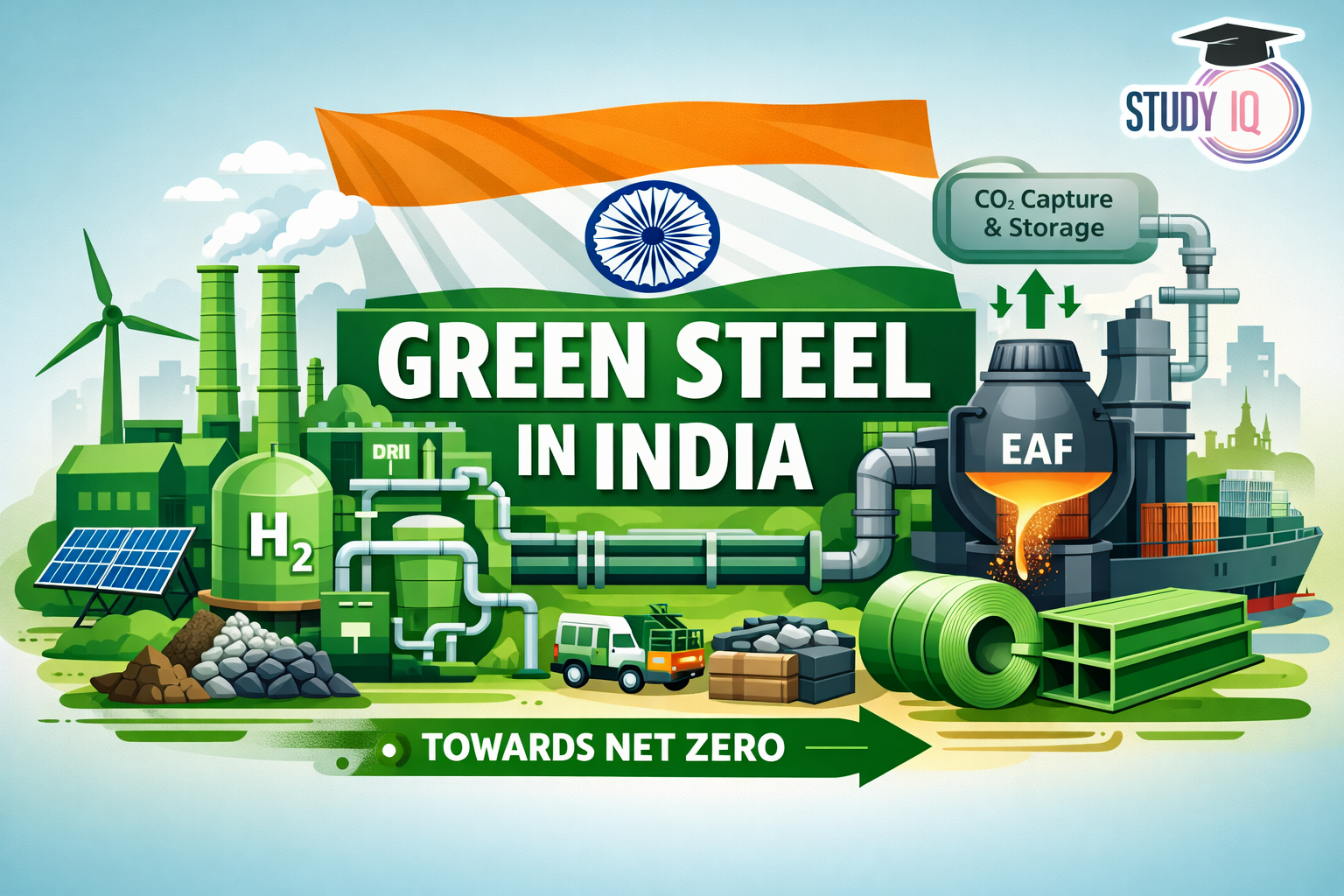
Green Steel in India: India has committed to achieving net-zero emissions by 2070 and to submitting a progressively ambitious Nationally Determined Contribution (NDC). Achieving these goals requires deep decarbonisation of hard-to-abate sectors, among which steel is the most critical. As steel underpins infrastructure, manufacturing, and urbanisation, its transition to green steel can decisively shape India’s climate trajectory without compromising development.
Green Steel in India: Why Steel Matters for India’s Climate Goals
1. Centrality to Economic Growth
-
Steel is foundational for housing, transport, renewable energy infrastructure, and industrial expansion.
-
India’s crude steel capacity is projected to rise from ~125 million tonnes to over 400 million tonnes by mid-century.
2. Major Source of Emissions
-
The steel sector contributes around 12% of India’s total CO₂ emissions.
-
Heavy dependence on coal-based blast furnace–basic oxygen furnace (BF-BOF) technology makes it highly carbon-intensive.
3. Risk of Carbon Lock-in
-
Steel plants are long-lived assets.
-
Continued investment in conventional technology risks embedding emissions for decades, undermining climate commitments.
What is Green Steel?
Green steel refers to steel produced with significantly lower or near-zero carbon emissions, using:
-
Green hydrogen–based direct reduced iron (H₂-DRI)
-
Electric arc furnaces (EAFs) powered by renewable energy
-
Scrap-based secondary steelmaking
-
Carbon capture, utilisation and storage (CCUS) as a transitional measure
Role of Green Steel in Achieving Climate and Net-Zero Goals
1. Deep Decarbonisation of a Hard-to-Abate Sector
-
Steel offers one of the largest single-sector emission reduction opportunities.
-
Decarbonising steel directly lowers India’s industrial emissions intensity.
2. Alignment with India’s NDC Commitments
-
Supports reduction in emissions intensity of GDP
-
Complements renewable energy expansion and green hydrogen deployment
-
Strengthens credibility of India’s long-term climate pathway
3. Enhancing Global Competitiveness
-
Global markets are increasingly linking trade with carbon performance.
-
Mechanisms like the Carbon Border Adjustment Mechanism (CBAM) of the European Union penalise carbon-intensive steel imports.
-
Green steel safeguards India’s export competitiveness and avoids future trade barriers.
4. Enabling a Just and Orderly Transition
-
Phased adoption allows workforce reskilling and regional industrial stability.
-
Prevents disruptive future adjustments under international pressure.
India’s Policy and Industry Response
Policy Initiatives
-
Greening Steel Roadmap outlining transition pathways
-
Green Steel Taxonomy, positioning India as a global first-mover
-
National Green Hydrogen Mission
-
Emissions intensity targets under the Carbon Credit Trading Scheme
Industry Actions
-
Pilot projects on hydrogen injection
-
Renewable energy procurement for steel plants
-
Energy efficiency improvements and CCUS exploration
However, pilot-scale action remains insufficient without rapid commercial deployment.
Key Challenges in Scaling Green Steel
-
High Cost of Green Hydrogen
-
Limited Availability of Scrap Steel
-
Inadequate Dedicated Renewable Capacity
-
Financing Constraints for Capital-Intensive Technologies
-
Skill Gaps in Advanced Metallurgical Processes
-
Risk of Continued Investment in Coal-Based Capacity
The Way Forward
1. Clear and Credible Policy Signals
-
Time-bound emission reduction targets for steel
-
Long-term clarity to guide private investment
2. Carbon Pricing and Market Instruments
-
Early introduction of carbon pricing to internalise emissions costs
-
International experience shows near-zero steel becomes viable at $90–100 per tonne of CO₂
3. Demand Creation
-
Green public procurement for infrastructure
-
Mandatory green steel certification and labelling
4. Infrastructure and Financial Support
-
Shared hubs for hydrogen, renewables, gas, and CO₂ transport
-
Targeted fiscal support for MSME steel producers to ensure a just transition
Conclusion
Green steel is not merely a technological choice but a strategic necessity for India. It sits at the intersection of climate responsibility, industrial competitiveness, and development priorities. By aligning industrial strategy with market-based climate policy, India can decarbonise its steel sector, avoid carbon lock-in, and emerge as a global leader in low-carbon manufacturing, while staying firmly on track towards its net-zero 2070 goal.
|
Read More Notes |
|
| Environment Notes | Art and Culture Notes |
| Science and Tech | History Notes |
| Geography Notes | Indian Polity Notes |
| General Knowledge | International Relation |
|
Explore StudyIQ Courses |
|
 Distinct Enumeration of DNTs in Census 2...
 Top 10 Richest Indians 2026 Full List Ne...
 The Transgender Persons (Protection of R...











 WhatsApp





