
Table of Contents
Context
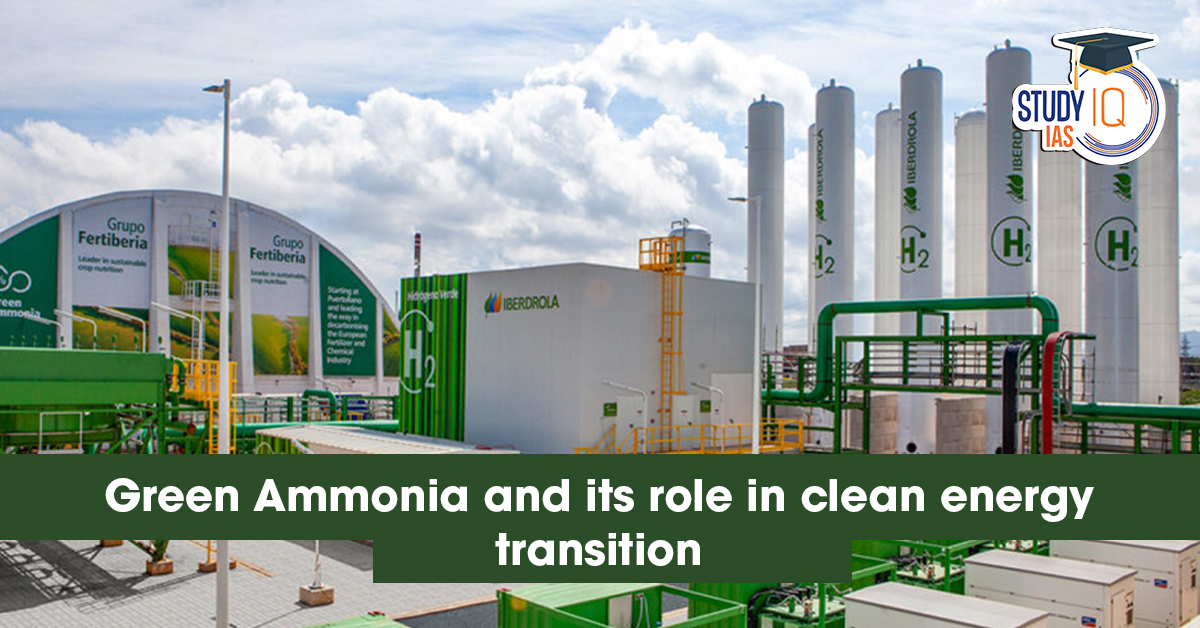
At India Energy Week 2026, the government operationalised its clean energy vision through SECI’s large-scale green ammonia auctions under the SIGHT programme, offering 10-year fixed-price contracts.
What is Green Ammonia?
- Green ammonia is a 100% renewable, carbon-free fertilizer and energy carrier produced by combining nitrogen from the air with green hydrogen (generated via water electrolysis using solar or wind energy).
- Unlike traditional “grey” ammonia that uses fossil fuels, green ammonia emits zero, offering a sustainable solution for agriculture, energy storage, and marine fuel.
- Production: Water is split into hydrogen and oxygen using renewable electricity. This green hydrogen is then combined with nitrogen using the Haber-Bosch process to produce ammonia.
What is the SECI Green Ammonia Auction Model?
- The SECI Green Ammonia Auction Model, under the National Green Hydrogen Mission’s SIGHT Scheme (Mode 2A), is a competitive, cost-based e-reverse auction for procuring green ammonia.
- It is designed to bridge the price gap with conventional ammonia. It features a 10-year, fixed-price contract, with SECI acting as an intermediary to facilitate demand, resulting in record-low prices around ₹55.75/kg as of mid-2025.
Key Features of the SECI Green Ammonia Model
- SIGHT Scheme Mode 2A: The auction is part of the Strategic Interventions for Green Hydrogen Transition (SIGHT) scheme, which provides financial incentives for producing and supplying green ammonia, implemented by SECI.
- Intermediary Procurement Model: SECI acts as an intermediary, bidding for and procuring green ammonia from producers and supplying it to fertilizer companies, addressing the “chicken-and-egg” demand-supply challenge.
- Competitive Bidding & Reverse Auction: The process involves e-bidding followed by an e-reverse auction to ensure the most competitive, market-driven pricing.
- Long-Term Contracts: Green Ammonia Purchase Agreements (GAPA) are signed for a period of 10 years, providing certainty to developers and investors.
- Payment Security Mechanism: A robust, built-in payment security mechanism ensures the financial viability of projects and reassures stakeholders.
- Aggregated Demand: The model aggregates demand for green ammonia, with planned auctions covering a cumulative capacity of over 7 lakh MT per annum, promoting economies of scale.
- Record-Low Pricing: The first auction in 2025 achieved a significant breakthrough, with prices dropping to roughly ₹55.75/kg, making green ammonia increasingly competitive with traditional, gray ammonia.
How Does the Green Ammonia Auction Model Reflect a Governance Shift from Subsidy to Market Creation?
- Aggregated Demand Mechanism: SECI pooled demand of up to 7,24,000 tonnes annually across 13 fertiliser plants, reducing fragmented procurement and enhancing scale efficiency.
- Long-term Offtake Contracts: Provides 10-year fixed-price agreements, ensuring revenue certainty and reducing investor risk.
- Competitive Bidding Framework: Attracted 15 bidders, with 7 successful awardees, strengthening transparency and price discovery.
- Production Subsidy Support: Includes viability gap support of ₹8.82/kg, ₹7.06/kg, and ₹5.3/kg over three years under SIGHT.
- Outcome: Establishes a cost-competitive domestic green ammonia market.
|
How Does India’s Price Discovery Compare with Global Benchmarks and What Does it Indicate? |
| ● Price Range Achieved: ₹49.75-₹64.74/kg ($572-$744/tonne).
● Global Benchmark Comparison: Nearly 40-50% lower than H2Global auction prices. ● Grey Ammonia Benchmark: Grey ammonia prices reach $515/tonne, narrowing cost gap significantly. ● Cost Gap Reduction: Long-term contracts and subsidies reduce transition risks. ● Outcome: Positions India as a potential global price influencer in green fuels. |
How Does the Policy Strengthen Energy Security and Reduce Import Vulnerability?
- Import Substitution: Contracted volume equals nearly 30% of India’s ammonia imports.
- Price Predictability: Fixed-price contracts reduce exposure to global volatility, currency risks, and geopolitical disruptions.
- Domestic Value Chain Creation: Integrates renewable energy, storage, hydrogen electrolysis, and ammonia synthesis.
- Energy Independence Objective: Aligns with India’s shift from energy security to energy independence.
- Outcome: Enhances strategic autonomy in fertiliser and energy sectors.
How Does Green Ammonia Contribute to India’s Decarbonisation Commitments?
- Industrial Decarbonisation: Supports fertiliser sector transition from grey to green ammonia.
- Hard-to-Abate Sectors: Enables decarbonisation in shipping, power generation, and heavy industry.
- Renewable Integration: Utilises low-cost renewable energy at scale.
- National Green Hydrogen Mission Alignment: Operationalises Mission targets through market instruments.
|
Read More Notes |
|
| Environment Notes | Art and Culture Notes |
| Science and Tech | History Notes |
| Geography Notes | Indian Polity Notes |
| General Knowledge | International Relation |
|
Explore StudyIQ Courses |
|
 Organ Donation in India: Legal, Ethical ...
 Finance Minister Launches National Monet...
 Role and Functioning of Parliamentary Fr...










 WhatsApp





