
Table of Contents
Context
- Graphics Processing Units (GPUs) have evolved from powering video games to becoming the backbone of artificial intelligence, scientific simulations, and the digital economy.
|
About GPU |
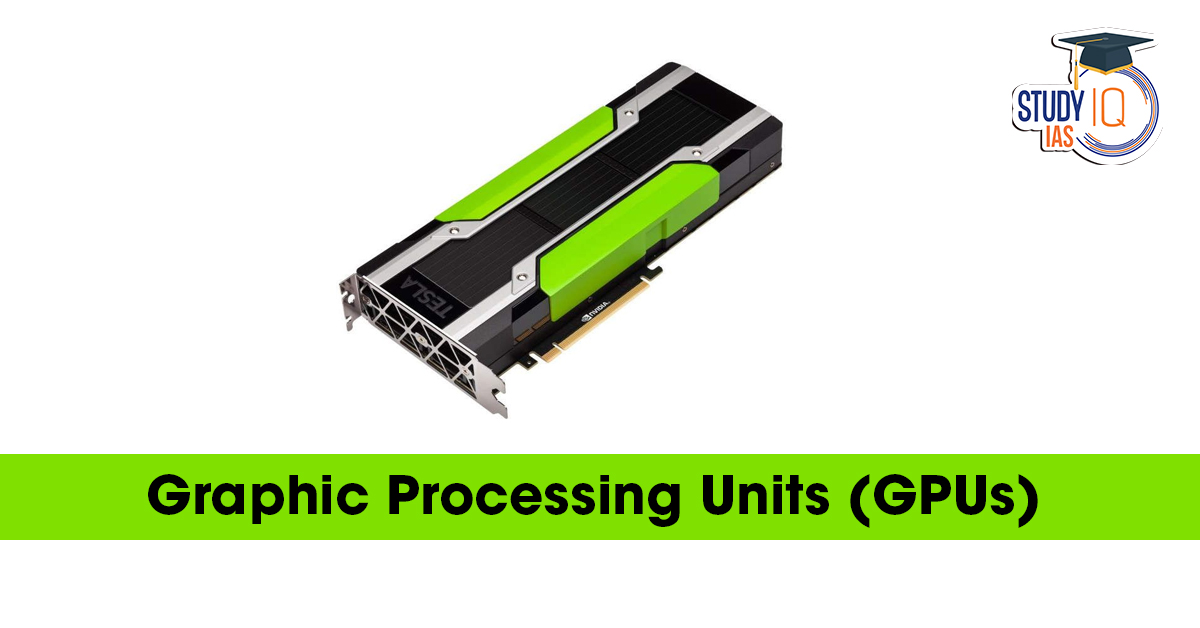
| ● Basic Definition: A GPU (Graphics Processing Unit) is a specialized processor designed to perform many simple calculations simultaneously at extremely high speed.
● Core Idea: Unlike CPUs, GPUs are built for parallel processing, meaning thousands of small computing cores work together on repetitive tasks. ● Historical Origin: The first widely marketed GPU was the GeForce 256 by Nvidia in 1999, initially designed for improving video game graphics. ● Modern Role: Today, GPUs are central to AI training, cloud computing, cryptocurrency mining, simulations, and high-performance scientific research. |
How Does a GPU Function
- Parallel Architecture: A GPU contains hundreds or thousands of smaller cores that execute identical instructions across large datasets simultaneously.
- Rendering Pipeline (Graphics Example): When rendering images, GPUs process objects in four stages: vertex processing, rasterization, pixel shading, and writing to frame buffer.
- Shaders: Small programs called shaders run across thousands of cores to calculate lighting, textures, reflections, and color for each pixel.
- Memory System: GPUs use high-bandwidth memory called VRAM to move massive data volumes quickly, reducing processing delays.
- High Data Throughput: They are designed to read and write large data blocks efficiently, essential for graphics and AI computations.
CPU vs GPU
| Feature | CPU | GPU |
| 1. Core Structure | Has few powerful cores (4–32) designed for complex instructions. | Has thousands of smaller cores designed for parallel calculations. |
| 2. Type of Tasks | Best for complex, sequential and decision-based tasks. | Best for repetitive, large-scale mathematical computations. |
| 3. Parallel Processing | Limited parallel processing capability. | Extremely high parallel processing capability. |
| 4. Multitasking Ability | Excellent at switching between multiple tasks quickly. | Performs best when focusing on one large task at a time. |
| 5. Main Applications | Used for operating systems, applications, and system control. | Used for AI training, gaming graphics, simulations, and data-heavy workloads. |
CPU Strength: CPUs excel in decision-making, branching tasks, and running operating systems.
GPU Strength: GPUs excel in performing identical mathematical operations across large arrays of data.
Architectural Difference: CPUs allocate more area to control logic and cache, while GPUs allocate more area to compute units.
Why Do Neural Networks Use GPUs?
- Matrix and Tensor Operations: Neural networks rely heavily on matrix multiplication and tensor calculations, which are repetitive and parallelizable.
- Massive Parameter Counts: Modern AI models contain millions to billions of parameters requiring simultaneous computations.
- Parallel Efficiency: GPU cores can multiply and add thousands of numbers simultaneously, accelerating training.
- Tensor Cores: Modern GPUs like Nvidia’s H100 include tensor cores optimized for AI matrix math.
- Memory Bandwidth: High-speed memory movement ensures large datasets and model parameters are processed efficiently.
How Much Energy Do GPUs Consume?
- Training Phase Consumption: An Nvidia A100 GPU consumes about 250 watts under load. Four GPUs running 12 hours use roughly 12 kWh.
- Inference Phase Consumption: Once trained, using the model consumes less power, roughly 2 kWh for moderate inference workloads.
- Server Overhead: Additional components (CPU, RAM, cooling) add 30–60% extra energy consumption.
- Data Centre Scale: Large AI data centres consume megawatts of power, leading to rising concerns over energy demand.
- Environmental Impact: AI training can significantly increase electricity demand, making renewable energy integration important.
Does Nvidia Have a Monopoly?
- Market Share in GPUs: Nvidia holds around 90% market share in high-performance discrete GPUs for AI applications.
- Competitors: AMD and Intel produce GPUs, but they lag behind Nvidia in AI-focused hardware and ecosystem maturity.
|
Alternatives to Nvidia GPUs |
| ● AMD GPUs: AMD produces competitive GPUs but has smaller market share in AI data centres.
● Intel GPUs: Intel is entering AI accelerator markets but remains behind in performance. ● Google TPUs: Google’s Tensor Processing Units (TPUs) are custom AI chips optimized for neural network tasks. ● Specialized AI Chips: Companies are developing ASICs (Application-Specific Integrated Circuits) for energy-efficient AI computing. |
- CUDA Ecosystem Advantage: Nvidia’s CUDA software platform allows developers to run AI workloads efficiently on Nvidia GPUs.
- Software Lock-In Effect: Switching from Nvidia requires rewriting code for other platforms, increasing dependency on Nvidia hardware.
- Data Centre Dominance: Nvidia dominates AI data centre GPUs, especially with products like H100 and A100.
- Regulatory Scrutiny: Regulators in the EU and US are investigating whether Nvidia’s dominance restricts competition.
Future of GPU Technology
- Smaller Fabrication Nodes: GPUs are moving toward 3–5 nanometer fabrication technologies for efficiency.
- Energy Efficiency Improvements: New architectures aim to improve performance per watt.
- Integrated AI Accelerators: Future chips may integrate CPU, GPU, and AI accelerators in unified systems.
 Gold Imports and the Indian Economy – ...
 Nilgiri Tahr Conservation: Ecology, Habi...
 50 Years of the Bonded Labour System (Ab...











 WhatsApp





