
Table of Contents
Context
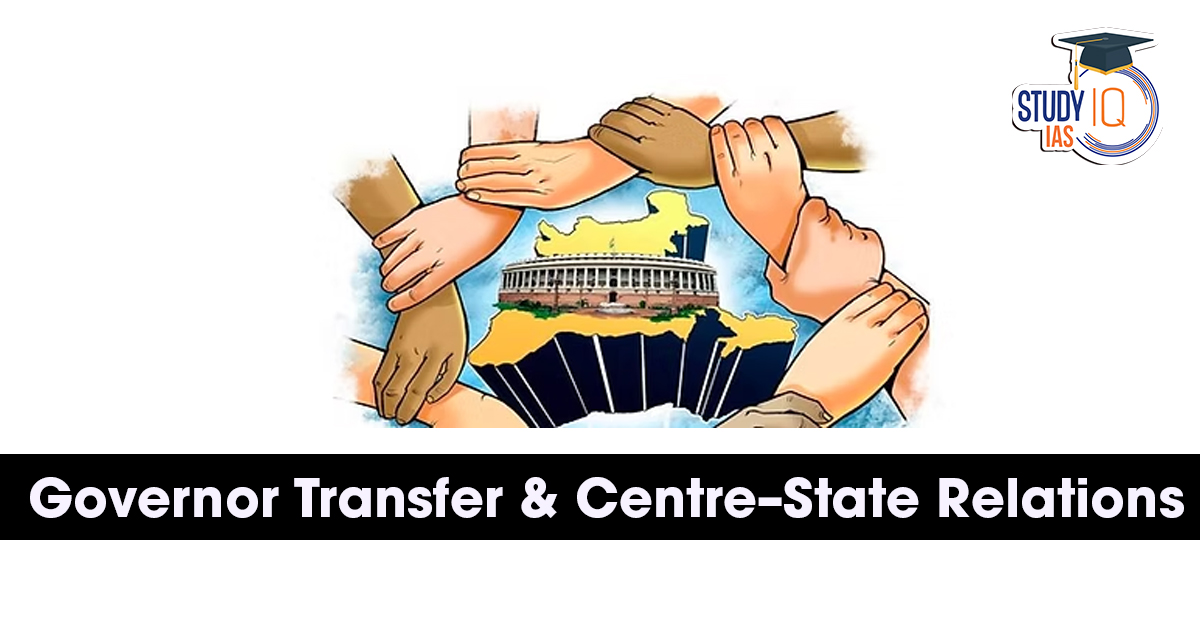
The Union government has reassigned several Governors across States and Union Territories. As part of this exercise, R. N. Ravi has been transferred to West Bengal following the sudden resignation of C. V. Ananda Bose. The reshuffle also includes changes in five other States and two Union Territories.
Appointment of the Governor
Constitutional Provisions
Article 153: Governor for Every State
- Mandatory constitutional office: This article provides that each State must have a Governor, who acts as the constitutional head of the State government.
- One Governor for multiple States: The Seventh Constitutional Amendment Act, 1956 made it possible for one individual to serve as Governor for more than one State at the same time.
Article 154: Executive Power of the State
- Formal executive authority: The executive power of the State is vested in the Governor, although it is exercised in practice on the advice of the Council of Ministers headed by the Chief Minister.
Article 155: Appointment
- Appointment by the President: The Governor is appointed by the President of India.
- Official process: The appointment is issued through a formal warrant signed and sealed by the President, making the Governor a representative of the Union government.
Article 156: Tenure
- Pleasure of the President: The Governor remains in office at the pleasure of the President, meaning they can be transferred or removed at any time.
- Normal term: The usual tenure is five years from the date of assuming office.
- Continuation beyond tenure: Even after completing five years, the Governor continues until a successor assumes office.
- Resignation: A Governor may resign by submitting a letter to the President.
Article 157: Qualifications
- Basic eligibility: A Governor must
- be a citizen of India, and
- be at least 35 years of age.
Article 158: Conditions of Office
- No legislative membership: The Governor cannot be a member of Parliament or a State Legislature. If such a member is appointed, their seat automatically becomes vacant.
- No other office of profit: The Governor is not allowed to hold any other paid public office.
- Official facilities: The office provides an official residence without rent, along with salary and allowances decided by Parliament.
- Multiple-State arrangement: If a Governor serves two or more States, the expenses are shared among those States according to the President’s order.
- Protection of salary: The Governor’s salary and allowances cannot be reduced during the tenure.
Article 159: Oath of Office
- Constitutional oath: Before assuming office, the Governor takes an oath to faithfully perform duties, protect the Constitution, and serve the people of the State.
- Administering authority: The oath is administered by the Chief Justice of the concerned High Court, or the senior-most judge if the Chief Justice is unavailable.
| Established Conventions |
| ● Appointment from Outside the State: Ensuring neutrality: Governors are usually appointed from outside the State so that they remain detached from local political interests.
● Consultation with the Chief Minister: Convention for smooth governance: It is generally expected that the Chief Minister of the State is consulted before the appointment, although this practice is not always followed. |
Appointment of the Lieutenant Governor (LG)
Article 239: Administration of Union Territories
- Presidential administration: Union Territories are administered by the President through an Administrator appointed by him.
- Location in the Constitution: This provision falls under Part VIII (Articles 239–241) dealing with Union Territories.
Designation of Administrator
- Different titles: The President decides the official title of the Administrator.
- Lieutenant Governors: In some Union Territories such as Delhi, Puducherry, Jammu and Kashmir, Ladakh, and Andaman and Nicobar Islands, the Administrator is called the Lieutenant Governor.
- Other UTs: In Chandigarh, Lakshadweep, and Dadra and Nagar Haveli and Daman and Diu, they are simply referred to as Administrators.
Article 239AA – Special Provision for Delhi
- Specific designation: This article states that the Administrator of the National Capital Territory of Delhi shall be known as the Lieutenant Governor.
Appointment Process
- Presidential appointment: The Lieutenant Governor is appointed by the President through a formal warrant.
- Role of the Union government: Since the President acts on the advice of the Union Council of Ministers, the Central government effectively recommends the appointment.
Tenure and Removal
- Pleasure doctrine: Like Governors, LGs also hold office at the pleasure of the President.
- Removal or transfer: The Central government can recommend transfer, removal, or resignation at any time, as the Constitution does not specify fixed grounds for removal.
Reasons behind Governors being appointed instead of elected?
Avoiding Power Conflicts
- Decision of the Constituent Assembly: India adopted the Canadian model of an appointed Governor, instead of the American model of an elected Governor.
- Reason: An elected Governor could compete with the Chief Minister, creating two centres of power within the State.
Parliamentary System
- Ceremonial head: In the parliamentary system, the Chief Minister exercises real executive power, while the Governor acts mainly as a constitutional head.
- Cost and practicality: Conducting a separate election for this largely ceremonial role was considered unnecessary.
Strengthening National Integration
- Link between Centre and States: The Governor acts as a bridge between the Union government and the State, helping maintain national unity.
Ensuring Political Neutrality
- Avoiding partisan politics: An elected Governor would likely rely on political parties for support, which could affect neutral decision-making during situations like hung assemblies or President’s Rule.
| Key recommendations on the appointment of Governors |
| Sarkaria Commission (1983)
● Eminent and non-political candidate: Recommended appointing a distinguished person from outside the State who has not been actively involved in politics recently. ● Consultation process: Suggested consulting the Chief Minister, Vice-President, and Speaker of the Lok Sabha before making the appointment. ● Tenure security: Advised that Governors should not normally be removed before completing their five-year term. Punchhi Commission (2007) ● Reform of pleasure doctrine: Proposed removing the “pleasure of the President” principle for Governors. ● Removal procedure: Suggested that a Governor should be removed only through a resolution of the State Legislature, similar to impeachment. National Commission to Review the Working of the Constitution (2002) ● Completion of tenure: Recommended that Governors should ordinarily complete their five-year term. ● Consultation before removal: If removal is necessary, the Chief Minister of the concerned State should be consulted. |
 Finance Commission Grants to Cities
 Rajya Sabha Elections: Process, Eligibil...
 Labour Market Impacts of Artificial Inte...






 WhatsApp





