
Table of Contents
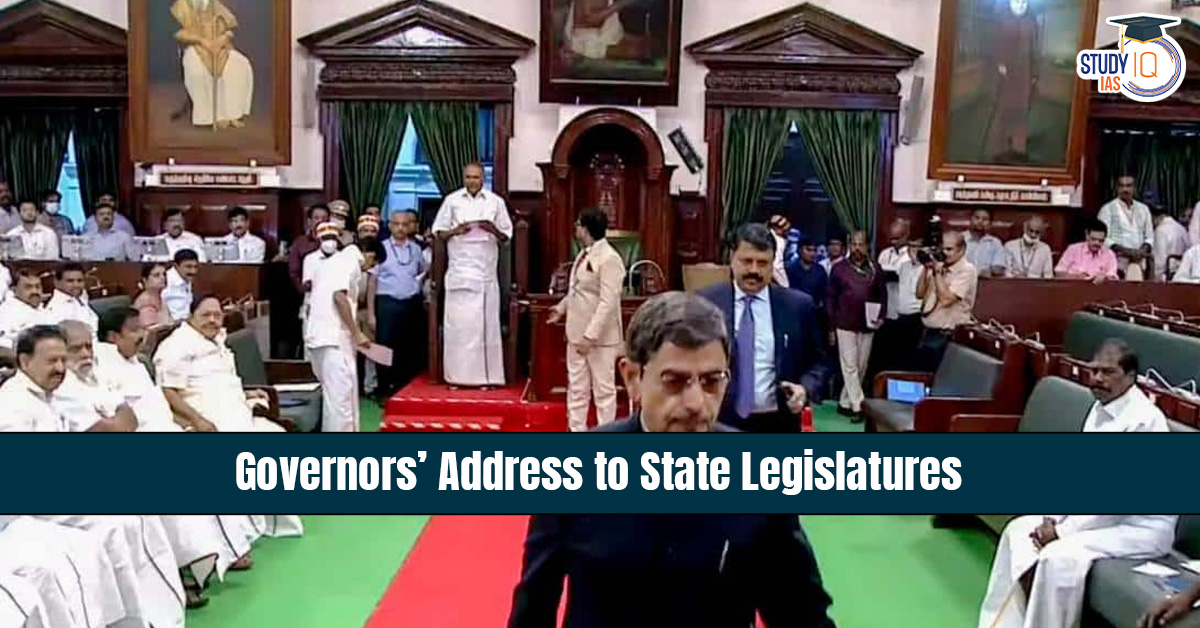
The Governor’s address to the State Legislature at the onset of legislative sessions is a constitutionally entrenched feature of India’s parliamentary democracy. The address serves as a formal expression of the elected government’s policies and legislative agenda, symbolising constitutional continuity, executive responsibility, and democratic governance. Recent incidents in Opposition-led States, where Governors have modified, abbreviated, or entirely refused to provide addresses crafted by elected governments, have prompted significant constitutional and political questions. These developments necessitate a reassessment of the Governor’s role within India’s federal framework, the constitutional provisions regulating gubernatorial duties, and the equilibrium between constitutional morality and political partisanship.
Chronological Development of the Governor’s Address
Colonial Foundations Established by the Government of India Act, 1935
The tradition of a Governor addressing the legislature originates from colonial constitutional frameworks. Section 63 of the Government of India Act, 1935 granted the Governor the authority to address the provincial legislature at his discretion. The implementation of provincial autonomy in 1937 substantially limited this discretion in practice. Governors commenced delivering speeches created in collaboration with elected ministries, delineating legislative goals and policy trajectories.
Consequently, prior to independence, a convention emerged in which the Governor’s address served not as a reflection of personal opinions but as a conduit for the executive’s agenda. This convention established the foundation for post-Constitutional practice.
The Debates of the Constituent Assembly and Constitutional Purpose
The Constituent Assembly deliberately embraced this norm while drafting the Constitution. During discussions on the rules concerning the Governor’s address, members underscored that the Governor is not an independent political entity but a constitutional figure bound to act on ministerial counsel. The address was perceived as an official articulation of the elected government’s policies to the legislature and, consequently, the public.
This understanding embodies the overarching constitutional doctrine that executive authority in a parliamentary democracy must reside with representatives accountable to the legislature.
Constitutional Framework Regulating the Governor’s Address Article 175: Discretionary Address
Article 175 of the Constitution stipulates that the Governor may address either House of the State Legislature or both Houses convened simultaneously. This provision is optional and is generally invoked sparingly. It permits the Governor to address the legislature on special occasions, but does not mandate such an address.
Article 176: Compulsory Address
Article 176 holds a pivotal position within the constitutional framework. The Governor is required to address the Legislature.
- At the commencement of the first session following each general election to the Legislative Assembly, and
- At the commencement of the first session of each year.
The address stipulated in Article 176 is mandatory and must delineate the government’s achievements from the previous year and its strategic agenda for the forthcoming year. This address is formulated by the Council of Ministers and simply presented by the Governor.
Article 176(2) additionally stipulates that legislative regulations must allocate time for the deliberation of issues mentioned in the address. The discussion culminates in the “Motion of Thanks,” facilitating legislative examination, debate, and democratic accountability.
The Role of the Governor in the Indian Constitution
The Governor holds a distinctive role under India’s constitutional framework. The Governor, appointed by the President pursuant to Article 155 and serving at the President’s discretion under Article 156, acts as the ceremonial leader of the State executive. The Governor, although endowed with specific discretionary rights, is primarily obligated to act on the advice of the Council of Ministers, as stipulated in Article 163.
The Supreme Court has consistently underscored that the Governor is not an agent of the Union Government but a constitutional authority whose principal obligation is to preserve, protect, and defend the Constitution, as stipulated by the oath in Article 159. The Governor’s role is fundamentally connected to constitutional morality, federal equilibrium, and democratic legitimacy.
Judicial Interpretation and Established Constitutional Law
Shamsher Singh v. State of Punjab (1974)
In Shamsher Singh v. State of Punjab, the Supreme Court decisively ruled that the Governor serves as a constitutional head who must operate on the aid and advice of the Council of Ministers in executing administrative tasks, except in specifically delineated discretionary matters. The Court dismissed the idea of the Governor as an independent power entity.
This judgment solidified the notion of ministerial responsibility within gubernatorial operations.
Nabam Rebia v. Deputy Speaker (2016)
In Nabam Rebia, the Supreme Court reiterated that the Governor’s duties under Articles 174, 175, and 176 must be performed based on ministerial advice. The Court unequivocally determined that the Governor cannot operate autonomously in legislative affairs unless explicitly authorised by the Constitution.
The ruling emphasised that discretionary powers cannot be broadened by convention or executive interpretation, reaffirming the supremacy of elected governments.
Moreover, in the landmark 1994 case S.R. Bommai v. Union of India, the 9-Judge Bench reaffirmed the significance of elected state governments and the legislative process within states, while firmly advising Governors to refrain from acting as instruments of the Centre. Although S.R. Bommai v. Union of India pertains to Article 356, its core principles can be deemed relevant to all gubernatorial powers in general.
Collectively, these authorities clarify that Article 176 alone confers no independent policymaking authority to the Governor. It unequivocally mandates the obligation to read a speech. The substance of that speech is not at the Governor’s discretion. It is instead governed by the Council of Ministers and the regulations of the House. This conforms to practices in other Commonwealth systems; for instance, the UK’s King’s Speech is “composed for the sovereign by the government” and presented in a neutral tone. In India, the President’s Address to Parliament (Article 87), analogous to Article 176, is likewise formulated by the Union Cabinet and outlines the government’s agenda.
Current Disputes and Developing Practices
Recent years have seen recurrent departures from established constitutional norms, especially in states governed by the Opposition.
Tamil Nadu: The Governor skipped portions of the address prepared by the Council of Ministers in 2022 and 2023 and has allegedly not addressed the Assembly at all since 2024, seemingly contravening Article 176.
Kerala: The Governor excised portions of the policy address formulated by the Cabinet, prompting apprehensions of unilateral amendments.
Karnataka: The Governor declined to read the Cabinet-sanctioned message, opting instead to present a concise, self-composed remark before departing the joint session.
Such measures signify a substantial deviation from constitutional norms and established judicial principles. By modifying or withholding the address, Governors essentially subvert the power of elected governments and impede the legislative process.
Constitutional and Democratic Consequences Eroding Parliamentary Accountability
The Governor’s address serves as the basis for legislative discourse on government policy via the Motion of Thanks. Any disruption to the address compromises this process, denying the legislature the chance to systematically examine the executive’s program.
Federalism and Intergovernmental Relations
The Constitution of India features a quasi-federal framework wherein both the Union and the States have constitutionally safeguarded jurisdictions. The Governor’s position, although acting as a conduit between the Centre and the States, must not transform into a tool of political domination. Regular gubernatorial interventions threaten to undermine federal trust and destabilise Centre-State ties.
Infringement of Constitutional Ethics
By swearing an oath to protect the Constitution, Governors pledge to honour constitutional conventions and court precedents. Actions that contravene established law undermine constitutional ethics and diminish institutional credibility.
The Politicisation of the Governor’s Office
Conflict between Governors and State governments is longstanding, with occurrences traceable to the 1960s. The frequency and intensity of current disputes indicate a qualitative change. Governors increasingly seem to operate as political figures rather than impartial constitutional leaders.
This politicisation has incited persistent calls for the elimination of the Governor’s position. Abolition is impracticable due to India’s federal structure; yet, reform is both essential and urgent.
Proposals for Reform and the Path Ahead
Recommendations of the Sarkaria and Punchhi Commission
Both the Sarkaria Commission (1988) and the Punchhi Commission (2010) acknowledged the necessity of depoliticising the office of the Governor. Essential guidelines comprise:
- Seeking the Chief Minister’s advice prior to the appointment of a Governor.
- Designating individuals devoid of current political commitments.
- Guaranteeing security of tenure to foster independence.
Although these ideas have not been entirely executed, they present a pragmatic approach to mitigating conflict and reinstating constitutional equilibrium.
Reinforcing Constitutional Norms
In addition to formal modifications, compliance with constitutional conventions is crucial. Governors must embrace their function as facilitators of democratic government rather than as adjudicators of political conflicts.
Conclusion
The Governor’s address to the State Legislature serves as a constitutional mechanism that strengthens democratic accountability, legislative discourse, and executive duty. Recent disruptions to this process jeopardise not only elected administrations but also the constitutional structure itself.
Judicial rulings have clearly determined that the Governor acts on ministerial advice when giving the address. Any divergence from this premise jeopardises federalism, parliamentary democracy, and constitutional integrity. In the context of India’s increasingly polarised political landscape, it is essential to uphold the neutrality and dignity of constitutional offices.
Reforms based on constitutional principles, court precedents, and commission recommendations provide a feasible path ahead. The legitimacy of democratic administration relies not only on constitutional language but also on the diligent adherence to constitutional principles by all players, particularly those responsible for protecting the Constitution.
 Trial by Social Media: Public Shaming, D...
 Mandating Prior Approval for Corruption ...
 Transferring Judges and the Integrity of...













 WhatsApp





