
Table of Contents
Context
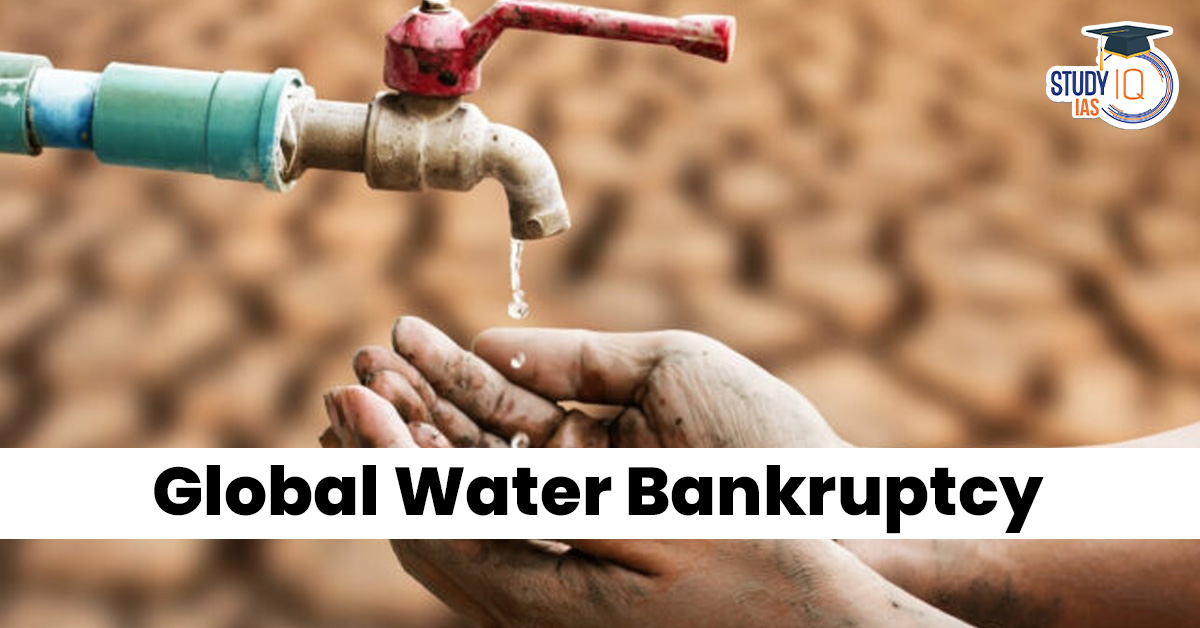
The United Nations University Institute for Water, Environment and Health (UNU-INWEH) released the Global Water Bankruptcy: Living Beyond Our Hydrological Means in the Post-Crisis Era.
Key Highlights
-
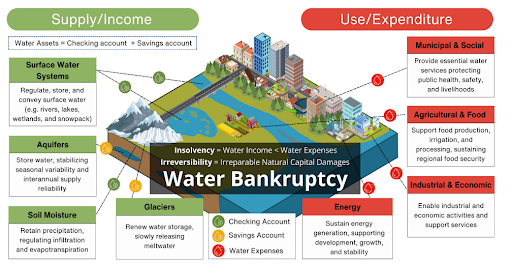
- The global human–water system as a whole has already entered the era of Global Water Bankruptcy
- About 2.2 billion people still lack safely managed drinking water, 3.5 billion lack safely managed sanitation, and about 4 billion people experience severe water scarcity for at least one month per year.
- Nearly 75% of the world’s population lives in countries classified as water-insecure or critically water-insecure with progress toward SDG 6 is far off track for 2030.
- Factors Leading to Water Bankruptcy
- Slow-Onset Depletion: Persistent overuse of surface and groundwater gradually erodes storage and quality, with warning signs often ignored until irreversible thresholds are crossed.
- Infrastructure-Driven Overshoot: Large dams and inter-basin transfers enable expansion of water use beyond sustainable limits.
- Ecological Liquidation: Degradation of wetlands, floodplains, forests, and soils boosts short-term productivity while undermining long-term water storage and buffering capacity.
- Climate-Amplified Overshoot: Climate change intensifies existing pressures by reducing reliable water supply and increasing variability in already overexploited systems.
Water Bankruptcy vs Water Stress vs Water Crisis
- Water Stress: High demand relative to supply, with impacts that are largely reversible through improved management.
- Water Crisis: Shock-driven disruptions that temporarily overwhelm water systems but can be restored through emergency and recovery measures.
- Water Bankruptcy: A chronic condition marked by structural depletion and long-term ecological damage.
 Renewable Energy Transition Challenges: ...
 Sinking of Iranian Warship IRIS Dena: Ca...
 U.S. 30-Day Waiver for India to Buy Russ...











 WhatsApp





