
Table of Contents
Context
- The release of a new GDP series with revised growth estimates has renewed debate about the state of the Indian economy.
- While the revised figures reinforce the narrative of India as the “fastest-growing major economy,” economists argue that excessive emphasis on GDP growth masks a critical issue — persistently high unemployment, especially among youth.
New GDP Series and the “Double-Deflation” Method
Key methodological change:
- The latest GDP estimates adopt the double-deflation method for calculating Gross Value Added (GVA).
- This method separately deflates output and input prices, giving a more accurate measure of real production.
- Revisions in growth estimates:
- The 2024–25 growth rate is revised upwards slightly, reinforcing growth optimism, while the 2023–24 growth rate is significantly revised downward.
- Despite revisions, India continues to be portrayed as the fastest-growing major economy globally.
Critical observation:
- While methodological improvements are welcome, the policy discourse remains disproportionately focused on production (GDP) rather than employment generation.
- Unemployment – The Understated Indicator
Rising unemployment trends:
- Data from surveys such as the Periodic Labour Force Survey (PLFS) indicate that unemployment remains higher than historical benchmarks.
- For example, unemployment Rate (Current Weekly Status) in 2011-12 was 3.7%, while it stands at an average of 2% (in the 10 months before Jan 2026).
- 2011-12 serves as a reasonable benchmark since the effects of the 2008 Global Financial Crisis and the Mukherjee Stimulus had largely subsided.
- Since then, unemployment has remained consistently higher, though it has moderated slightly in recent years.
- Youth unemployment:
- The situation is more severe for young people (15–29 years). For example, the youth unemployment rate (Usual Status) in 2011-12 was 7.7%, while it reached 10.2% 2023-24.
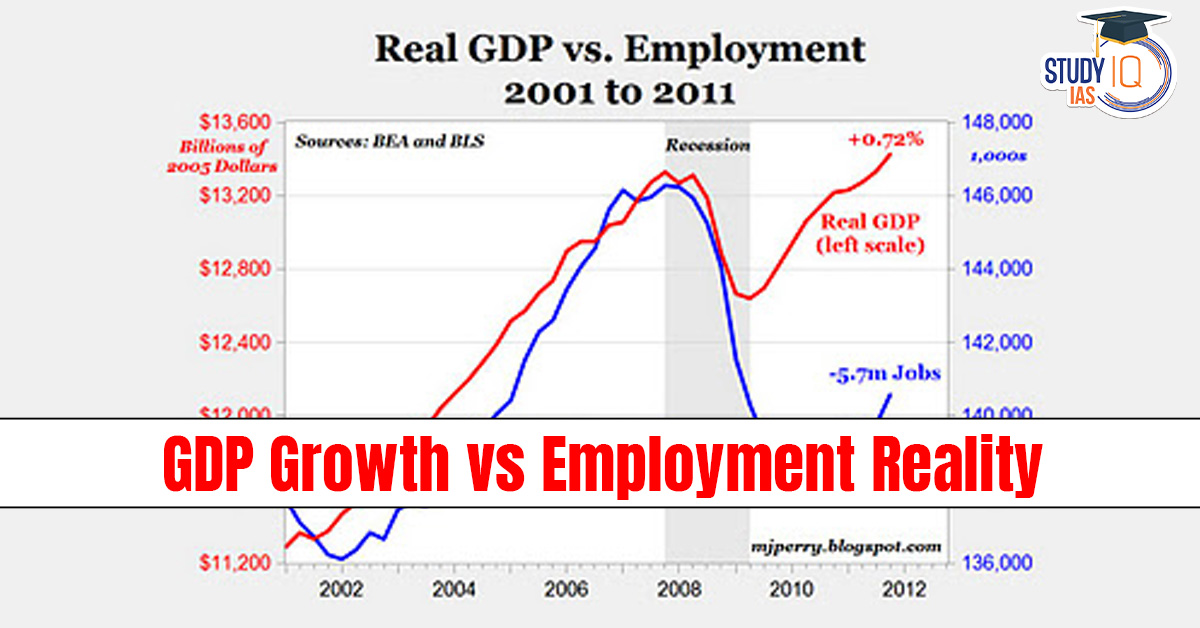
- This indicates that economic growth has not translated proportionately into job creation, pointing to the phenomenon of “jobless growth.”
Selective Presentation of Economic Indicators
- A key criticism concerns the asymmetry in official communication. For example, the Economic Survey presents detailed inflation data from 2011 onwards, highlighting its decline.
- However, unemployment data for the same period is not similarly emphasised.
- If comparable unemployment data were presented, it would reveal that unemployment today remains higher than historic levels, contradicting the optimistic narrative of economic performance.
Methodological Puzzle in Unemployment Data
- An unusual pattern emerges from PLFS data. During 2020-21 (COVID-19 pandemic), though the GDP contracted by ~7%, unemployment declined.
- Global comparison: In countries like the United States, unemployment surged during the pandemic despite a smaller GDP contraction.
- Implication: This anomaly suggests a need for greater methodological scrutiny and clarification from the National Statistical Office (NSO) to enhance credibility of unemployment data.
Key Challenges and Way Forward
- Overemphasis on GDP growth: As the primary economic indicator.
- Reorient economic policy towards employment: Shift focus from growth-centric policy to employment-intensive growth.
- Persistent unemployment: Particularly among youth.
- Promote labour-intensive sectors: Such as manufacturing (especially MSMEs), construction, agro-processing, and labour-intensive exports such as textiles and footwear.
- Jobless growth: Where production increases without proportional employment generation.
- Strengthen agricultural productivity: Sustained agricultural growth helps control food inflation and supports rural employment.
- Selective economic narrative: Highlighting favourable indicators while downplaying others.
- Balanced economic monitoring: Economic assessment should give equal importance to GDP growth, inflation, and employment.
- Data credibility concerns: Due to unexplained statistical patterns.
- Improve labour market data: Greater transparency in PLFS methodology. Clarification of anomalies, such as declining unemployment during economic contraction.
Conclusion
India’s strong GDP growth narrative does not fully capture the realities of the labour market.A sustainable economic strategy must therefore move beyond celebrating growth figures and prioritise employment generation, data transparency, and balanced policy evaluation.
|
Read More Notes |
|
| Environment Notes | Art and Culture Notes |
| Science and Tech | History Notes |
| Geography Notes | Indian Polity Notes |
| General Knowledge | International Relation |
|
Explore StudyIQ Courses |
|
 Supreme Court Upholds the Right to Die w...
 Bill to Codify IPS Deputation in CAPFs: ...
 IEA Agrees to Release 400 Million Barrel...











 WhatsApp





