
Table of Contents
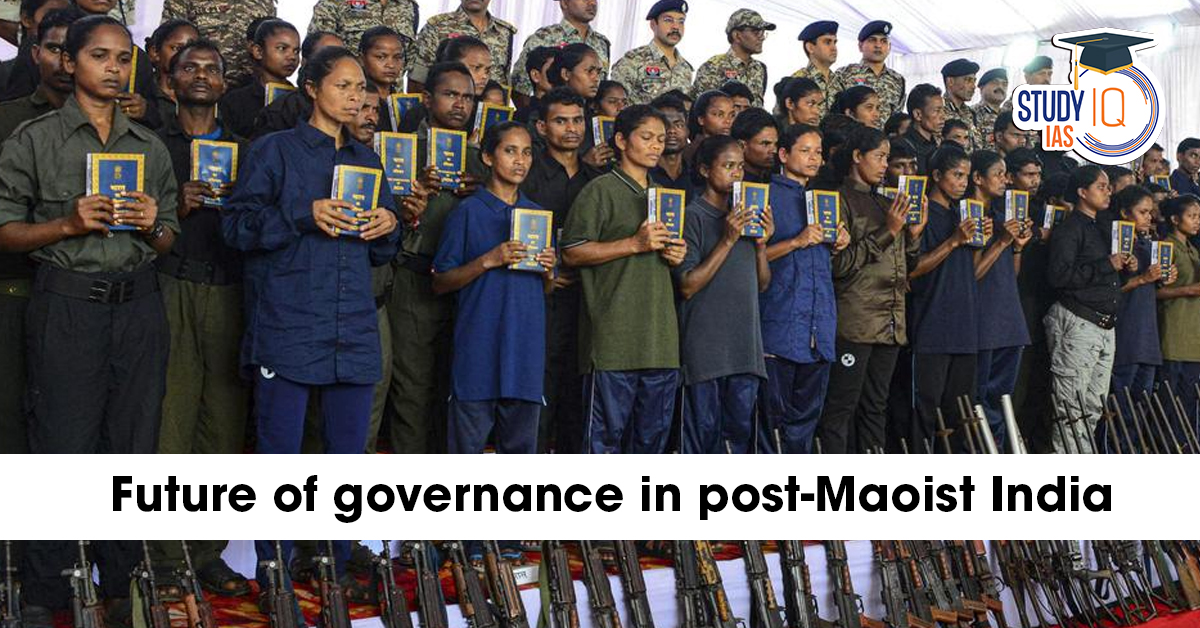
As India gradually weakens the operational capacity of the Maoist movement through sustained security operations and development interventions, a critical question emerges: what comes after Maoism? While the decline of Left-Wing Extremism (LWE) marks a significant internal security achievement, the future of governance in post-Maoist India will determine whether peace is durable or merely temporary.
Historically, Maoism thrived not just because of poverty, but due to deep governance deficits, institutional alienation, and justice failures in Fifth Schedule Areas. Therefore, post-Maoist governance must move beyond policing and welfare delivery to rebuild trust, political agency, and democratic institutions in tribal regions.
Understanding Post-Maoist India
Post-Maoist India does not imply the complete disappearance of extremist ideology. Instead, it signifies:
-
Reduced territorial control of Maoists
-
Diminished armed capabilities
-
Increased state presence in previously inaccessible areas
However, state presence alone is not governance. If administrative systems continue to remain extractive, unrepresentative, and opaque, new forms of conflict may replace old ones.
Why Governance is Central to Post-Maoist Stability
1. Maoism as a Symptom, Not a Disease
Maoist insurgency functioned as a substitute governance structure in many tribal areas, offering:
-
Swift (though coercive) justice
-
Local dispute resolution
-
Control over land and forests
In post-Maoist regions, the vacuum left by insurgents must be filled by legitimate, participatory, and rights-based governance, not militarised administration.
Key Pillars of Future Governance in Post-Maoist India
1. Political Re-Imagination of the Fifth Schedule
The Fifth Schedule must evolve from a symbolic constitutional promise into a functional governance framework.
Key reforms needed:
-
Mandatory annual reporting by Governors on Scheduled Areas
-
Greater accountability of Tribal Advisory Councils
-
Clear operational guidelines for Governor’s discretionary powers
Without political prioritisation, Fifth Schedule Areas risk reverting to administrative neglect.
2. Genuine Local Self-Governance Beyond Tokenism
While reservations exist at local levels, real power remains with non-tribal permanent bureaucracy.
Strengthening PESA
-
Legal enforcement of Gram Sabha consent
-
Fiscal autonomy to village institutions
-
Administrative penalties for violations
Post-Maoist governance must treat Gram Sabhas as decision-making bodies, not consultation forums.
3. Learning from the Sixth Schedule Model
Post-Maoist governance can borrow institutional features from Sixth Schedule Areas, such as:
-
Autonomous District Councils
-
Legislative and financial powers
-
Control over land, forests, and customary laws
A hybrid Fifth-Sixth Schedule governance model could help bridge autonomy and national integration.
4. Representation in the Permanent Bureaucracy
One of the deepest alienation drivers has been outsider-dominated administration.
Future priorities:
-
Special recruitment drives for tribal youth
-
Local cadre civil services for Scheduled Areas
-
Preference for local language and cultural knowledge
Governance must look and feel locally rooted.
5. Justice Delivery as Conflict Prevention
The absence of accessible justice legitimised Maoist “people’s courts”.
Post-Maoist Justice Reforms
-
Mobile courts in remote areas
-
Community-based dispute resolution mechanisms
-
Tribal customary laws integrated with formal judiciary
Justice should be visible, speedy, and culturally sensitive.
6. Policing Reform and Demilitarisation
As Maoist violence declines, policing must transition from counter-insurgency to community partnership.
-
Reduce prolonged deployment of central armed forces
-
Strengthen state police with local recruitment
-
Build trust through community policing
Security must support governance—not substitute it.
7. Rights-Based Development, Not Extractive Growth
Post-Maoist governance faces a critical dilemma: development versus displacement.
Policy Priorities
-
Strict enforcement of Forest Rights Act (FRA)
-
Re-evaluation of Compensatory Afforestation Fund (CAF) implementation
-
Free, prior, and informed consent for mining projects
Without rights protection, economic growth risks recreating conditions for conflict.
Digital Governance: Opportunity and Risk
Digital welfare delivery has improved efficiency, but in tribal areas it also risks:
-
Exclusion due to poor connectivity
-
Language barriers
-
Over-centralisation of decision-making
Post-Maoist governance must ensure technology complements participation, not replaces it.
Rebuilding Trust: The Core Challenge
Trust deficit between the state and tribal communities is inter-generational.
Trust-building measures include:
-
Truth and reconciliation mechanisms for conflict-affected regions
-
Withdrawal of false cases against civilians
-
Rehabilitation of surrendered cadres with dignity
Peace is sustained not by fear, but by legitimacy.
The Way Forward: A New Governance Charter
Post-Maoist India requires a new governance imagination, built on:
-
Autonomy with accountability
-
Representation with authority
-
Development with dignity
Security victories will remain fragile unless governance becomes inclusive, just, and participatory.
Conclusion
The future of governance in post-Maoist India lies not in celebrating the defeat of insurgency, but in addressing the reasons why insurgency once thrived. Fifth Schedule Areas must transition from zones of exception to spaces of democratic renewal.
Only when governance listens, represents, and empowers will Maoism truly become a closed chapter in India’s history.
 World Bear Day 2026: Date, Theme, Histor...
 Shaheed Diwas 2026: History, Significanc...
 Mahad Satyagraha 1927, History and Signi...










 WhatsApp





