
Table of Contents
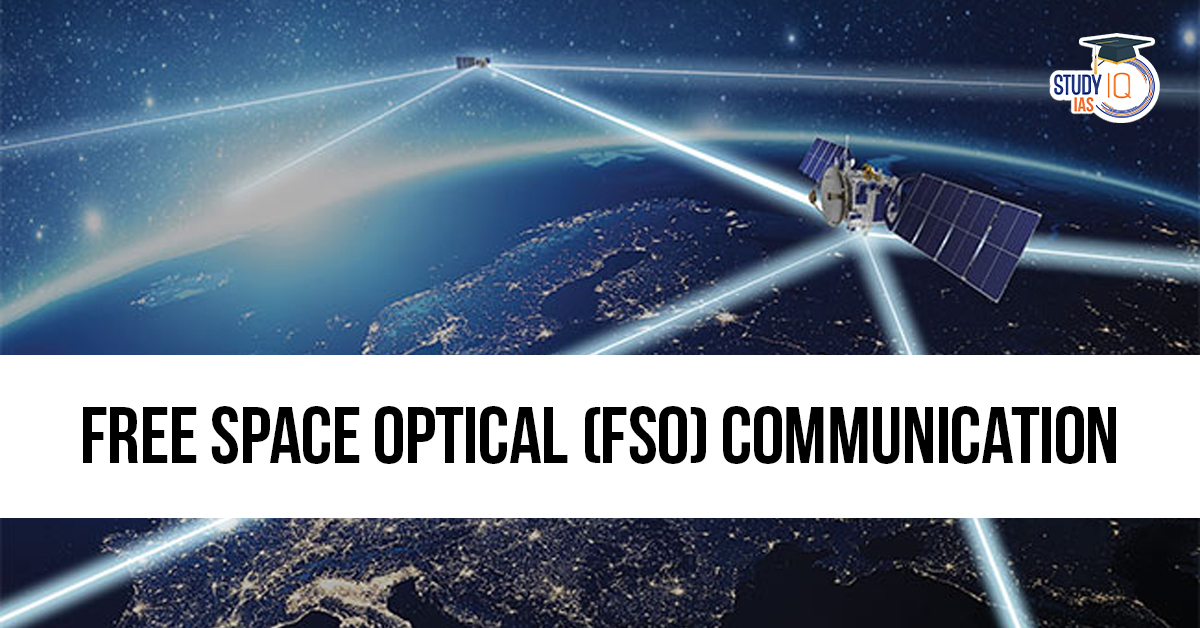
Free Space Optical (FSO) communication is a wireless communication technology that uses laser beams to transmit data through free space instead of optical fibers or radio waves. It enables extremely high data rates, low latency, and secure communication. With the emergence of Beyond 5G and 6G, FSO is gaining importance as a backbone technology for Non-Terrestrial Networks (NTN) connecting satellites, High Altitude Platform Stations (HAPS), and ground infrastructure.
What is Free Space Optical Communication?
FSO communication involves the transmission of modulated optical signals through the atmosphere or space using narrow laser beams. Data is encoded on light and transmitted directly between two terminals having a clear line of sight.
Key Features:
-
Uses optical spectrum instead of RF spectrum
-
Requires line-of-sight connectivity
-
Offers very high bandwidth and data rates
-
Highly directional and secure
Working Principle of FSO
-
Data is converted into optical signals using a laser source.
-
The laser beam travels through free space (air, vacuum, or space).
-
At the receiver, a photodetector converts the optical signal back into electrical data.
-
Advanced tracking and alignment systems ensure stable communication between moving platforms like satellites and HAPS.
Significance of FSO Communication
Ultra-High Data Rates
FSO can support speeds from several Gbit/s to multiple Tbit/s, far exceeding traditional RF systems.
Spectrum Efficiency
The optical spectrum is unregulated and abundant, unlike the congested RF spectrum.
Enhanced Security
Narrow laser beams are difficult to intercept or jam, making FSO suitable for strategic and defense communication.
Backbone of Non-Terrestrial Networks
FSO enables fast inter-satellite links and satellite-to-ground communication essential for 6G NTN architecture.
Recent Developments
World-First 2 Tbit/s Demonstration
Japan’s NICT achieved the first successful 2 Tbit/s FSO communication using compact terminals mountable on satellites and HAPS.
This proves that terabit-class optical communication is now practical for mobile platforms and not limited to laboratory setups.
Technological Innovations
-
Miniaturized optical terminals
-
Beam Divergence Control technology
-
High-precision tracking systems
-
Wavelength Division Multiplexing (WDM)
Applications of FSO Communication
Satellite Communication
-
Inter-satellite optical links
-
Satellite-to-ground high-speed data transmission
High Altitude Platform Stations (HAPS)
-
Acts as an intermediate layer between satellites and Earth
-
Enables flexible 6G coverage
Disaster Management
-
Rapid deployment of communication in disaster-hit areas
-
Useful when fiber and mobile networks are damaged
Defense and Strategic Uses
-
Secure, jam-resistant communication
-
Military satellites and command networks
Last-Mile Connectivity
-
Effective in remote and hilly regions
-
Alternative to costly fiber deployment
Challenges in FSO Communication
Atmospheric Attenuation
Fog, rain, dust, and turbulence weaken laser signals.
Line-of-Sight Dependency
Any obstruction between transmitter and receiver disrupts communication.
Pointing, Acquisition and Tracking (PAT)
Extremely precise alignment is required, especially for moving platforms.
Size, Weight and Power (SWaP) Constraints
Satellite-mounted systems must be compact and energy-efficient.
Reliability Issues
Urban environments and vibrations affect beam stability.
FSO and India’s Strategic Interests
-
Supports India’s 6G vision and space communication roadmap
-
Can enhance ISRO’s satellite communication systems
-
Useful for defense, disaster resilience, and digital connectivity
-
Complements BharatNet and Digital India initiatives
Way Forward
-
Integration of FSO with RF hybrid systems for reliability
-
Increased research on atmospheric compensation techniques
-
Indigenous development of optical terminals and modems
-
Public-private collaboration for satellite internet infrastructure
-
Deployment of FSO-enabled Non-Terrestrial Networks for 6G
Conclusion
Free Space Optical communication represents a transformative leap in communication technology. Its ability to deliver ultra-high data rates, secure transmission, and spectrum-efficient connectivity makes it a cornerstone for future 6G and Non-Terrestrial Networks. Although challenges like atmospheric interference and precision tracking persist, recent technological breakthroughs show that FSO is rapidly moving from experimental research to real-world deployment. In the coming decade, FSO is expected to become the optical backbone of integrated space-air-ground communication systems, redefining global digital connectivity.
Sharing is caring!
 Navigating Uncharted Waters: What Next f...
 Astronaut Reentry Explained: How Spacecr...
 Missile Interceptors Explained: Role in ...











 WhatsApp





