
Table of Contents
Context
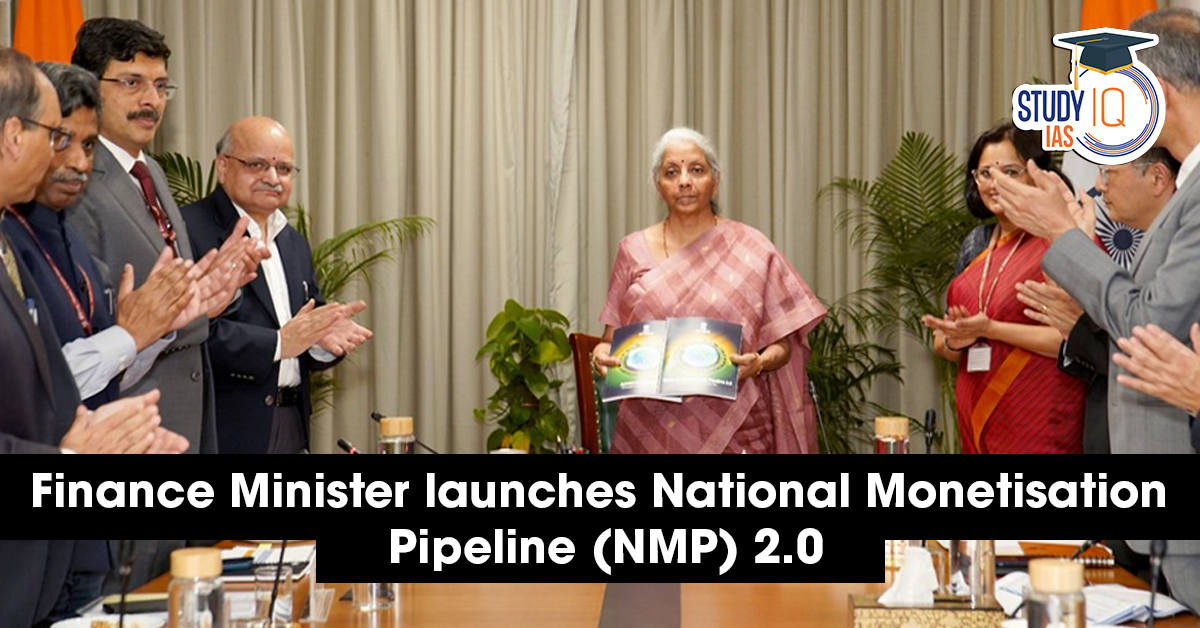
The Union Finance Minister has launched the National Monetisation Pipeline 2.0 (NMP 2.0) to accelerate infrastructure financing through asset monetisation.
What is it?
- NMP 2.0 is the second phase of India’s national asset monetisation programme that provides a medium-term roadmap for monetising operational public infrastructure assets.
- It focuses on unlocking value from existing brownfield assets to generate resources for new infrastructure creation and capital expenditure.
- Ministry / Implementing Agency: Developed by NITI Aayog in consultation with infrastructure line ministries.
- Implemented under the guidance of the Ministry of Finance and monitored by the Core Group of Secretaries on Asset Monetisation (CGAM).
Aim
- To recycle public assets and mobilise funds for fresh infrastructure development without increasing fiscal burden.
- To provide visibility and investment opportunities for private sector participation in infrastructure.
Key Features
- Total Monetisation Potential: ₹16.72 lakh crore for FY 2026–2030, including ₹5.8 lakh crore private investment.
- Guidance Framework: Structured as a methodology and roadmap document for ministries and investors.
- Multiple Monetisation Models: PPP concessions, InvITs, securitisation of cash flows, strategic auctions, and partial divestments.
- Revenue Allocation Mechanism: Proceeds flow to Consolidated Fund of India, PSUs, State Consolidated Funds, or direct private investments.
- Sector-Wide Coverage: Includes highways, railways, power, ports, coal, mining, telecom, aviation, tourism and urban infrastructure.
- Process Standardisation: Emphasis on simplification and time-bound execution based on lessons from NMP 1.0.
- Monitoring Mechanism: Continuous oversight by an empowered inter-ministerial group led by Cabinet Secretary.
Top 5 Sectoral Shares (FY 2026–30)
- Highways, MMLPs & Ropeways – 26% (₹4.42 lakh crore)
- Power Sector: 17% (₹2.76 lakh crore)
- Railways: 16% (₹2.62 lakh crore)
- Ports: 16% (₹2.63 lakh crore)
- Coal: 13% (₹2.16 lakh crore)
Significance
- Promotes asset recycling, enabling reinvestment into new infrastructure projects.
- Reduces dependence on direct budgetary expenditure for CAPEX.
- Strengthens PPP ecosystem and attracts long-term private investment.
|
Read More Notes |
|
| Environment Notes | Art and Culture Notes |
| Science and Tech | History Notes |
| Geography Notes | Indian Polity Notes |
| General Knowledge | International Relation |
|
Explore StudyIQ Courses |
|
 Organ Donation in India: Legal, Ethical ...
 Green Ammonia and Its Role in Clean Ener...
 Role and Functioning of Parliamentary Fr...











 WhatsApp





