
Table of Contents
In the contemporary geopolitical landscape, critical minerals have acquired the same strategic importance that oil held in the 20th century. India’s ambitions in clean energy transition, electric mobility, defence manufacturing, digital infrastructure, and space technology are heavily dependent on minerals such as lithium, cobalt, nickel, copper, and rare earth elements (REEs). With global supply chains highly concentrated and China dominating mineral processing, India’s mineral diplomacy has become a vital pillar of its foreign and economic policy.
Strategic Importance of Critical Minerals for India
Critical minerals are essential for:
-
Lithium-ion batteries for electric vehicles and energy storage
-
Solar panels, wind turbines, and smart grids
-
Semiconductors and electronics
-
Defence systems, missiles, and aerospace technology
India is import-dependent for most of these minerals and has limited domestic refining and processing capacity. This creates vulnerabilities in:
-
Energy security
-
Industrial competitiveness
-
Strategic autonomy
Thus, mineral diplomacy is not merely about trade, but about national security and long-term economic resilience.
India’s Two-Pronged Strategy
1. Building Domestic Capabilities
-
Identification of critical and strategic minerals under national policy.
-
Exploration of domestic reserves of lithium, rare earths, graphite, and nickel.
-
Reforms in mining laws to attract private and foreign investment.
-
Focus on developing refining, beneficiation, recycling, and processing infrastructure.
2. Securing Overseas Assets and Partnerships
-
Acquisition of mineral assets abroad.
-
Long-term supply agreements.
-
Technology-sharing and joint processing arrangements.
This approach balances immediate supply security with long-term self-reliance.
Key Pillars of India’s International Mineral Partnerships
Australia
-
Politically stable with strong ESG norms.
-
Major reserves of lithium, cobalt, and rare earths.
-
India–Australia Critical Minerals Investment Partnership supports joint projects and financing.
-
A cornerstone of India’s Indo-Pacific mineral strategy.
Japan
-
A model of mineral security through:
-
Diversified sourcing
-
Strategic stockpiling
-
Advanced processing technology
-
-
Cooperation includes joint extraction, processing, and stockpiling.
African Nations
Africa is central due to mineral abundance and historical ties.
-
Namibia: Lithium, rare earths, uranium
-
Zambia: Copper and cobalt
-
DRC: Cobalt
India’s engagement combines mineral access with development cooperation and capacity building.
United States
-
Cooperation focuses on secure and transparent supply chains.
-
Initiatives like the TRUST Initiative aim at:
-
Rare-earth processing
-
Technology collaboration
-
Alternative supply networks
-
-
However, tariffs and protectionist policies limit full cooperation.
European Union
-
The Critical Raw Materials Act (CRMA) links sustainability with industrial strategy.
-
India can align with EU:
-
ESG standards
-
Transparent sourcing
-
Recycling and circular economy initiatives
-
Expanding Geographical Outreach
Latin America
A new frontier for India’s mineral diplomacy:
-
Argentina and Chile: Lithium
-
Peru: Copper
-
Brazil: Nickel and rare earths
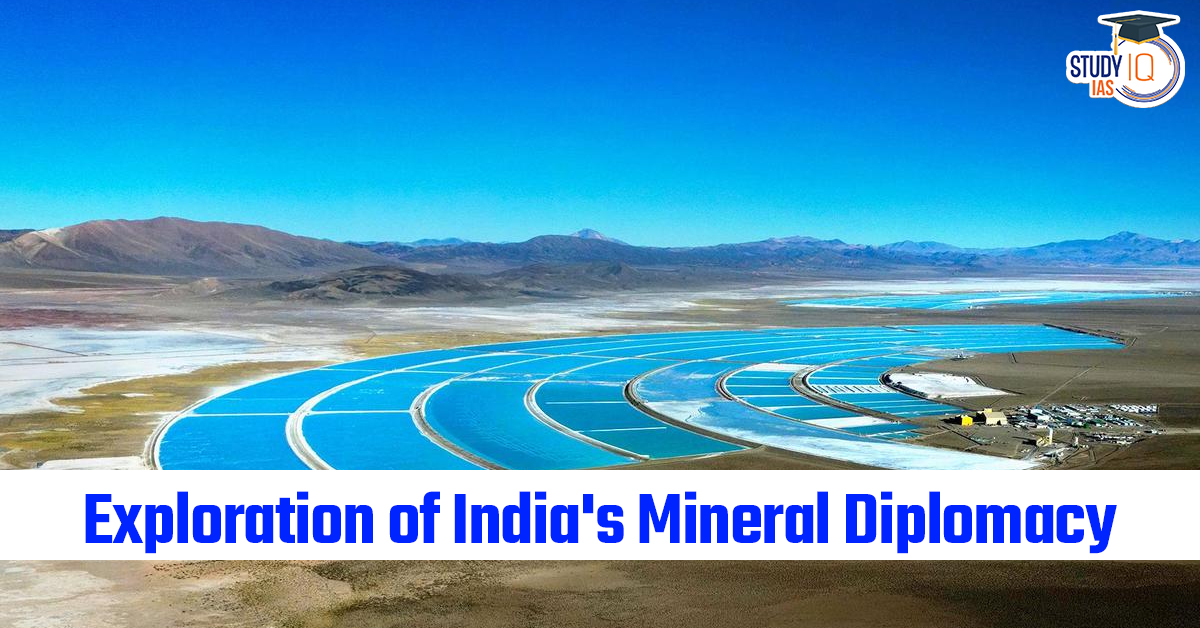
KABIL’s agreement with Argentina marks India’s first major overseas lithium initiative.
Canada
-
Politically stable and resource-rich.
-
Reserves of nickel, cobalt, copper, and rare earths.
-
Strong ESG standards make it a reliable strategic partner.
West Asia
-
Potential midstream partner for:
-
Refining
-
Battery material processing
-
Capital investment
-
Russia
-
Substantial reserves of strategic minerals.
-
Sanctions and logistics limit engagement.
-
Can act as a diversification hedge.
Institutional Mechanisms Supporting Mineral Diplomacy
KABIL (Khanij Bidesh India Limited)
-
A joint venture of NALCO, HCL, and MECL.
-
Mandated to:
-
Acquire overseas mineral assets
-
Secure long-term supplies
-
Strengthen strategic resource access
-
Multilateral Platforms
-
BRICS
-
G20
-
Quad
These forums increasingly discuss resilient and diversified mineral supply chains.
India’s Core Vulnerability: Processing and Refining
Despite diplomatic outreach, India’s major weakness lies in:
-
Limited refining and beneficiation capacity
-
Inadequate rare-earth separation technology
-
Dependence on China for midstream processing
Without domestic processing:
-
Supply chain control remains incomplete
-
Strategic autonomy remains constrained
Challenges in India’s Mineral Diplomacy
-
Technology Deficit
-
Rare-earth separation
-
Battery-grade mineral processing
-
Recycling technologies
-
-
Implementation Gaps
-
Many MoUs do not translate into operational mines.
-
-
ESG and Social Concerns
-
Environmental sustainability
-
Community displacement
-
Responsible mining practices
-
-
Geopolitical Risks
-
Political instability in mineral-rich regions
-
Sanctions and trade barriers
-
Way Forward
1. Develop Domestic Processing Ecosystems
-
Establish refining and smelting hubs.
-
Invest in rare-earth separation and battery material manufacturing.
2. Strategic Stockpiling
-
Build reserves of critical minerals on the Japanese model.
3. Integrate ESG into Diplomacy
-
Promote transparent and responsible mining.
-
Align overseas projects with sustainability norms.
4. Strengthen KABIL and PSUs
-
Provide financial and diplomatic backing.
-
Enable faster overseas asset acquisition.
5. Promote Recycling and Circular Economy
-
Recover lithium, cobalt, and REEs from e-waste and spent batteries.
Conclusion
India’s mineral diplomacy marks a strategic shift from resource dependence to supply chain resilience. While India has successfully built a diverse network of partnerships across Africa, Australia, Latin America, Europe, and North America, the real challenge lies in converting diplomacy into industrial capability. Only by developing domestic processing infrastructure, acquiring technology, and embedding sustainability can India achieve true mineral security and ensure its clean energy transition, industrial growth, and strategic autonomy in a mineral-driven geopolitical order.
 Navigating Uncharted Waters: What Next f...
 Astronaut Reentry Explained: How Spacecr...
 Missile Interceptors Explained: Role in ...











 WhatsApp





