
Table of Contents
Context
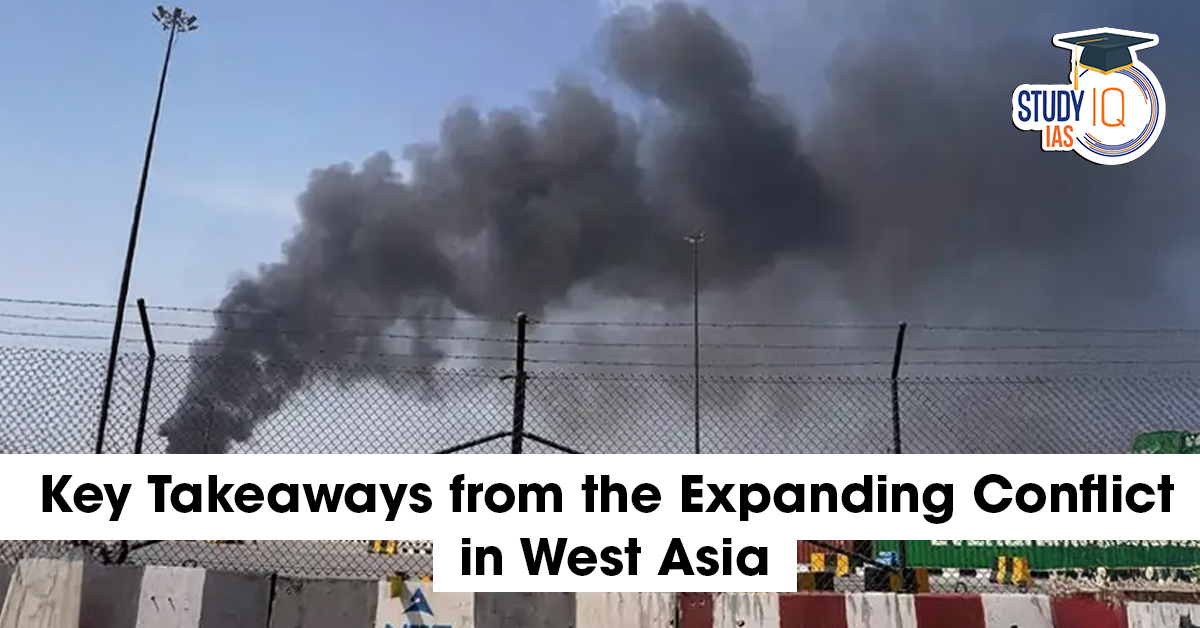
- The ongoing war in West Asia has rapidly escalated into a multi-country conflict with global consequences. What began as targeted strikes has now expanded into a wider confrontation involving regional powers, global actors, and key energy routes. The conflict is reshaping energy markets, security calculations, and diplomatic alignments, making it one of the most significant geopolitical crises in recent times.
Five big takeaways
- Regional War with Global Impact
- Widening Geographical Spread: The conflict has expanded beyond Iran and Israel to involve multiple countries across West Asia and beyond, making it a broad regional war with global linkages.
- Global Consequences Without World War Status: Although not a World War, the involvement of many countries and indirect participation of global powers has created worldwide economic and security effects.
- Iran’s Strategic Resilience
- Strong Institutional Survival Mechanism: Despite heavy airstrikes and leadership losses, Iran has not collapsed due to its deeply entrenched political and military structures.
- Mosaic Defence Doctrine: Iran has decentralised its military into multiple autonomous units, ensuring continued resistance even if central leadership is weakened.
- Missile and Drone Expansion: Iran has used ballistic missiles and drones to target multiple countries, expanding the battlefield and increasing pressure on adversaries.
- Control of Strategic Chokepoints: By disrupting the Strait of Hormuz, Iran has impacted global oil supply chains, demonstrating its leverage in maritime security.
- Israel’s Strategic Gains
- Elimination of Key Adversaries: Israel has significantly weakened its enemies by targeting top Iranian leadership and proxy groups, strengthening its strategic position.
- Political Advantage for Leadership: The war has improved the domestic political standing of Israeli leadership, especially after earlier security failures.
- India’s Strategic Dilemma
- Balancing Multiple Interests: India must manage relations with Israel, Iran, and Gulf countries, all of which are crucial for energy, trade, and diaspora security.
- Energy and Economic Concerns: With nearly 60% of energy imports coming from West Asia, rising oil prices and supply disruptions pose serious economic risks.
- Unclear Endgame and Exit Strategy
- Shifting War Objectives: The United States has shown uncertainty in its goals, ranging from regime change to limited military objectives, creating strategic ambiguity.
- Possibility of Mutual Victory Claims: Both sides can claim success — the US/Israel through military damage, and Iran through economic disruption and survival, complicating conflict resolution
|
Read More Notes |
|
| Environment Notes | Art and Culture Notes |
| Science and Tech | History Notes |
| Geography Notes | Indian Polity Notes |
| General Knowledge | International Relation |
|
Explore StudyIQ Courses |
|
 Neighbourhood Diplomacy and the West Asi...
 In war on Iran, Israel knows what it wan...
 World Happiness Report 2026: Finland Top...











 WhatsApp





