
Table of Contents
Context
In response to an energy crisis triggered by recent geopolitical strikes on Iran, the Centre invoked the Essential Commodities Act (ECA), 1955.
About
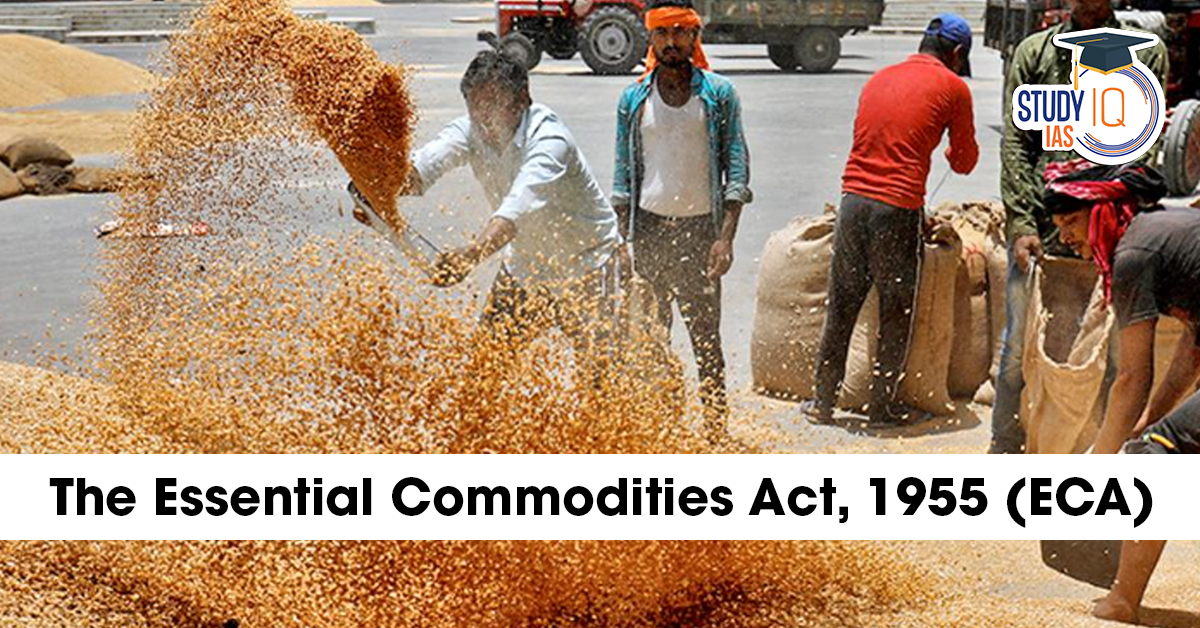
- The Essential Commodities Act is a central legislation enacted to control the production, supply, and distribution of specific commodities deemed essential for the general public. It empowers the government to prevent hoarding and black marketing while ensuring equitable distribution at fair prices.
Aim
- To ensure the steady availability of essential goods.
- To prevent artificial scarcity and regulate the prices at which these commodities are bought or sold.
- To secure commodities for the defense of India or the efficient conduct of military operations.
Key Features
- Declaration of Commodities: Essential commodity means any item specified in the Schedule of the Act.
- Amending the Schedule: The Central Government can add or remove commodities from the Schedule in consultation with State Governments.
- Stock Limits: The government can fix the quantity of a commodity any person or trader can hold in stock.
- Price Regulation: The Act allows for the fixation of prices, particularly for items like foodgrains, edible oils, and sugar.
- Penalties: Contravention of orders under Section 3 can lead to imprisonment ranging from three months to seven years, plus fines.
- Confiscation: Authorities have the power to seize and confiscate commodities, along with the vehicles or animals used for their transport, if the Act is violated.
When the Act is Invoked
The Act is typically invoked during extraordinary circumstances to protect consumers:
- War or Famine: As seen in the recent 2026 energy crisis linked to the U.S.-Israel-Iran conflict.
- Natural Calamities: Used during the COVID-19 pandemic to ensure the availability of masks and sanitizers.
- Extraordinary Price Rise: Invoked when the retail price of non-perishable agricultural produce increases by 50%, or horticultural produce by 100%.
- Festive Seasons/Elections: Historically used to moderate prices of wheat or sugar before major festivals or state elections to maintain stability.
|
Read More Notes |
|
| Environment Notes | Art and Culture Notes |
| Science and Tech | History Notes |
| Geography Notes | Indian Polity Notes |
| General Knowledge | International Relation |
|
Explore StudyIQ Courses |
|
 State of the World’s Migratory Species...
 Balancing Innovation with Women’s Digi...
 Open Market Operations (OMO): Meaning, O...











 WhatsApp





