
Table of Contents
Context: Recent archaeological investigations conducted by the Archaeological Survey of India (ASI) on Elephanta Island (Gharapuri, off the Mumbai coast) have revealed a significant 6th-century settlement.
Key Findings on Elephanta Island Excavations
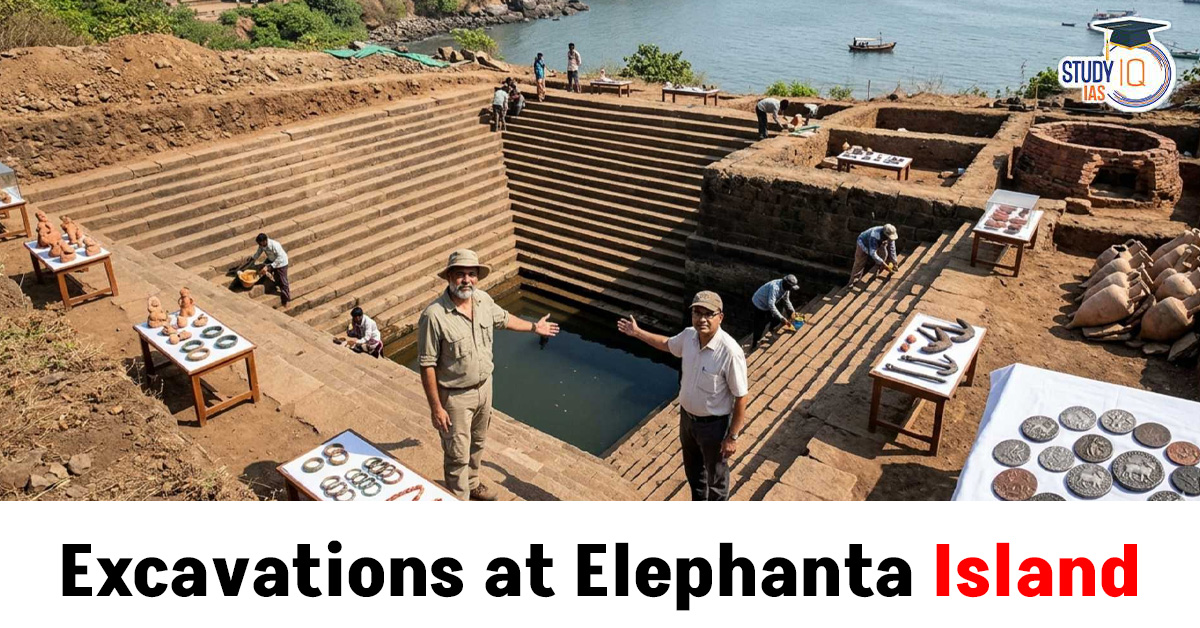
- The Stepped Reservoir Architecture: A sophisticated T-shaped hydraulic structure measuring approximately 14.7 meters in length. Current excavations have exposed 20 steps built with precise stone masonry.
- Analytical evidence suggests that the stone blocks were not indigenous to the island but were transported from the mainland, indicating complex logistical planning and resource mobilisation.
- Ceramic Assemblages and Trade Indicators: The recovery of approximately 3,000 sherds of Amphorae signifies direct or indirect trade links with the Mediterranean/Byzantine world. These vessels were primarily used for transporting wine and oil.
- The presence of Torpedo Jars indicates maritime exchange with Mesopotamia and the Persian Gulf.
- Material Culture and Industrial Activity: Excavations yielded a brick structure identified as a dyeing vat, suggesting local textile processing for maritime export.
- Associated finds include carnelian and quartz beads, glass bangles, terracotta figurines, and stone anchors, characterising the site as a prosperous port-town.
- Numismatic Markers: Sixty coins in copper, lead, and silver were retrieved. A significant portion is attributed to Krishnaraja (c. 550–575 CE) of the Kalachuri dynasty.
- The coins feature a seated bull (Nandi) on the obverse and a temple symbol with the legend Sri Krishnaraja on the reverse.
Significance of the Discovery
- Advanced Hydraulic Engineering: Marks a shift from basic rock-cut cisterns to sophisticated masonry reservoirs, essential for capturing monsoon run-off on the island’s non-porous basaltic terrain.
- Commercial Hub (Entrepôt): The vast quantity of Mediterranean and West Asian ceramics (Amphorae and Torpedo jars) proves the island was a major 6th-century maritime trade centre, not just a religious site.
- Dynastic Wealth & Patronage: Numismatic evidence links this commercial peak to the Kalachuri dynasty. It suggests that the funding for the famous Elephanta cave temples likely originated from this flourishing global trade.
|
Kalachuri Dynasty |
1. Early Kalachuris of Mahishmati (6th–7th Century CE)
2. Kalachuris of Tripuri (Chedi) (9th–12th Century CE)
|

 Regulatory Issues in India’s Nuclear P...
 Deep-Space Distance Measurement: New Tec...
 Trade Receivables Discounting System (TR...













 WhatsApp





