
Table of Contents
Context
- National Oceanic and Atmospheric Administration (NOAA) has updated how El Niño and La Niña are officially classified — reflecting a warming world where old baselines no longer apply.
|
ENSO: The Natural Climate Engine |
| What Is ENSO?
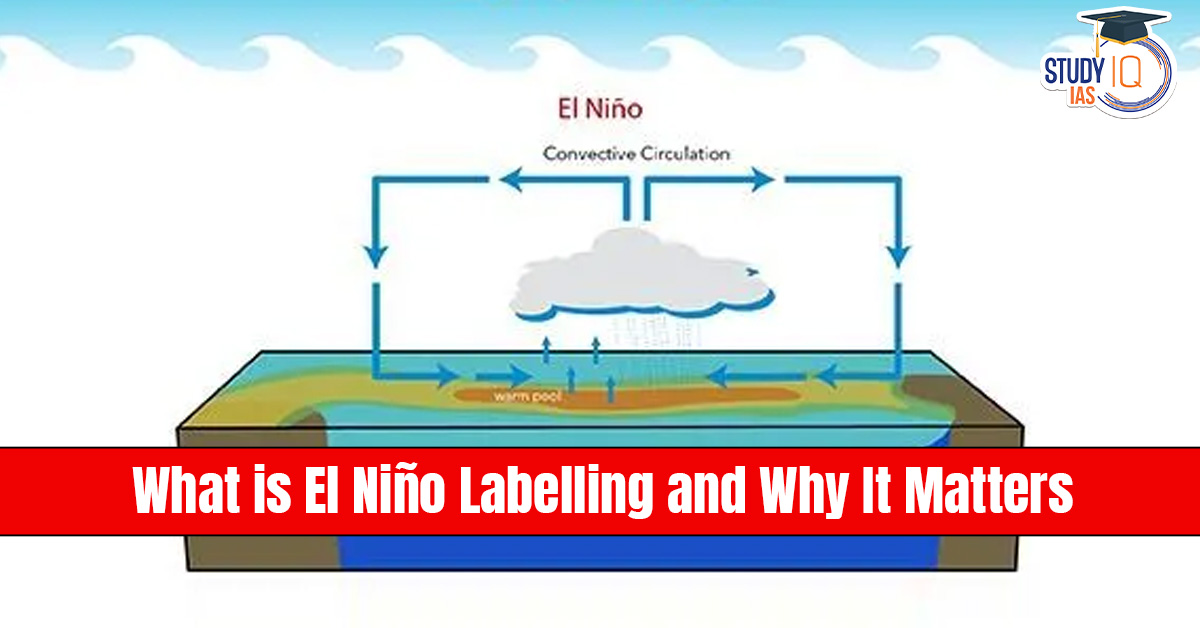
● El Niño and La Niña are phases of the El Niño–Southern Oscillation (ENSO) — a recurring climate pattern in the equatorial Pacific Ocean. ○ El Niño occurs when surface waters in the central and eastern Pacific become warmer than normal. ○ La Niña occurs when those waters become cooler than normal. ● This cycle typically shifts every 2–7 years and influences global weather systems, including rainfall patterns, droughts, cyclones, and heatwaves. How ENSO Affects Global Temperatures ● El Niño years usually raise global average temperatures temporarily because warm ocean water releases more heat into the atmosphere. ● La Niña years slightly cool global temperatures by keeping more heat stored in deeper ocean layers. ● However, in today’s world, even La Niña phases are occurring on a much warmer background temperature than decades ago. |
Why Scientists Changed El Niño Labelling
The Problem with Old Definitions:
- ENSO events are classified based on how much Pacific Ocean temperatures deviate from a long-term average.
- But global warming has raised overall ocean temperatures. This means the “normal” baseline used in past decades no longer reflects today’s reality.
NOAA’s Updated Calculation: NOAA revised its system for defining El Niño and La Niña by adjusting the temperature baseline. This recalibration means:
- Some past El Niño events might not qualify under new criteria.
- More events may be classified as La Niña.
- Temperature anomalies are measured relative to a warmer reference period.
In simple terms, the climate has changed so much that scientists had to reset the measuring scale.
|
Read More Notes |
|
| Environment Notes | Art and Culture Notes |
| Science and Tech | History Notes |
| Geography Notes | Indian Polity Notes |
| General Knowledge | International Relation |
|
Explore StudyIQ Courses |
|
 International Polar Bear Day 2026: Impor...
 Recent Defence Expansion in India: Moder...
 US Duties on Solar Exports: Impact on In...











 WhatsApp





