
Table of Contents
Context
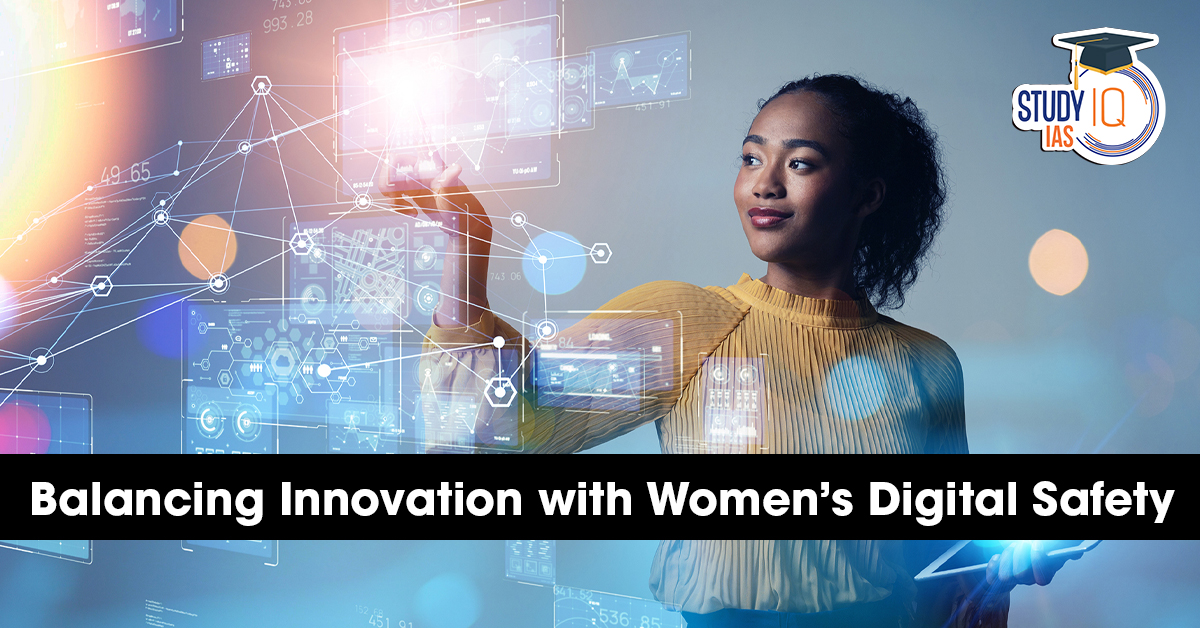
Discussions around AI have intensified following the India AI Impact Summit 2026 held in February 2026. As the world marks International Women’s Day on March 8, it is important to ensure that AI development is guided by ethical principles that protect women from online abuse and exploitation.
Rising digital threats to Women
- Prevalence of online abuse: Studies suggest that 16%–58% of women worldwide have experienced online harassment, including trolling, threats, and non-consensual sharing of images.
- Extension of gender-based violence: Violence against women, which traditionally occurred in physical spaces, has now expanded into the digital realm.
- Difficulty in self-protection: Unlike physical environments where precautionary measures can sometimes reduce risk, online spaces allow anonymity and rapid spread of harmful content, making protection more difficult.
- Forms of digital abuse: These include cyberstalking, doxxing (publishing personal information), harassment, impersonation, and non-consensual sexual imagery.
The emerging threat of deep fakes
- Meaning: Deepfakes are AI-generated or manipulated images, videos, or audio recordings that falsely portray individuals doing or saying things they never did.
- Misuse against women: Deepfake technology is often used to create non-consensual sexualised images of women, causing reputational harm and psychological distress.
- Example of AI misuse: The AI chatbot Grok AI, developed by xAI, has faced criticism for being misused to generate such manipulated images.
- Impact: Once such content spreads online, it becomes extremely difficult to remove completely, leading to long-term social and emotional consequences for victims.
Gender gap in AI development
- Low female participation: According to data from UN Women and United Nations Development Programme, women constitute only about 22% of AI professionals, and fewer than 14% occupy senior roles.
- Male-dominated design: Many deepfake tools are designed mainly by men and often fail to account for gendered harms.
- Impact on technology: Lack of diverse perspectives leads to biased systems and inadequate safeguards against misuse.
- Benefits of diversity: Increasing women’s participation in AI development can bring unique lived experiences, helping design safer and more inclusive technologies.
Legal and regulatory measures in India
- Government guidelines: The Ministry of Electronics and Information Technology has issued directives requiring online intermediaries to remove deep fake content within three hours of receiving a takedown notice.
- Objective: These guidelines aim to reduce the spread of harmful AI-generated content and provide quicker relief to victims.
- Challenges: Despite existing laws against cybercrime and online harassment, delays in investigation and enforcement remain a major concern.
Importance of digital safety education
- Digital native generation: Nearly one-third of internet users are children, making them highly vulnerable to online risks.
- Early education: Digital safety and responsible technology use should be taught from the elementary level, as with physical and sexual safety.
- Awareness of AI misuse: Young users must be sensitised to issues such as cyberbullying, deepfakes, privacy violations, and the ethical use of technology.
Conclusion
Artificial intelligence offers transformative opportunities for economic growth and social development. However, without ethical safeguards, it can also intensify existing gender inequalities. Protecting women from digital abuse, particularly in the era of deepfakes and anonymous online harassment, must therefore become a central principle guiding AI innovation. Building inclusive technology, robust regulation, and widespread digital awareness will ensure that technological progress benefits everyone rather than leaving women to bear the costs of advancement.
|
Read More Notes |
|
| Environment Notes | Art and Culture Notes |
| Science and Tech | History Notes |
| Geography Notes | Indian Polity Notes |
| General Knowledge | International Relation |
|
Explore StudyIQ Courses |
|
 State of the World’s Migratory Species...
 Essential Commodities Act, 1955 (ECA): O...
 Open Market Operations (OMO): Meaning, O...




 WhatsApp





