
Table of Contents
Context
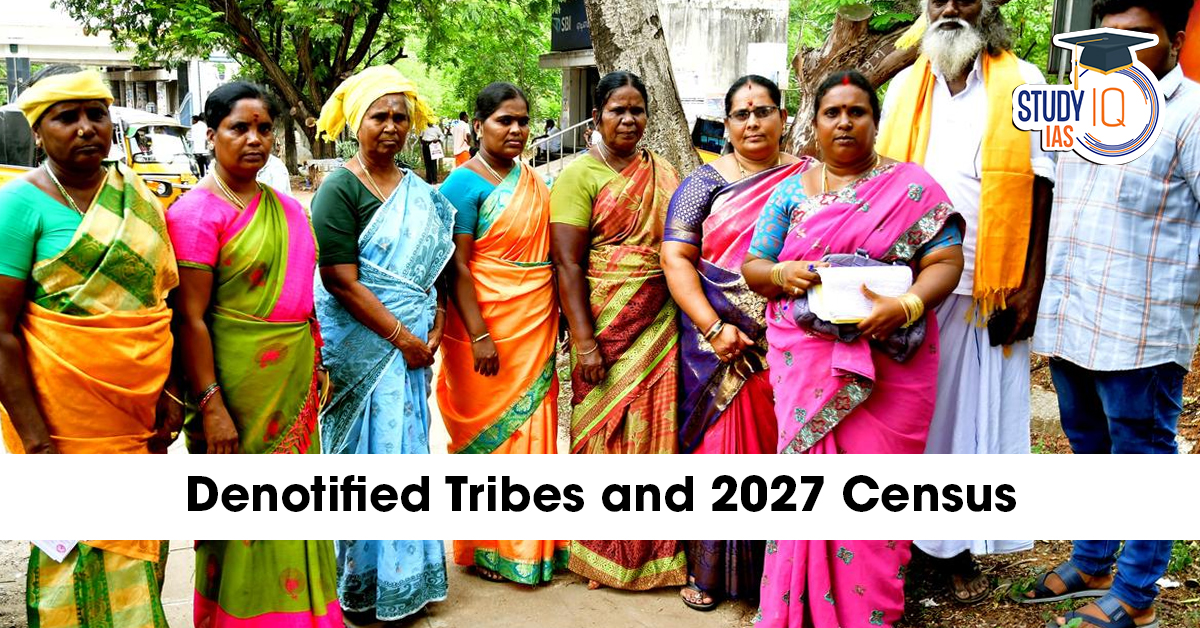
Denotified Tribes, along with nomadic and semi-nomadic communities, are seeking a separate entry in the 2027 caste Census. Their central concern is that being grouped under Scheduled Castes, Scheduled Tribes, or Other Backward Classes has hidden their distinct history of exclusion and their present-day disadvantages.
Historical Roots of Marginalisation
- During British rule, several nomadic and semi-nomadic communities were labelled as “criminal” under the Criminal Tribes Act, 1871.
- Although the Act was repealed in 1952, the social stigma attached to these communities continued across generations.
- After denotification, they were absorbed into existing categories without a distinct constitutional status, leaving their identity and entitlements unclear.
Demand for a Separate Census Category
- Community leaders are seeking constitutional recognition through a separate Schedule, on the lines of SCs and STs.
- A distinct census column or code is seen as essential to record their population size and living conditions accurately.
- The Ministry of Social Justice has supported their inclusion and conveyed this to the Registrar General of India.
- While the government has confirmed that they will be counted in the 2027 Census, the framework for doing so is yet to be finalised.
Misclassification and Its Consequences
- The Idate Commission (2017) identified about 1,526 DNT, NT and SNT communities across India.
- Of these, nearly 269 communities are still outside the SC, ST and OBC lists.
- Many others are placed within these categories but remain disadvantaged when compared to socially and politically stronger groups.
- This has resulted in limited access to welfare benefits and weak representation in public institutions.
Unequal Levels of Deprivation
- DNTs are not a homogeneous group; levels of deprivation vary across communities.
- Nomadic groups continue to face deeper disadvantages in education, income, housing and access to services than settled groups.
- A 2024 Supreme Court judgment allowing sub-classification within SCs and STs has reinforced demands to recognise such internal differences among DNTs as well.
Gaps in Welfare Implementation
- Welfare measures such as the SEED scheme exist but have reached only a small section of the intended beneficiaries.
- A major constraint is the reluctance or delay by States in issuing DNT certificates, which blocks access to schemes.
- Between 2020 and 2025, only ₹69.3 crore of the ₹200 crore allocated under SEED was utilised.
- Low awareness, administrative delays and overlap with other schemes have further reduced impact.
Why Enumeration Is Crucial
- Reliable population data is necessary for designing targeted policies, allocating budgets and monitoring outcomes.
- At present, there are no official national figures on the size of the DNT population.
- Separate and clear enumeration in the 2027 Census is therefore viewed as the foundation for recognition and inclusion.
Major Challenges Faced by DNTs, NTs and SNTs
- Continuing stigma: Discrimination rooted in colonial-era labelling persists.
- Insecure livelihoods: Limited access to land, housing and stable sources of income.
- Administrative barriers: Difficulty in obtaining caste certificates in many States.
- Weak representation: Minimal presence in decision-making bodies and welfare institutions.
| Idate Commission (2014) |
|
Government Initiatives
- SEED Scheme (2022):
-
-
- Provides coaching for competitive exams, health insurance, livelihood support and housing assistance.
- Allocated ₹200 crore over five years and implemented through the DWBDNC.
-
- Education-focused measures:
-
- Dr Ambedkar Pre- and Post-Matric Scholarships for DNT students not covered under SC, ST or OBC categories.
- Nanaji Deshmukh Hostel Scheme to support students pursuing education away from home.
Way Forward
- Administrative measures: Expedite classification and issue caste certificates with clear identifiers.
- Improving welfare delivery: Increase awareness and simplify access to schemes like SEED through local institutions and NGOs.
- Data and representation: Conduct a comprehensive caste-based census and encourage community participation in policy-making.
- Institutional reform: Establish a permanent statutory body and district-level grievance mechanisms to address exclusion and discrimination.
 India-China Trade Relations, Border Disp...
 Digital Arrest Scams, Key Measures and I...
 World Meteorological Day 2026: Theme, Hi...











 WhatsApp





