
Table of Contents
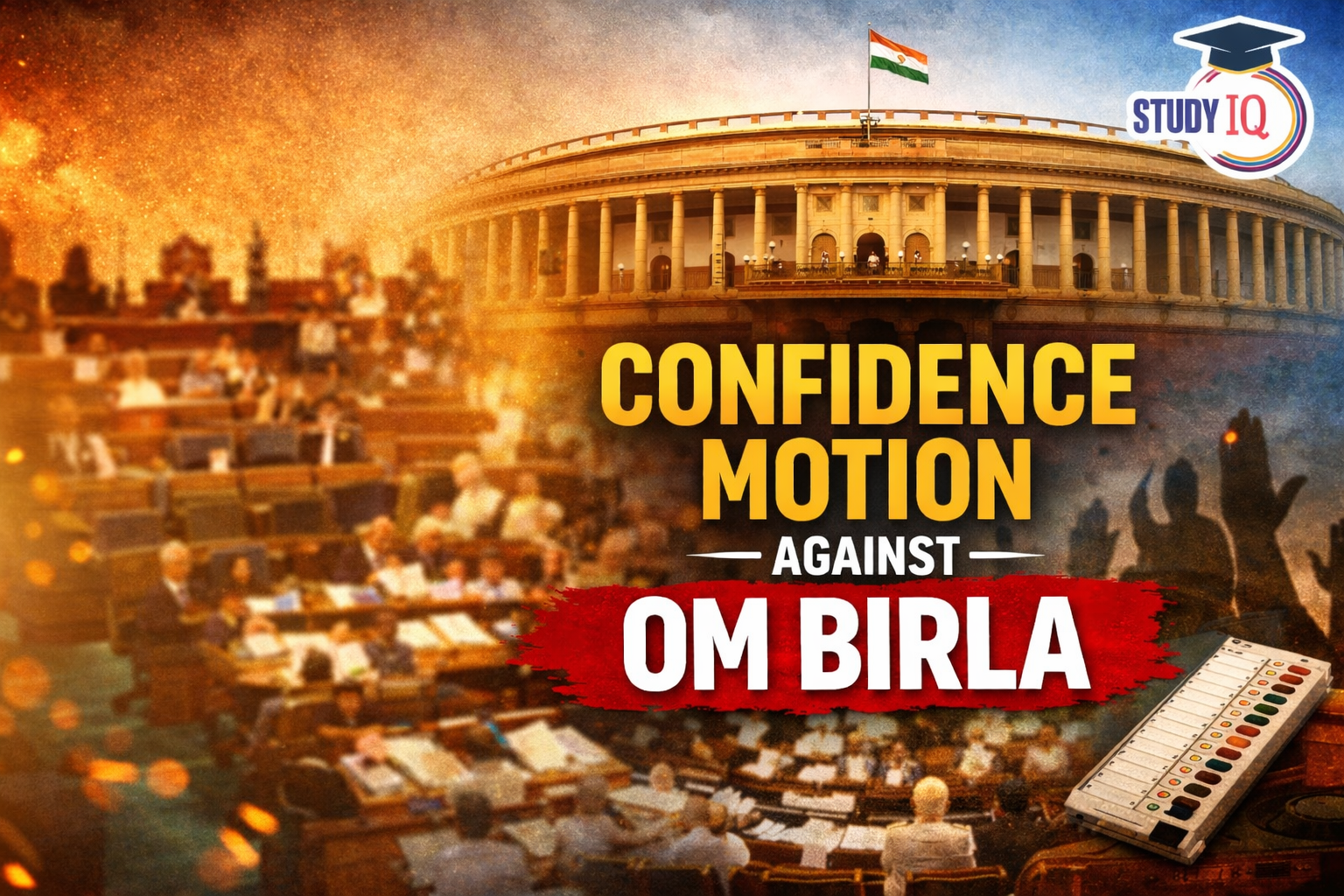
A rare constitutional development has unfolded in Parliament with the Opposition moving a confidence removal motion against the Speaker of the Lok Sabha. The notice, brought under Article 94(c) of the Constitution of India, seeks the removal of Speaker Om Birla, alleging partisan conduct during House proceedings. Though often described loosely as a “no-confidence motion,” constitutionally this is a resolution for removal of the Speaker, governed by strict rules and high voting thresholds.
This article explains how such a motion works, whether the Opposition has the numbers, historical precedents, and why the issue matters for democracy and exams.
What Is a Confidence or Removal Motion Against the Speaker?
Unlike a no-confidence motion against the government, a motion against the Lok Sabha Speaker is not about survival of the executive. It is a constitutional accountability mechanism that allows members of the House to seek removal of the Speaker through a formal resolution.
The Speaker occupies a high constitutional office and is expected to act impartially. However, the Constitution ensures that the Speaker remains answerable to the House itself.
Read: Election Of Lok Sabha Speaker, Criteria and Voting Process
Constitutional Basis: Article 94(c)
Article 94(c) of the Constitution of India provides that
A Speaker may be removed from office by a resolution of the Lok Sabha passed by a majority of all the then members of the House.
Key conditions
-
Applies only to Lok Sabha
-
Requires 14 days prior notice
-
Needs absolute majority, not a simple majority
This ensures stability of the office while preserving parliamentary control.
Step-by-Step Procedure for Removal of Lok Sabha Speaker
The procedure is governed by Rules 200 to 203 of the Rules of Procedure and Conduct of Business in Lok Sabha.
Step 1 Submission of Notice
Any Lok Sabha member can submit a written notice to the Secretary General, clearly stating the charges.
Step 2 Mandatory Notice Period
A minimum 14-day notice is compulsory before the motion can be taken up.
Step 3 Admission Test in the House
When the motion is placed before the House
-
At least 50 members must rise in support
-
If this number is not met, the motion fails immediately
Step 4 Discussion and Voting
If admitted
-
Discussion is scheduled within a fixed timeframe
-
Debate is limited strictly to the charges mentioned
-
Voting is conducted
For the motion to pass, it must receive majority of all the then members of the House.
Role of the Speaker During the Motion
When a motion for removal is under consideration
Speaker does not preside over the sitting
Usually Deputy Speaker presides
However, the Speaker
-
Can participate in debate
-
Can vote in the first instance
-
Cannot cast a deciding vote in case of a tie
Even if Lok Sabha is dissolved, the Speaker continues in office until just before the first sitting of the new House.
Does the Opposition Have the Numbers?
This is the most crucial political question.
In a House of around 543 members, removal requires more than half of the effective total strength, roughly 272 votes if vacancies are minimal.
Current broad alignment
-
NDA has around 293 seats
-
Opposition INDIA bloc has around 238 seats
Conclusion on Numbers
Even if the motion is admitted, the Opposition does not appear to have sufficient numbers to remove the Speaker unless there is a major shift in alliances.
As a result, the motion is widely seen as
-
A symbolic assertion
-
A political statement on record
-
A challenge to the perceived neutrality of the Chair
Historical Precedents: Has This Ever Succeeded?
Since Independence, such motions have been moved only three times
1954 against G V Mavalankar
1966 against Hukam Singh
1987 against Balram Jakhar
All motions failed.
No Lok Sabha Speaker has ever been removed from office.
Why This Motion Matters Despite Likely Failure
Even without numerical success, such motions are significant because they
-
Place allegations formally on the parliamentary record
-
Trigger constitutional debate on Speaker neutrality
-
Highlight tensions between the ruling party and Opposition
-
Reinforce parliamentary accountability mechanisms
They also underline the delicate balance between the authority of the Chair and democratic dissent.
Importance for UPSC and Other Exams
Prelims Focus
-
Article 94
-
Absolute majority vs simple majority
-
14 day notice rule
-
Minimum 50 members support
Mains GS II
-
Role and neutrality of Speaker
-
Parliamentary accountability
-
Balance between stability and oversight
Essay and Ethics
-
Institutional neutrality
-
Democratic norms in legislatures
Conclusion
The confidence or removal motion against Speaker Om Birla is constitutionally valid but politically challenging. While the Opposition may fall short of numbers, the episode brings renewed focus on parliamentary ethics, neutrality of constitutional offices, and democratic accountability. Historically rare and procedurally strict, such motions remain an important safeguard within India’s parliamentary framework.
|
Read More Notes |
|
| Environment Notes | Art and Culture Notes |
| Science and Tech | History Notes |
| Geography Notes | Indian Polity Notes |
| General Knowledge | International Relation |
|
Explore StudyIQ Courses |
|
 CAPF Bill 2026: Key Features, Significan...
 Tropical Cyclone Narelle Red Sky Western...
 Wildlife Crime Control Bureau (WCCB): Ro...













 WhatsApp





