
Table of Contents
Context
In the Union Budget 2026-27, Finance Minister Nirmala Sitharaman announced a major scheme to incentivize Carbon Capture, Utilization, and Storage (CCUS) technologies.
Key Features of the Budget 2026 Scheme
- Financial Outlay: ₹20,000 crore over 5 years.
- Focus Sectors: Targeted at five “hard-to-abate” sectors: Power, Steel, Cement, Refineries, and Chemicals.
- Objective: Scaling up Technology Readiness Levels (TRL) from laboratory research to industrial-scale pilot and demonstration projects.
- Complements the “R&D Roadmap for CCUS” launched by the Department of Science and Technology in December 2025.
About Carbon Capture, Utilisation,n and Storage
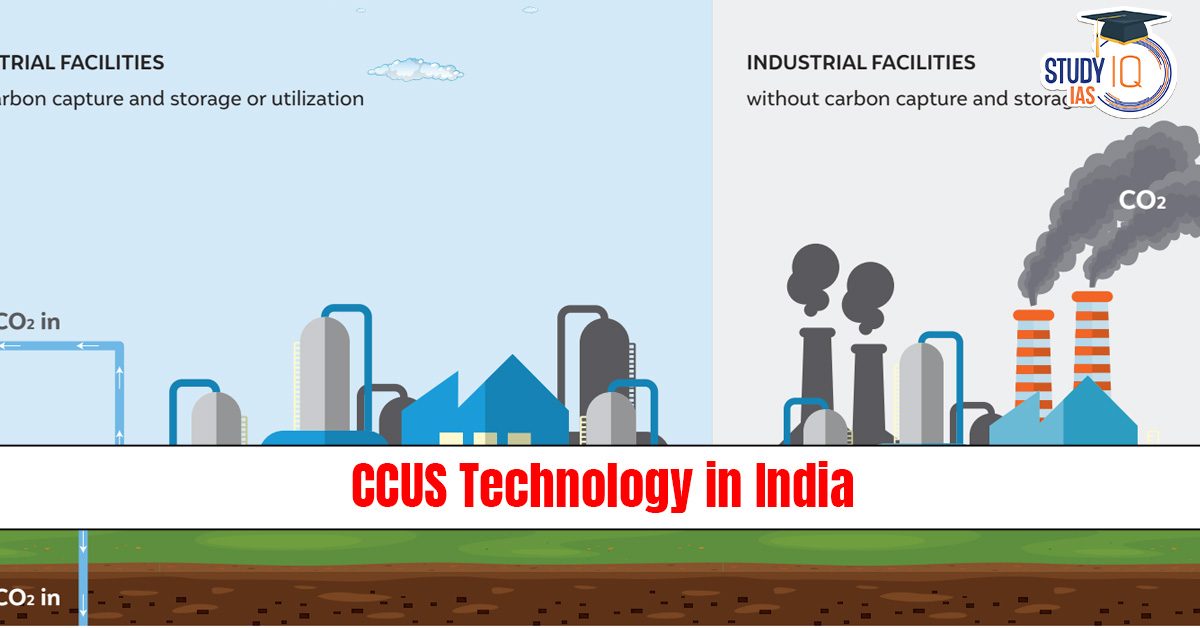
- Carbon Capture, Utilization, and Storage (CCUS) refers to a set of technologies designed to capture carbon dioxide (CO₂) emissions from large point sources and either reuse them in industrial processes or store them permanently in geological formations.
- CCUS is considered a crucial tool for decarbonising “hard-to-abate” sectors where electrification alone cannot eliminate emissions.
Potential Role of CCUS in Tackling Climate Change
- Mitigation of Industrial Emissions: Reduces emissions from hard-to-abate sectors like steel, cement, and fertilizers where renewable substitution is limited.
- E.g., Norway’s Sleipner Project captures about one million tonnes of CO₂ annually from its offshore natural gas production and injects it into deep saline aquifers in North Sea.
- Complement to Renewable Energy: Complements renewables by tackling existing emissions and enabling low-carbon hydrogen production through Blue Hydrogen.
- Eg: Shell’s Quest Project in Canada captures over 1 Mt CO₂ annually from hydrogen production.
- Pathway to Negative Emissions: When paired with bioenergy (BECCS), CCUS can deliver net negative emissions, vital for offsetting aviation and shipping.
- Eg: The Drax power station in the UK is piloting BECCS for large-scale carbon removal.
- Enhancing Energy Security: CO₂ utilization in Enhanced Oil Recovery (EOR) boosts fossil recovery while reducing emissions and improving supply security.
- Eg: The US Permian Basin EOR projects inject millions of tonnes of captured CO₂ to extract additional oil.
- India’s Potential: India’s sedimentary basins offer 400–600 Gt CO₂ storage potential, making CCUS critical for Net Zero 2070.
- Captured CO₂ can be converted into value-added products like green urea, methanol, building materials, polymers, and even used in enhanced oil recovery, creating profitable abatement opportunities.
- Such utilization supports India’s circular economy, reduces imports (e.g., fertilizers, fuels), and contributes to large-scale decarbonization.
- Eg: NTPC and IOCL are piloting CCUS projects for thermal power plants and refineries.
| R&D Roadmap to Enable India’s Net Zero Targets through Carbon Capture, Utilization and Storage (CCUS) |
The roadmap outlines a three-phase Research and Development programme for advancing CCUS technologies. The three phases are:
|
|
Read More Notes |
|
| Environment Notes | Art and Culture Notes |
| Science and Tech | History Notes |
| Geography Notes | Indian Polity Notes |
| General Knowledge | International Relation |
|
Explore StudyIQ Courses |
|
 Good Friday 2026: Date, History, Meaning...
 Removal of the Chief Election Commission...
 Artemis II Launch 2026 LIVE: Crew Begins...













 WhatsApp





